
Formlabs’ Vision for the Future: Driving 3D Printing Innovation, Global Expansion, and Community Engagement
Formlabs, a pioneering American manufacturer, stands as a cornerstone in the global 3D printing market, particularly renowned for its leadership in the stereolithography (SLA) segment. With over 500 dedicated employees spread across seven offices worldwide, the company has an impressive track record, having already facilitated the production of more than 40 million parts. Recently, Formlabs marked a significant milestone by hosting its User Summit in Europe for the very first time, choosing Berlin as the vibrant hub for this landmark event. During the summit, Formlabs unveiled ambitious plans, projecting an astounding goal of empowering one billion users to leverage its cutting-edge 3D printing technology for part creation within the next five years. This aspirational target underscores the company’s commitment to democratizing additive manufacturing. To delve deeper into Formlabs’ strategic initiatives, especially concerning its expanding footprint in Europe, we had the exclusive opportunity to speak with Stefan Hollaender, EMEA Managing Director, and Dávid Lakatos, Chief Product Officer.
Understanding the Formlabs User Summit: A Platform for Innovation and Collaboration
Stephan Hollaender elaborated on the foundational philosophy behind the User Summit, revealing that the concept originated several years ago and has been successfully implemented multiple times in the United States. He explained, “The whole idea of such a users’ summit is a couple of years old, it is something we have done in the US a couple of times already. There we saw how positive and insightful the discussion is with the people who are really using our products in their daily life for either production, design, or even creating new stuff they have in mind.” These gatherings serve as invaluable forums for direct engagement, allowing Formlabs to receive real-time feedback from its diverse user base. This direct exchange provides critical insights into the performance of their products—highlighting both strengths and areas requiring further development and improvement. Customers frequently present innovative ideas, fostering a collaborative environment where Formlabs can partner to introduce new materials and products to the market. The summit is designed to be a dynamic platform where users not only share their experiences and feedback with the company but also learn from the applications and innovations of their peers, strengthening the entire Formlabs community.

Stefan Hollaender (left) and Dávid Lakatos (right)
Bringing the Summit to Europe: A Strategic Move for a Key Market
Dávid Lakatos shed light on the strategic decision to extend the User Summit to Europe, emphasizing the region’s critical importance to Formlabs’ global operations. “Europe is about 40% of our market; it’s the largest market after North America for Formlabs,” he stated. This substantial market share underscores Europe’s role as a powerhouse for additive manufacturing adoption. Recognizing this potential early on, Formlabs established its Berlin office in 2014. Lakatos highlighted Formlabs’ proactive global strategy from its inception, contrasting it with many European 3D printing companies that often remain regionally focused and less known in the North American market. “We, from the very beginning, have been looking into industrial reports, making sure we distributed enough,” he added, emphasizing a deliberate effort to achieve widespread market penetration. While acknowledging that Asia presents a different market landscape where Formlabs is “still behind,” he noted the rapid growth they are experiencing there. Looking ahead, Formlabs aspires to eventually bring its User Summit to Asia, further solidifying its commitment to supporting and engaging its global user base across all key markets.
Formlabs’ Evolving Product Range: Innovations in SLA and the Leap to SLS
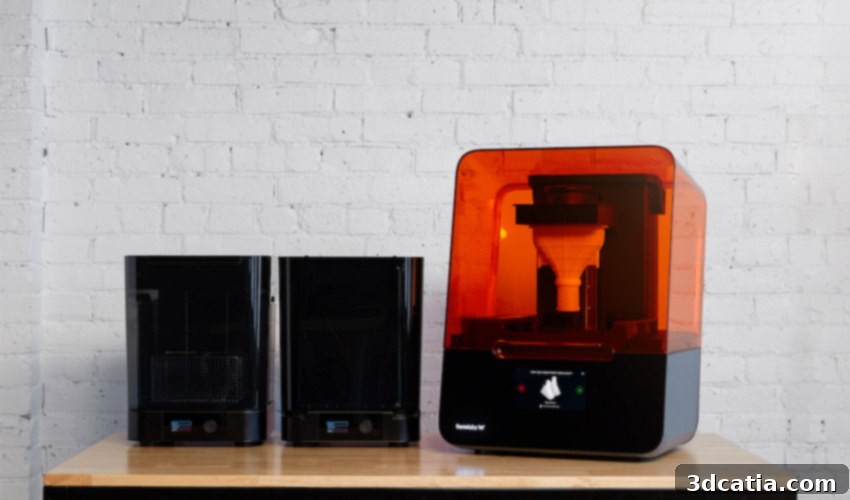
Addressing inquiries about Formlabs’ latest product offerings, Dávid Lakatos provided an update on their recent printer launches and ongoing developments. “Yes, we launched the Form 3 in April and we started shipping it during the summer,” he confirmed. The Form 3, powered by Formlabs’ revolutionary Low Force Stereolithography (LFS) technology, represents a significant advancement, promising higher print quality, improved reliability, and easier maintenance compared to previous generations. Since its launch, over a thousand units have been shipped, and sales continue to climb, with lead times steadily decreasing due to optimized manufacturing processes. Initial market feedback has been overwhelmingly positive, and Formlabs remains committed to continuous improvement, focusing on enhancing the printer’s capabilities through ongoing software updates and expanding the range of compatible materials over the next year.
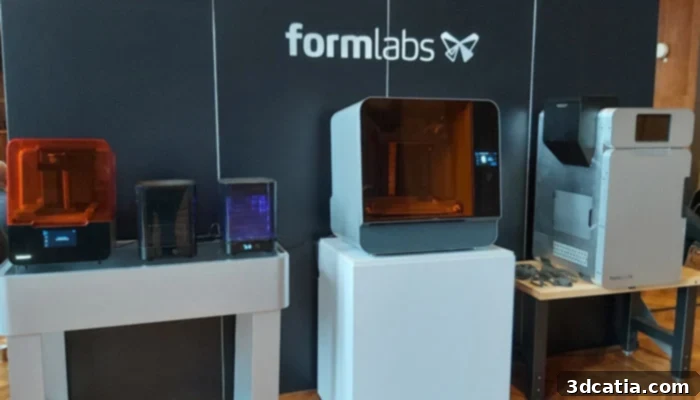
Formlabs’ machines at the User Summit
Complementing the Form 3, Formlabs also developed the Form 3L, a large-format LFS 3D printer. This machine is built upon the same robust technology as the Form 3, but scaling up the build volume has presented unique manufacturing challenges. Lakatos admitted, “This is our first large machine, so there are definitely some things we’ve been learning on how to manufacture it, and we’re going to have updates as we go.” Despite these learning curves, the company expresses strong confidence in the Form 3L’s potential, anticipating it will be a highly successful product. The introduction of the Form 3L is particularly exciting as it aims to engage a new and distinct user base. Industries such as automotive and aerospace, which previously found Formlabs’ machines less suitable due to smaller build volumes, are expected to be disproportionately impacted by the Form 3L’s larger capacity. This expansion opens up new possibilities for larger prototypes, functional parts, and production aids within these demanding sectors.
Furthermore, Formlabs is making a significant leap into the Selective Laser Sintering (SLS) market with the highly anticipated Fuse 1. Initially announced in June 2017, its availability has been delayed. Lakatos candidly addressed this, stating, “We are falling behind with the availability of the product, that said, we do so because we want to ship the right printer.” This commitment to quality over speed distinguishes Formlabs, as they are not aiming to simply offer another low-cost SLS machine. Instead, their ambition is to challenge the high-end industrial SLS market by delivering comparable quality at a dramatically reduced price point—from the €250,000-€300,000 range down to an accessible €20,000-€25,000. This disruptive pricing strategy, combined with uncompromised quality, is poised to democratize industrial-grade SLS technology, making it accessible to a much broader range of businesses, from small engineering firms to in-house manufacturing departments. The good news is that Formlabs has identified and addressed the necessary technical hurdles, with beta units expected to ship this year and full commercial availability slated for next year, marking a transformative moment for accessible industrial 3D printing.
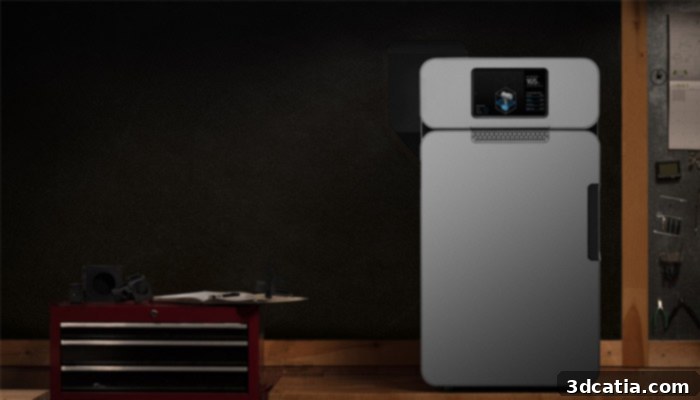
Fuse 1 System from Formlabs
Europe: A Hub for Innovation and Untapped Potential
Stefan Hollaender articulated Europe’s pivotal role in Formlabs’ growth strategy, describing the operations in the region as “a hell of a race.” The Berlin office, serving as the central hub for marketing, sales, and service, is experiencing rapid expansion and also coordinates field operations across the continent. Hollaender emphasized the immense opportunity in Europe, particularly due to the continent’s robust ecosystem of small to medium-sized businesses (SMEs). He highlighted that market leaders not only in Germany but also in countries renowned for their strong engineering capabilities, such as the UK, France, and Italy, have successfully carved out significant niches in advanced manufacturing and production. Europe’s deep-rooted and strong plastics industry further solidifies its position as a key market where additive manufacturing can thrive by enabling localized production. “I believe that in Europe, we have a lot of untapped potential, to be honest,” Hollaender remarked. Despite rapid growth and considerable success, Formlabs sees a substantial opportunity to adopt a more structured and integrated approach. This involves moving beyond simply selling machines to actively assisting companies in developing optimized workflows and production flows. By embedding more technical knowledge and expertise within their support structures, Formlabs aims to ensure their technology seamlessly integrates into customers’ existing production facilities. Hollaender views this as the “next big step” for Formlabs in Europe, transforming them from a hardware provider into a holistic solutions partner. He concluded with optimism, “In Europe, I feel like we are just at the starting point, and we’re going to keep growing the great ride we’ve had so far.”
Dávid Lakatos added another crucial detail to Formlabs’ deepening investment in Europe: “Just to add one thing, for a long time we’ve been focusing our engineering and product development efforts in North America. As of last year, we opened our first engineering office outside of Boston, in Budapest, Hungary.” This strategic move signifies Formlabs’ commitment to leveraging European talent for core engineering and product development, further decentralizing its R&D efforts and strengthening its global innovation capabilities.
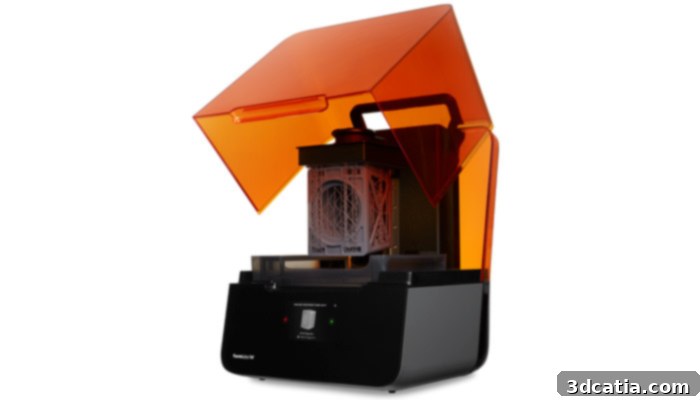
The Form 3 3D printer from Formlabs
Formlabs’ Forward Momentum: Shaping the Future of 3D Printing
Looking ahead, Dávid Lakatos articulated Formlabs’ overarching strategic objective: “Our goal is to be the most relevant and important 3D printing company in the market.” He emphasized that achieving this requires a multi-faceted approach, recognizing that no single technology can dominate the entire additive manufacturing landscape. This conviction drives Formlabs’ strategic expansion into diverse technological branches, such as SLS. By broadening its technological portfolio, Formlabs aims to cater to an ever-wider array of industrial and creative applications, ensuring its solutions remain at the forefront of innovation and user accessibility. This commitment to versatility and comprehensive offerings solidifies their position as a leading force in the evolving 3D printing ecosystem, continually pushing the boundaries of what is possible with additive manufacturing.
A Call to Innovators: Join the Formlabs Global Team
In his concluding remarks, Dávid Lakatos extended an open invitation to the readers, many of whom are deeply immersed in industry-specific outlets. “I would just say to the people that read a more industry-specific outlet that these are the people that often end up working at Formlabs,” he noted. He underscored the vast opportunities available within Formlabs’ rapidly expanding global network, which now includes seven offices spanning Boston, North Carolina, Berlin, Budapest, Shenzhen, Tokyo, and Singapore. These diverse locations are all actively seeking bright, innovative individuals to join their teams. “I think we are literally hiring for every position right now,” Lakatos affirmed, highlighting the company’s dynamic growth trajectory. He even playfully suggested, “Even if you’re a nuclear engineer, we can figure out a way to utilize your skills at Formlabs, so please take the time to see if there’s something that’s interesting to you.” This message powerfully conveys Formlabs’ inclusive and innovative culture, encouraging professionals from all backgrounds to explore how their unique talents can contribute to shaping the future of 3D printing at Formlabs.
The video above showcases the Formlabs’ last User Summit in Boston, U.S.
What are your thoughts on Formlabs’ ambitious expansion in Europe and their latest innovations? We invite you to share your perspective in a comment below or join the discussion on our Facebook and Twitter pages! For all the latest news and updates in the world of 3D printing, remember to sign up for our free weekly Newsletter, delivered straight to your inbox!