
Revolutionizing Industries: The Latest Innovations in 3D Printing Technology
This week, we delve into the dynamic world of additive manufacturing, exploring how cutting-edge 3D printing technologies are transforming various industries, from automotive production to aerospace and sustainable housing. We’ll uncover groundbreaking applications, significant efficiency gains, and the imaginative potential that 3D printing holds for our future. Prepare to witness how companies like Ford Motor Company and Mighty Buildings are leveraging these advancements to redefine manufacturing processes, reduce costs, and accelerate innovation. Join us on this journey through the most impactful 3D printing videos and stories, showcasing the incredible versatility and power of this revolutionary technology.
Ford’s Visionary Approach: Large-Format 3D Printing for Automotive Innovation
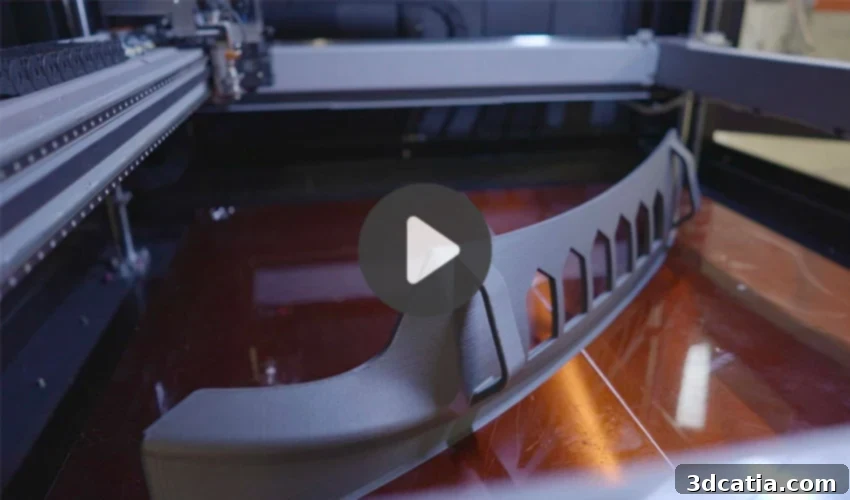
The Ford Motor Company stands as a testament to the enduring power of innovation, with a remarkable 30-year history of integrating additive manufacturing into its diverse applications. From rapid prototyping to the creation of highly functional tooling, Ford has consistently pushed the boundaries of what’s possible with 3D printing. Their long-standing commitment underscores the technology’s critical role in modern automotive engineering and production. The company’s strategic investment in large-format 3D printing, specifically acquiring a BigRep One machine, has been a game-changer, enabling them to design and produce custom tools of unprecedented scale and complexity directly within their facilities.
This advanced capability allows Ford to rapidly produce a wide array of specialized tools perfectly adapted to specific vehicle designs and assembly processes. For instance, they have successfully 3D printed an entire series of ergonomic and highly precise tools designed to assist in the accurate positioning of intricate parts on various vehicle types, including popular hatchbacks. The primary benefit of employing large-format 3D printing for Ford lies in its ability to manufacture substantial parts in a single, continuous operation. This eliminates the need for cumbersome multi-part assembly steps that are often required with traditional manufacturing methods, significantly streamlining the production workflow. The impact of this technological adoption is profound: Ford has reported an astounding 94% reduction in production times for tooling in their factories. This massive efficiency gain not only accelerates product development cycles but also drastically cuts manufacturing costs, cementing 3D printing as an indispensable asset in Ford’s journey toward future mobility solutions.
Streamlining Production: Low-Volume Rapid Injection Molding with 3D Printed Molds
Injection molding is a cornerstone of mass production, but its traditional implementation presents significant hurdles, particularly for low-volume runs and rapid prototyping. The initial investment in tooling, such as steel or aluminum molds, is notoriously high, and the lead times for mold fabrication can stretch for weeks or even months. These factors invariably slow down the introduction of new products to the market, hindering agility and responsiveness in competitive industries. However, the landscape is rapidly changing with the advent of 3D printing technology, offering an incredibly cost-effective and agile alternative for rapid tooling.
3D printing allows for the quick design and fabrication of molds made from various polymer materials, such as high-temperature resins. These printed molds are ideal for producing small series of thermoplastic prototypes or even functional end-use parts. The advantages are manifold: companies can iterate designs rapidly, test market viability with actual injection-molded parts, and significantly reduce the financial risk associated with traditional mold-making. This revolutionary approach shortens development cycles, empowers designers with unprecedented freedom, and makes low-volume production economically viable. For those keen to delve deeper into this transformative process, a highly informative 3Dnatives webinar featuring Juliette Combe from Formlabs provides invaluable insights. Formlabs, a leader in resin 3D printing, has been at the forefront of developing materials and processes that enable the reliable and efficient production of 3D-printed injection molds, demonstrating how this technology is democratizing access to injection molding capabilities.
Reaching for the Stars: Relativity Space and the World’s First 3D-Printed Rockets
Relativity Space represents the pinnacle of ambition and technological prowess in the aerospace industry. This audacious American startup harbors an extraordinary goal: to enable the colonization of Mars by putting one million people on the red planet. Central to this monumental aspiration is their pioneering use of additive manufacturing to rapidly construct rocket ships. What sets Relativity Space apart is their audacious commitment to 3D printing entire rockets, not just components, leveraging the scale and efficiency that only additive manufacturing can provide.
Their innovative approach involves proprietary large-scale metal 3D printers, which build rockets from raw material to flight-ready vehicle with dramatically fewer parts and significantly reduced lead times compared to traditional aerospace manufacturing. This method allows for unprecedented design complexity, lightweight structures, and rapid iteration of designs—crucial for a field where every gram and every day counts. The ability to print complex geometries in a single piece minimizes welding and assembly steps, thereby reducing potential points of failure and speeding up production. Their Terran 1 rocket, notably the world’s first entirely 3D-printed rocket, showcased this capability, proving that additive manufacturing can meet the stringent demands of spaceflight. Their next-generation rocket, Terran R, aims to be fully reusable and even larger, pushing the boundaries of what’s possible with 3D printing in space exploration. Relativity Space isn’t just building rockets; they’re fundamentally reshaping how space vehicles are designed, manufactured, and launched, bringing humanity closer to its extraterrestrial dreams.
Building the Future: Mighty Buildings and Sustainable Concrete 3D Printed Housing
The global housing crisis, coupled with the urgent need for more sustainable construction practices, has spurred remarkable innovation in the building sector. Mighty Buildings, an American company, is at the forefront of this revolution, utilizing advanced concrete 3D printing technology to erect the walls of its houses. Their mission is not just to build structures but to provide more accessible, affordable, and environmentally friendly housing solutions for a growing population. By leveraging the precision and efficiency of additive manufacturing, Mighty Buildings is transforming the traditional, often wasteful, construction paradigm.
Their primary focus is on producing Accessory Dwelling Units (ADUs), which are essentially small, versatile cabins designed for various purposes, including living spaces, home offices, or guest houses. These units offer flexible housing options and can be rapidly deployed. The concrete 3D printing process allows for the automated construction of robust and structurally sound walls with minimal human intervention. This method significantly reduces material waste by precisely depositing concrete only where it’s needed, a stark contrast to the substantial waste generated by conventional construction techniques. Furthermore, the speed of 3D printing dramatically cuts down construction times and labor costs, making housing more affordable. Mighty Buildings’ vision extends beyond mere cost reduction; they are committed to offering a more sustainable construction method that generates less waste and uses materials more efficiently. This approach not only addresses housing shortages but also champions ecological responsibility, demonstrating a powerful synergy between technological advancement and environmental stewardship. The video below offers a fascinating behind-the-scenes look at their 3D printing operations, the construction process, and the inspiring vision driving Mighty Buildings.
Imagining Tomorrow: The Limitless Potential of “Print-Anything” 3D Printing
Step into a world where the boundaries of creation are defined only by imagination. The concept of being able to 3D print anything you could ever need—from the mundane to the extraordinary—is a captivating vision of the future. This video invites you to ponder several hypothetical situations in a world where such ubiquitous 3D printing capabilities are a reality. But the intriguing question is: are we already living in the nascent stages of this mystical place where you can print food, custom cars, entire houses, and even vital medical supplies?
Indeed, the advancements highlighted in this article—from Ford’s industrial tools to Mighty Buildings’ homes and Relativity Space’s rockets—demonstrate that this futuristic vision is rapidly transitioning into tangible reality. Imagine a future where personalized nutrition is delivered through 3D printed food, tailored to individual dietary needs and preferences. Or consider the possibility of on-demand car manufacturing, where vehicles are custom-designed and printed locally, reducing global supply chains and environmental impact. The ability to instantly print emergency shelters in disaster zones or bespoke architectural marvels would revolutionize urban planning and humanitarian aid. In the medical field, the implications are even more profound: personalized prosthetics, custom surgical guides, and even bioprinting of human tissues and organs are no longer purely speculative concepts but areas of active research and development. While the complete “print anything” reality is still some distance away, the rapid pace of innovation in materials science, printer technology, and software development brings us closer every day. This ongoing journey is not just about making existing things better; it’s about unlocking entirely new possibilities, challenging our understanding of production, consumption, and even what it means to create. The future of limitless 3D printing is not just a dream; it’s an evolving blueprint for a transformed world.
What are your thoughts on this week’s incredible selection of 3D printing videos and the revolutionary applications they showcase? We’d love to hear your perspectives on how these technologies are shaping our world. Share your comments below or engage with us on our Facebook and Twitter pages. To stay informed about all the latest news and breakthroughs in additive manufacturing, don’t forget to sign up for our free weekly newsletter, delivered directly to your inbox!