
Revolutionizing Child Safety: How 3D Scanning and Personalization Created the Flo Mask
In today’s rapidly evolving world, the demand for truly personalized products is growing, driven by a desire for enhanced comfort, efficiency, and effectiveness. Among the most cutting-edge methods for creating such bespoke solutions, 3D scanning stands out as an exceptionally efficient and reliable technique. With modern 3D scanners reaching unprecedented levels of precision, the possibilities for customization are virtually limitless. Whether the application calls for crafting adapted anatomical models for medical purposes, designing custom-fit eyewear, or even engineering specialized products like personalized shoes for athletes, 3D technologies have consistently demonstrated their immense capabilities. A compelling testament to this transformative power is the Flo Mask project, conceived by Kevin Ngo, a dedicated father residing in Silicon Valley. Leveraging the sophisticated digitalization solutions provided by Artec, Ngo developed an innovative protective mask specifically designed for children aged 4 to 12 years, aiming to shield them effectively from airborne viruses and environmental air pollution.
The Genesis of Flo Mask: A Father’s Quest for Child Protection
The inspiration behind the Flo Mask emerged from a profoundly challenging period in 2018. That year, California experienced some of the most deadly and destructive forest fires ever recorded, blanketing vast regions in thick, hazardous smoke. The devastating impact on air quality spurred Kevin Ngo into action, igniting his personal mission to find a reliable way to protect children from such environmental threats. Existing solutions at the time proved inadequate, with conventional masks often being ill-fitting, uncomfortable, and ineffective for younger wearers. After extensively testing dozens of commercially available options, which he ultimately found to be either too slow in their adoption, insufficiently precise in fit, or simply uncomfortable for children to wear consistently, Ngo recognized a critical gap in the market. It was this realization that led him to explore the potential of advanced digitalization technology as a viable pathway to a superior solution.
To translate his vision into reality, Kevin Ngo sought the expertise of Artec, a renowned Luxembourg-based company that has carved a niche in the development of cutting-edge 3D scanners and sophisticated 3D software for many years. Artec’s reputation for precision, speed, and reliability in 3D capture made them an ideal partner for a project demanding such high stakes in child safety. The collaborative effort between Kevin and Artec focused on identifying a scanning solution that could deliver an unparalleled combination of accuracy, operational speed, and resolution, crucial for capturing the intricate facial geometries of children. Their choice ultimately fell upon the Artec Eva portable 3D scanner. This particular model, celebrated for its advanced white structured light technology, was deemed perfect for the task. Its structured light process is not only remarkably precise but also completely harmless to humans, making it an exceptionally safe choice for scanning children. The Artec Eva offered the perfect blend of technical capabilities and user-friendliness needed to embark on this ambitious project, promising to revolutionize the way protective gear could be designed and personalized for the youngest members of society.
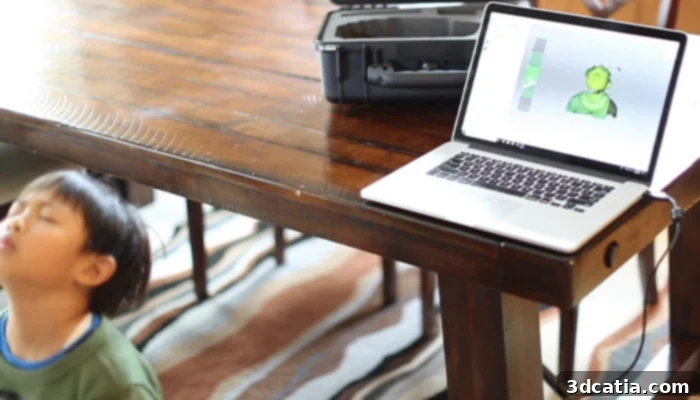
A child undergoing a safe and quick facial scan using the Artec Eva 3D scanner for the Flo Mask project. (Photo Credit: Artec)
Leveraging 3D Scanning for Precision and Personalized Fit
The success of the Flo Mask hinged entirely on achieving an optimal fit that would offer maximum protection without compromising comfort. To this end, a crucial step was to collect a comprehensive 3D dataset that accurately reflected the wide diversity of children’s facial structures, especially the varying shapes and sizes of noses. Recognizing this imperative, Kevin Ngo embarked on an extensive tour across the San Francisco Bay Area. During this period, he meticulously scanned the faces of numerous children from a broad spectrum of ethnic backgrounds, including Asian, Hispanic, African American, and Caucasian children. This commitment to diversity in data collection was vital, ensuring that the final mask design could cater effectively to a wide range of users, moving beyond a generic “one-size-fits-all” approach that often fails to provide adequate protection.
The chosen tool, the Artec Eva 3D scanner, proved indispensable for this intensive data acquisition phase. Renowned for its rapid capture capabilities and high-resolution output, the Eva made the scanning process incredibly efficient and straightforward. Each facial scan was completed in a mere 20 seconds, a speed particularly advantageous when working with children who might find it challenging to remain still for extended periods. Following each quick scan, a brief 30-second post-scan cleaning process ensured that the captured 3D data was pristine and ready for subsequent design stages. This remarkable efficiency allowed Ngo to gather a substantial and diverse dataset quickly, laying a robust foundation for the development of a truly effective and inclusive protective mask. The ability of the Artec Eva to capture intricate details with such speed and safety was a game-changer, demonstrating the practical advantages of advanced 3D scanning in real-world product development scenarios, particularly those focused on human safety and comfort.
From Scan to Solution: The Iterative Design and Prototyping Process
With the comprehensive 3D facial scans in hand, Kevin Ngo and his team embarked on the critical phase of design and prototyping, meticulously transforming raw data into a functional product. Ngo elaborated on the intricate process: “We aligned each scan by the tip of the lip, creating a common reference point across all diverse facial geometries. From this precise alignment, we were able to computationally identify and refine an optimal one-size-fits-all shape that could serve as the foundational template. The wealth of scan data played an instrumental role in guiding our design, enabling us to achieve a shape that was approximately 90% accurate right from the initial iterations.” This foundational design then paved the way for an intensive phase of iterative refinement, marrying digital precision with physical testing.
The journey from initial design to final product involved several cycles of 3D printing and rigorous testing. Ngo’s team performed “half a dozen cycles of 3D printing and test try-ons on the kids.” This hands-on approach was invaluable, allowing for crucial feedback directly from the intended users. Each cycle involved making small, targeted adjustments to the design based on observations during fitting sessions and feedback from both children and parents, progressively refining the mask’s shape, fit, and comfort. With each iteration, prototypes were produced at increasingly higher resolutions, bringing them closer to the desired final product. To accurately simulate the tactile experience and performance of the final mask material, Kevin Ngo specifically opted for the material jetting 3D printing process during prototyping. He explained that this method was chosen “in order to faithfully reproduce the texture of a potential silicone and therefore to validate the final shape before moving on to production.” Material jetting offered the ability to create prototypes with elastomeric properties similar to silicone, allowing the team to assess the mask’s flexibility, seal integrity, and overall comfort much more accurately than with other prototyping methods. This meticulous, multi-stage process of scanning, digital design, iterative 3D printing, and real-world testing was fundamental to developing a protective mask that was not only highly effective but also exceptionally comfortable and well-received by children.
The Flo Mask Advantage: Unparalleled Protection and Comfort for Children
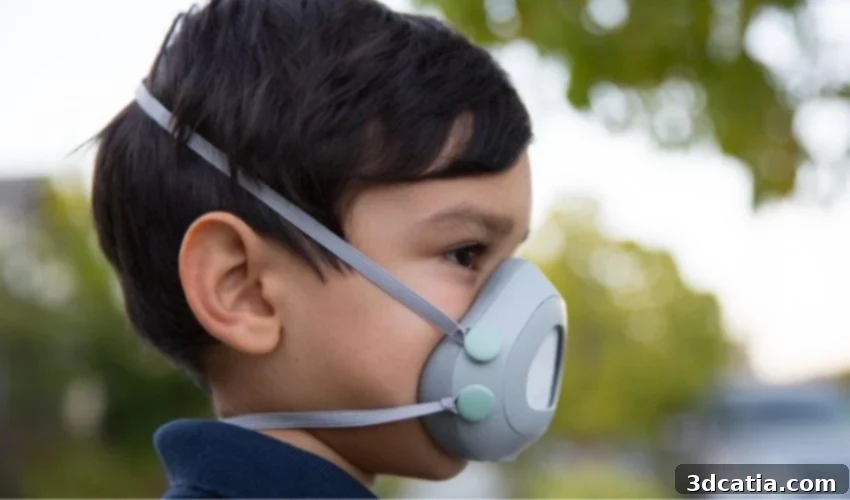
The culmination of Kevin Ngo’s dedication, Artec’s advanced 3D scanning technology, and a rigorous iterative design process is the Flo Mask—a revolutionary protective gear tailored specifically for children. The mask boasts several key design features that set it apart in the market for child respiratory protection. Fundamentally, the Flo Mask incorporates a highly flexible seal designed to comfortably surround the child’s face. This innovative seal creates an effective barrier, crucial for preventing air leakage and ensuring that inhaled air passes only through the mask’s filters. A critical design aspect of this seal is its ability to prevent the mask from touching the child’s lips, significantly enhancing comfort, allowing for clearer speech, and reducing the feeling of claustrophobia that often accompanies traditional masks. This thoughtful consideration addresses common complaints from children regarding mask wear, making it more likely for them to comply with wearing it for extended periods.
Beyond the flexible seal, the Flo Mask is also equipped with adjustable straps. These straps are engineered to provide a secure and customized fit for various head sizes, ensuring the mask stays comfortably in place without causing irritation or pressure behind the ears, a common issue with fixed-strap masks. By keeping the ears clear, the design further contributes to overall comfort, making the mask less intrusive and more wearable for active children. Officially launched in December 2020, the Flo Mask has rapidly gained traction and is now worn by more than 2,000 children across the United States, a clear indicator of its acceptance and effectiveness. The press release highlights the mask’s exceptional performance, noting that its advanced filters block more than 99.8% of viruses. This impressive filtration efficiency significantly surpasses standard protection levels, offering parents peace of mind regarding their children’s safety. Furthermore, the Flo Mask sets a new benchmark for breathability, exceeding the stringent breathability standards set by the Food and Drug Administration (FDA) by a remarkable 600%. This means children can breathe easily and comfortably, even during physical activity, without feeling restricted—a critical factor for sustained wear and comfort. Kevin Ngo’s ambitious bet has undoubtedly paid off. Through the strategic application of digitalization and Artec’s sophisticated scanning solutions, he has successfully developed a groundbreaking product that not only offers superior protection against viruses and pollution but also prioritizes the comfort and compliance of children. The Flo Mask stands as a shining example of how personalized 3D technologies can address critical real-world challenges, particularly in public health and safety.
Beyond the Mask: The Future of Personalized Protective Equipment
The success story of the Flo Mask is more than just about a protective device; it’s a powerful illustration of the transformative potential of 3D scanning and additive manufacturing in creating highly personalized and effective solutions for critical needs. Kevin Ngo’s journey from a concerned parent grappling with inadequate options to a pioneering innovator highlights how accessible and impactful these technologies have become. The ability to precisely scan individual anatomies and then iteratively design and 3D print custom-fit prototypes represents a paradigm shift from traditional mass-production methods. This approach not only ensures optimal functionality and comfort but also significantly improves user compliance, which is paramount for any protective gear, especially for children.
The implications of the Flo Mask project extend far beyond respiratory protection. This methodology—combining ultra-fast, human-safe 3D scanning with advanced 3D printing for iterative, user-centric design—can be applied to a myriad of other personalized products. Imagine custom-fitted helmets for sports, bespoke orthotics, prosthetics that perfectly match individual body shapes, or even specialized eyewear tailored to unique facial contours. In each case, the core principles demonstrated by Flo Mask—precision, comfort, and enhanced performance through personalization—remain equally relevant. As 3D scanning and printing technologies continue to advance, becoming even more accessible and affordable, we can expect to see an acceleration in the development of similarly innovative, personalized solutions across various industries, from healthcare to consumer goods. The Flo Mask serves as a compelling blueprint for the future of product design, where individual needs and anatomical differences are not just accommodated but celebrated, leading to superior products that truly make a difference in people’s lives.
What are your thoughts on this innovative personalized protective gear for children? Do you believe 3D scanning and printing are the future of customized products? We invite you to share your insights in a comment below or join the conversation on our LinkedIn, Facebook, and Twitter pages! Don’t forget to sign up for our free weekly Newsletter here to get the latest 3D printing news delivered straight to your inbox! You can also find all our compelling videos and interviews on our YouTube channel.
Cover Photo Credit: Flo Mask