
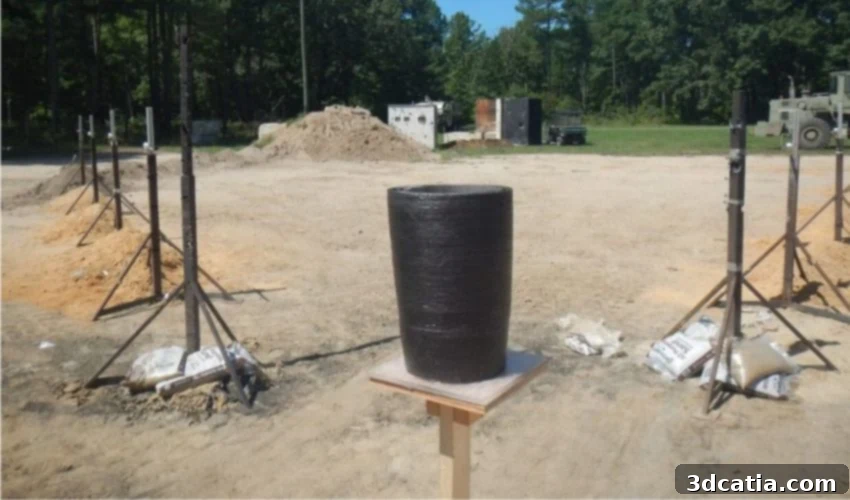
Advancing Defense: 3D Printing Revolutionizes Munitions Manufacturing at NSWC Indian Head Division
For decades, the design and production of conventional munitions have relied heavily on traditional manufacturing processes involving cast, forged, or pressed metals. While effective, these methods often lead to high production costs, lengthy lead times, and limited scalability, particularly for complex designs. Recognizing these inherent challenges, Russ Maines, a distinguished Test and Evaluation Division Director at the Naval Surface Warfare Center Indian Head Division (NSWC IHD), embarked on a pioneering mission: to integrate innovative manufacturing technologies, specifically additive manufacturing (also known as 3D printing), with established practices to transform the future of defense munitions. His vision centers on creating more agile, cost-effective, and robust weapon systems. This ambitious endeavor has recently achieved a significant milestone, with NSWC IHD successfully completing the first-ever arena tests on general-purpose bombs featuring 3D-printed cross-sections. The initial results of these groundbreaking tests have proven to be more than just promising; they herald a new era in defense manufacturing.
The successful test series took place at Fort Walker, Virginia, marking a pivotal moment in the exploration of additive manufacturing for military applications. The centerpiece of these evaluations was a meticulously engineered bomb, whose critical components were 3D printed by the highly acclaimed Oak Ridge National Laboratory (ORNL). This advanced munition was developed under the auspices of the Defense Threat Reduction Agency (DTRA), a testament to a collaborative effort aimed at pushing the boundaries of defense technology. NSWC IHD received this novel test article with a specific mandate: to conduct a thorough assessment of its lethality and overall performance characteristics in a controlled environment. According to a detailed press release issued by NSWC IHD, the entire testing operation was meticulously overseen by a dedicated team of engineers from the Detonation and Combustion Technology Branch. These experts were responsible for the precise, hand-packing of the innovative 3D-printed bomb case with C4 explosive material. Following this critical preparation, the arena was carefully staged, equipped with an array of high-speed cameras and sophisticated monitoring gauges. This comprehensive setup ensured the collection of extensive, real-time data throughout the detonation sequence, providing invaluable insights into the behavior and efficacy of the 3D-printed components under extreme conditions.
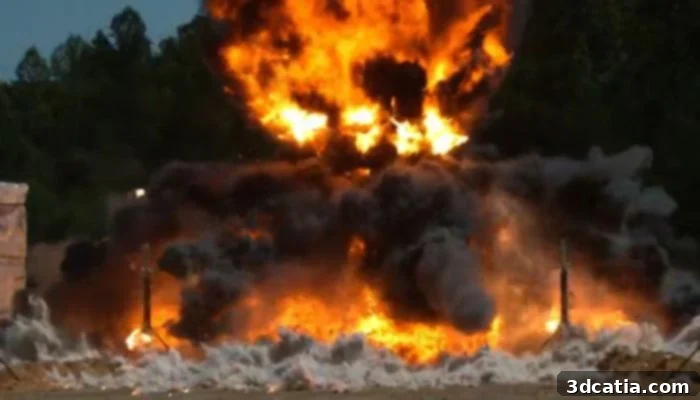
Test arena immediately after detonation of the test article, showcasing the immediate aftermath of the blast.
While the initial series of tests represents merely the first step in a longer, more comprehensive evaluation process, their immediate success has instilled considerable optimism within the defense community. Russ Maines, reflecting on the outcomes, remarked, “So far, the data says there’s no reason to stop. And now, we see our models need adjustments.” This statement underscores not only the impressive performance of the 3D-printed munitions but also highlights the iterative and adaptive nature of scientific development, where new data continuously refines theoretical models. The extensive data gathered by the NSWC IHD team revealed that these innovative bombs were not only effective in their primary function but also exhibited unexpected and highly advantageous qualities. Notably, engineers observed significant improvements in blast physics and enhanced bomb fragmentation patterns. These unforeseen benefits suggest that additive manufacturing could potentially lead to weapon systems that are not just more cost-effective and faster to produce, but also inherently more effective in their intended applications, opening up new avenues for optimizing munition design.
Beyond the critical aspect of bomb performance, NSWC IHD’s aggressive pursuit of 3D printing technology for munitions production is driven by a profound strategic imperative: to achieve faster and more economical manufacturing. The economic benefits are already strikingly evident; the 3D-printed bombs utilized in the Fort Walker tests demonstrated a production cost that was three times lower than that of traditionally manufactured counterparts, even at an initial low rate of production. This dramatic cost reduction signals a transformative potential for defense budgeting and resource allocation. This advancement comes at a particularly critical juncture for the US Navy, which currently faces an unprecedented demand for munitions, far exceeding levels seen in decades. Simultaneously, the global supply chain, which underpins defense manufacturing, remains fragile and susceptible to disruption. The ability to rapidly and affordably produce essential munitions through additive manufacturing offers a powerful solution to these dual challenges, ensuring both national security readiness and fiscal prudence. By leveraging 3D printing, the Navy can move towards a more resilient, responsive, and efficient manufacturing ecosystem, reducing dependence on vulnerable supply lines and accelerating the deployment of vital defense assets.
Russ Maines eloquently articulated the broader implications of this technological shift: “Digitally transforming weapons manufacturing will create new Department of Defense [DoD] pipelines that only strengthen supply chains. And while we’re at it, we could leverage this technology to make bombs quicker, cheaper, and most importantly, better. And as the Navy’s only publicly funded arsenal, Indian Head is uniquely positioned to do it.” His statement underscores the strategic vision for additive manufacturing: not just as a tool for incremental improvement, but as a catalyst for a fundamental overhaul of defense production. By establishing digital manufacturing pipelines, the DoD can foster greater flexibility, reduce reliance on single-source suppliers, and build a more robust industrial base capable of responding to dynamic global threats. The NSWC Indian Head Division, with its long-standing expertise and unique position as the Navy’s sole publicly funded arsenal, is ideally situated to spearhead this transformation, turning innovative concepts into tangible, deployable defense capabilities. Their work is a direct response to the urgent need for a defense industrial base that is both cutting-edge and economically sustainable, capable of supporting national interests with unprecedented agility.
While the 3D printing of highly sophisticated weapons remains in its nascent stages of development, the compelling advantages demonstrated by these initial tests are undeniable. When integrated strategically alongside other innovative manufacturing methodologies, additive manufacturing offers a pathway for the US Navy and the broader Department of Defense to continually push the boundaries of technological advancement. The overarching goal is to achieve production processes that are both faster and significantly less expensive, without compromising on performance or safety. Chief of Naval Operations Adm. Lisa Franchetti has aptly characterized such advancements as “battlefield innovation with profound implications for the changing character of war.” This perspective highlights how rapid prototyping, on-demand manufacturing capabilities, and the potential for customized weapon systems could fundamentally alter military strategy and operational dynamics. The ability to quickly design, test, and deploy new munitions or adapt existing ones to evolving threats provides a distinct tactical advantage. Furthermore, the inherent design freedom offered by 3D printing can lead to optimized geometries, consolidated parts, and integrated functionalities that are simply unachievable with conventional methods, leading to lighter, more efficient, and potentially more effective weapon payloads. The continuous investment in and refinement of these technologies underscore a commitment to maintaining a technological edge in an increasingly complex global security landscape. To delve deeper into the intricate details of this transformative project and the personal commitment behind it, readers are encouraged to explore the comprehensive NSWC IHD story available here.
The pioneering efforts by the NSWC IHD in the realm of 3D printed bombs represent a significant leap forward in defense technology. This research not only promises to enhance the capabilities of military forces but also addresses critical challenges related to cost, production speed, and supply chain resilience. What are your thoughts on the NSWC IHD’s groundbreaking work on 3D printed bombs and the potential it holds for the future of warfare? Do you believe that additive manufacturing will play a dominant role in shaping the next generation of military hardware? We invite you to share your insights and opinions in a comment below or join the conversation on our LinkedIn, Facebook, and Twitter pages! For the latest updates and breaking news in the additive manufacturing industry, don’t forget to sign up for our free weekly Newsletter here, delivered straight to your inbox. You can also discover a wealth of educational and informational videos on our dedicated YouTube channel, offering deeper dives into the world of 3D printing innovation.
*All Photo Credits: NSWC IHD. Cover photo: Section of 3D printed bomb case under test.