
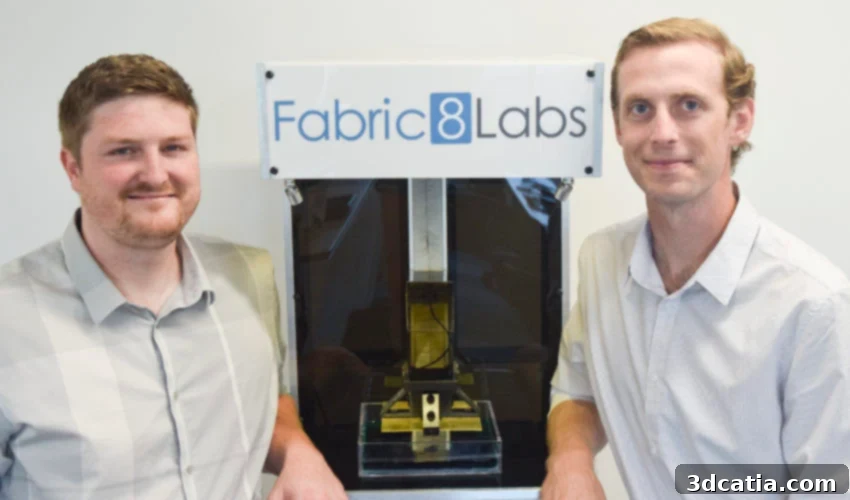
Fabric8Labs: Revolutionizing Metal 3D Printing with Laser-Free, Powder-Free Electrochemical Deposition
The additive manufacturing landscape has been undergoing a seismic shift, particularly within the realm of metal 3D printing. Since 2017, this sector has captivated innovators and investors alike, marked by the introduction of numerous new metal 3D printers from over 20 major companies and an influx of hundreds of millions of dollars in investment. This intense focus underscores the undeniable potential and bright future that metal additive manufacturing holds for industries worldwide.
Amidst this bustling innovation, a Californian-based startup, Fabric8Labs, has emerged with a truly disruptive approach. Our recent conversation with the Fabric8Labs team unveiled a technology poised to redefine expectations for metal 3D printing. What sets Fabric8Labs apart is its revolutionary method that eliminates the traditional prerequisites of lasers, metal powders, and even high heat – elements that have historically contributed to the high cost and complexity of metal additive manufacturing. Naturally, this unique proposition piqued our interest, prompting a deeper dive into their technology, their aspirations for the future, and their vision for the industry.
The Genesis of Fabric8Labs: Addressing Industry Challenges
The founding team of Fabric8Labs identified a critical gap in the market while working in environments where metal additive manufacturing held the promise of immense impact. Despite the clear potential, they repeatedly encountered a significant barrier: the available metal 3D printing technologies were prohibitively expensive, making it challenging to build a compelling business case for their widespread adoption. This realization sparked a collective mission to explore alternative, more accessible methods for metal additive manufacturing. Their search led them to the principles of electrochemical deposition, a process known for its ability to create high-quality metal deposits. This foundational understanding allowed the team to conceptualize and develop what has now become their proprietary, game-changing process.
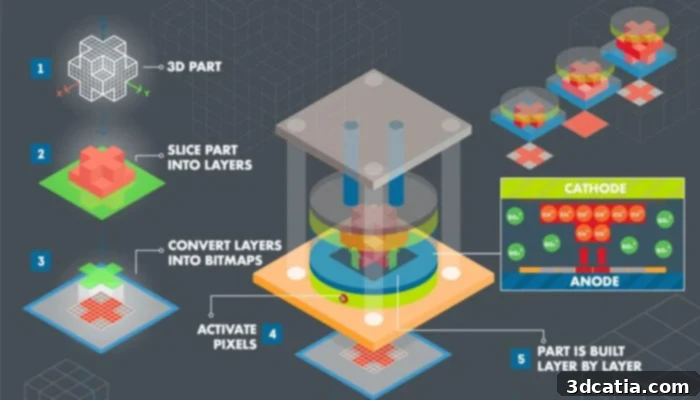
An infographic illustrating the innovative technology developed by Fabric8Labs, highlighting its unique electrochemical deposition process.
Unveiling Stereo-Electrochemical Deposition (SED): A Paradigm Shift in Metal AM
Fabric8Labs’ core innovation lies in its patented Stereo-Electrochemical Deposition (SED) technology. This sophisticated process is rooted in localized electrodeposition, a method that offers unparalleled precision and control. At its heart, the system utilizes an array of microscopic electrodes, which are precisely submerged within an electroplating solution. What makes SED truly remarkable is the granular control over each individual electrode, allowing for the deposition of exact, minute quantities of material, meticulously building up objects layer by layer. This atom-by-atom assembly ensures exceptional control over the material’s microstructure.
One of the most significant advantages of this non-thermal manufacturing technique is its ability to bypass the need for expensive metal powders and high-powered lasers. Traditional powder bed fusion methods require significant energy input to melt and fuse metal particles, often leading to material waste and complex post-processing. By eliminating these components, Fabric8Labs dramatically reduces both equipment costs and the price of feedstock materials, making metal 3D printing far more accessible and economical. Furthermore, because materials are deposited at an atomic level, essentially “atom by atom,” rather than fusing agglomerations of powder, the resulting metal deposits are almost fully dense, exhibiting superior mechanical properties and significantly higher quality. This contrasts sharply with the potential for porosity and internal stresses often found in parts produced by powder-based methods, offering a pathway to consistently reliable and high-performance components.
Expanding Material Versatility and Printer Specifications
Fabric8Labs is poised to make a substantial impact on the market by offering a diverse range of compatible metals, catering to a broad spectrum of industrial applications. Initially, their focus will be on rolling out machines compatible with high-demand materials such as copper and various nickel alloys, including Nickel-Cobalt, alongside several types of stainless steel. These metals are crucial for applications requiring high conductivity, corrosion resistance, and robust mechanical strength.
Beyond their initial offerings, the company has announced ambitious plans to support an even wider array of advanced materials. The compatible materials list for their forthcoming metal 3D printers is extensive, including Copper, Nickel, Iron, Cobalt, Cobalt-Chrome, Pewter, Inconel, Zinc, Aluminum, Titanium, Stainless Steel, Silver, and Gold. This broad material palette opens up unprecedented possibilities for engineers and designers across various sectors, from high-performance aerospace components to intricate medical implants and even luxury goods.
To meet diverse production needs, Fabric8Labs is launching two distinct metal 3D printer series: the Series 1000 and the Series 2000. The Series 1000, designed for precision and intricate part production, offers a respectable build capacity of 3081 cm³ with an impressive resolution of 100μm in the Z-axis and 25μm in the X and Y axes. This level of detail is critical for complex geometries and fine features. For larger scale manufacturing and higher throughput, the Series 2000 provides a maximum build volume of 63713 cm³, boasting an even finer Z-axis resolution of 65μm, while maintaining the precise 25μm X and Y resolution. These specifications underscore Fabric8Labs’ commitment to delivering both versatility and precision, enabling users to produce a wide range of parts from micro-components to larger functional prototypes and end-use parts with exceptional quality.
Further, since materials are being deposited at the atomic level “atom by atom” rather than fusing powder, the deposits formed are almost fully dense and much higher quality, offering superior mechanical properties and reliability for critical applications.
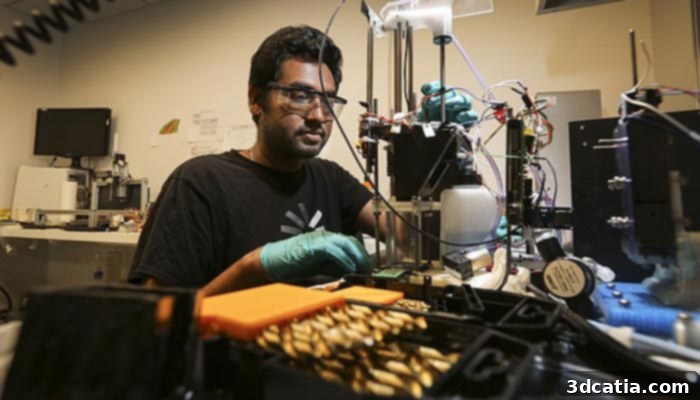
Shiv Shailendar, a dedicated researcher integral to the Fabric8Labs project, showcasing the precision and innovation behind their metal 3D printing.
Strategic Industry Targeting: Medical, Aerospace, and Communications
Fabric8Labs has strategically identified several key industries as primary targets for its disruptive technology: medical devices, aerospace, and communications. This focused approach is driven by the intrinsic alignment between the material requirements, the need for complex part geometries, and the specific production volumes characteristic of these sectors, all of which align perfectly with the capabilities of their Stereo-Electrochemical Deposition technology.
In the **medical device industry**, the ability to produce highly intricate, biocompatible metal components with superior surface finishes and minimal internal defects is paramount. Fabric8Labs’ atom-by-atom deposition ensures the creation of nearly fully dense parts, critical for implants, surgical tools, and custom prosthetics where material integrity and patient safety are non-negotiable. The precision offered by SED allows for the fabrication of complex lattice structures and micro-components that can significantly enhance device functionality and integration within the human body.
For **aerospace applications**, the demand for lightweight, high-strength metal components with complex geometries is constant. Parts often require exotic materials and designs that optimize performance while reducing weight and fuel consumption. Fabric8Labs’ non-thermal, powder-free process enables the creation of such components with exceptional material properties, potentially reducing lead times and manufacturing costs associated with traditional methods. The ability to print with materials like Inconel and Titanium, known for their high temperature and corrosion resistance, makes SED particularly attractive for engine components, structural brackets, and other critical aerospace parts.
The **communications industry** benefits from SED’s precision in producing highly conductive components and complex electronic enclosures. As devices become smaller and more powerful, the need for intricate heat sinks, antennas, and connector components made from materials like copper becomes crucial. The high resolution and material purity achievable with Fabric8Labs’ technology can lead to improved signal integrity, enhanced thermal management, and miniaturization of electronic systems, driving innovation in areas like 5G infrastructure, advanced sensors, and satellite communications.
The Evolving Landscape of Metal 3D Printing and Fabric8Labs’ Role
The year 2018 was indeed a pivotal period that began to define the burgeoning metal 3D printing space, and its significance continues to grow exponentially. The innovations announced in 2017 brought a surge of attention to additive manufacturing, promising new efficiencies and capabilities. Following this, 2018 served as a crucial turning point where this concentrated attention shifted towards exploring and implementing the unique and novel applications that these nascent technologies, including Fabric8Labs’ SED, could enable. This trend has only accelerated, with the industry moving beyond mere hype to practical, large-scale implementation.
Fabric8Labs, with its innovative approach, is not just participating in this evolution but actively driving it. By addressing the critical limitations of cost and material quality associated with traditional metal AM, they are paving the way for broader adoption across industries that were previously hesitant due to financial or technical barriers. Their laser-free, powder-free, and non-thermal process represents a significant leap forward, making high-quality metal parts more accessible and fostering an environment ripe for new product development and manufacturing paradigms. The long-term impact of technologies like SED will be seen in their ability to democratize metal additive manufacturing, enabling more companies to leverage its benefits for prototyping, tooling, and ultimately, high-volume end-part production.
Looking Ahead: Partnership and Innovation
As Fabric8Labs continues its journey to commercialize its groundbreaking technology, the team is actively seeking collaborations. They are specifically looking for visionary beta partners to rigorously test their production prototypes, with trials expected to commence in mid-2018 and beyond. These partnerships are vital for refining their systems, gathering real-world feedback, and demonstrating the robustness and versatility of SED technology across diverse industrial applications. Beyond beta testing, Fabric8Labs is continually on the lookout for interesting and challenging applications that can truly push the boundaries of what their technology can achieve, welcoming inquiries from any industry with a need for advanced, cost-effective metal additive manufacturing solutions.
What are your thoughts on Fabric8Labs’ revolutionary approach to metal 3D printing? We encourage you to share your insights in a comment below or join the conversation on our Facebook and Twitter pages! Don’t miss out on the latest advancements in additive manufacturing – sign up for our free weekly Newsletter to receive all the essential 3D printing news directly in your inbox!