
EY Global 3D Printing Report 2019: Unveiling the Rapid Expansion and Industrial Maturation of Additive Manufacturing
The prestigious audit firm EY has released its highly anticipated second report, titled Global 3D Printing Report 2019, providing an in-depth analysis of the additive manufacturing landscape. This publication builds upon their inaugural 2016 edition, clearly illustrating the significant evolution of the market over a three-year span. Notably, the report highlights a dramatic increase in the practical adoption of 3D printing technologies across industries. According to EY’s findings, a remarkable 65% of companies surveyed now report actively utilizing 3D printing, a substantial leap from just 24% in 2016. This surge indicates a growing recognition of the technology’s inherent advantages and its potential to revolutionize production processes. Furthermore, the study reveals that four out of ten companies have strategically invested in their own internal additive manufacturing solutions, demonstrating a strong commitment to integrating these capabilities into their core operations and leveraging the myriad benefits it offers, from rapid prototyping to complex functional part production. The report also meticulously tracks a distinct geographical shift in market dynamics. Asia, spearheaded by key players like South Korea and China, is rapidly expanding its footprint and gaining considerable market share, often at the expense of traditional leaders such as Germany and the United States, signaling a global redistribution of additive manufacturing prominence.
The comprehensive data underpinning the Global 3D Printing Report 2019 was meticulously gathered from a diverse pool of 900 participants representing 726 distinct companies worldwide. This extensive research encompassed 13 countries, predominantly from pivotal economic regions including the United States, Europe, and Asia, ensuring a broad and representative global perspective. Furthermore, the study incorporated insights from nine different sectors of activity, offering a granular view of additive manufacturing adoption across various industrial landscapes. For instance, in the United States alone, the survey engaged 219 companies, reflecting a deep dive into regional trends and challenges within one of the largest economies. This robust methodology ensures the credibility and breadth of the report’s conclusions, providing valuable benchmarks for understanding the global trajectory of 3D printing and highlighting key areas of growth and innovation across diverse industries.
A particularly striking revelation from the report is the leadership position of South Korea and China in terms of technology adoption, a significant divergence from the market landscape observed in 2016. This shift is not merely coincidental; as the report elucidates, it likely reflects the more dynamic economic development experienced by these Asian nations in recent years, a growth trajectory that is clearly extending into the burgeoning additive manufacturing market. The rapid industrialization and technological advancement in these regions have created fertile ground for embracing innovative production methods. Their governments and industries have often prioritized investment in cutting-edge technologies to enhance global competitiveness. Another compelling explanation posits that these countries have acutely recognized the strategic imperative of harnessing emerging technologies, like 3D printing, to forge a novel competitive advantage. This represents a conscious pivot away from their historical reliance on cost leadership, indicating a sophisticated understanding of how advanced manufacturing can drive future economic prosperity and global market dominance. This strategic embrace positions them at the forefront of the additive manufacturing revolution, potentially reshaping global supply chains and manufacturing paradigms through advanced, localized production.
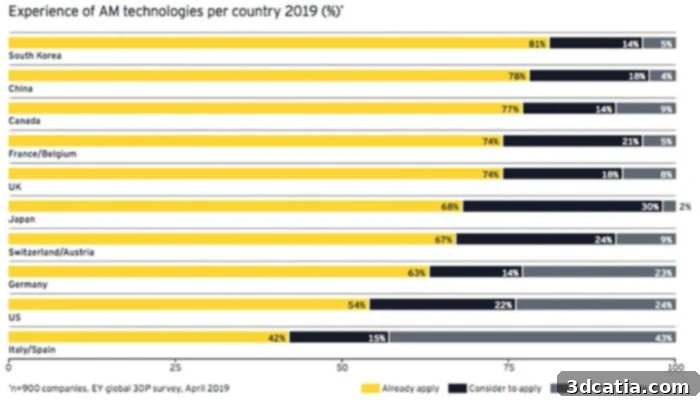
Image via EY
When examining the adoption rates across various industry sectors, the aerospace sector stands out as having accumulated the most extensive experience and expertise in additive manufacturing technologies. A significant 78% of companies within this highly specialized sector affirm their active utilization of the technology, underscoring its critical role in producing lightweight, complex, and high-performance components vital for aircraft and spacecraft. The demanding requirements for precision, strength-to-weight ratio, customization, and the ability to consolidate multiple parts into a single print in aerospace make 3D printing an ideal solution for achieving performance gains and cost efficiencies. While other sectors may not exhibit such high adoption percentages, the report clearly indicates a tremendous and accelerating increase in their engagement with AM compared to 2016 figures. This demonstrates a broadening understanding and application of 3D printing beyond its traditional early adopter domains. For example, the interest in and practical experience of additive manufacturing among logistics and transportation companies has surged six-fold since 2016. This remarkable growth points to the versatility of 3D printing in addressing diverse industrial challenges, from optimizing supply chains and creating on-demand spare parts to developing specialized tooling for efficient transport operations. As these sectors gain more experience and witness tangible benefits, they are likely to unlock even greater value from additive manufacturing, further accelerating its industrial integration.
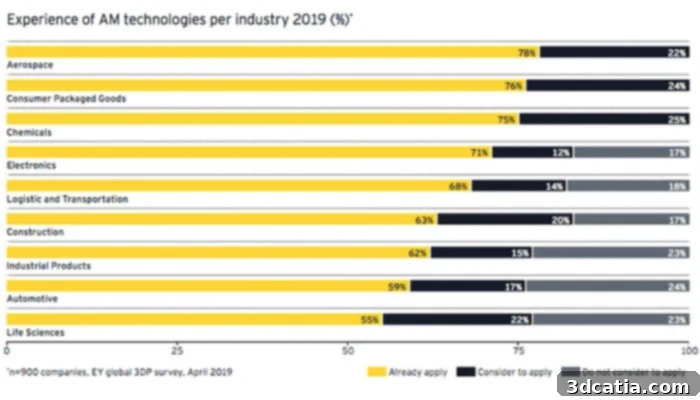
Image via EY
AM Serial Production Takes Off: From Prototypes to End-Use Parts
One of the most significant trends identified and discussed in recent months within the additive manufacturing community is the unequivocal shift of additive manufacturing beyond its traditional role in rapid prototyping. The technology is now increasingly being embraced and adopted for the direct creation of functional, end-use parts. This fundamental transition signifies a maturation of the technology and its integration into mainstream manufacturing workflows, moving it from a niche prototyping tool to a robust production method. These functional parts encompass a wide array of applications, including critical end-use components and final products directly utilized by the client, often customized or optimized for specific performance characteristics and demanding operational environments. Furthermore, AM is proving invaluable for producing specialized tools and molds that are integral to traditional manufacturing processes, offering unprecedented design freedom, faster iteration cycles, and significant cost reductions in toolmaking. Lastly, the capability to manufacture spare parts on demand from digital warehouses is revolutionizing inventory management and supply chain resilience, reducing storage costs and ensuring availability of legacy or low-volume parts. The EY survey revealed that nearly one third of the companies surveyed in 2019 had successfully produced one or more of these three crucial types of functional parts. More precisely, 18% of companies are leveraging the technology to directly manufacture end components, while 15% and 14% of companies are utilizing additive manufacturing for the direct production of tools and spare parts, respectively. This robust data underscores a tangible movement towards industrial application and widespread adoption of AM for production-grade outputs, marking a new era for advanced manufacturing.
Looking ahead, the report presents compelling forecasts regarding the future trajectory of serial production using additive manufacturing. A substantial 46% of companies anticipate applying 3D printing technology for their serial production needs by the year 2022, representing a dramatic increase from the mere 18% currently engaged in such practices. This projected growth highlights an optimistic outlook and a strategic push towards fully integrating AM into high-volume manufacturing, shifting it from a supplementary technology to a core production method. However, this ambitious figure is not uniformly distributed across all surveyed countries and regions. Asia, once again, is conspicuously setting the pace for this industrial transformation, demonstrating a more aggressive adoption curve for serial production. This regional disparity underscores varying levels of investment, technological readiness, supportive industrial policies, and strategic priorities in different global markets. It suggests that Asian economies are perhaps more agile in adapting to new manufacturing paradigms. The chart below provides a detailed breakdown of these regional projections, offering insights into where the most rapid advancements in additive manufacturing for serial production are expected to occur and indicating the regions that are likely to lead the charge in defining the future of digital and flexible manufacturing.
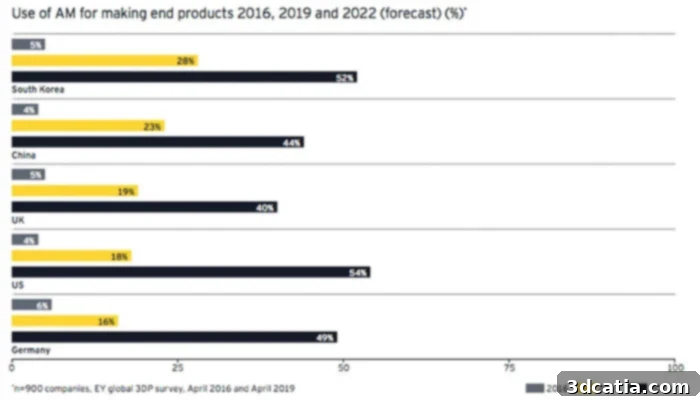
Image via EY
Delving into the perceived advantages, one of the primary benefits of 3D printing consistently highlighted by participants is its unparalleled ability to engineer solutions that precisely meet individual customer demands, thereby offering businesses a clear and formidable competitive advantage. This is vividly demonstrated by the sheer volume of custom-made 3D printed parts now prevalent across virtually every sector of activity, from bespoke medical implants and prosthetics to highly personalized consumer goods and specialized industrial components. The inherent flexibility and customization capabilities of additive manufacturing allow companies to cater to niche markets and deliver highly personalized products at scale, something traditional manufacturing struggles to achieve economically. Beyond customization, the technology is also lauded for its efficiency, significantly reducing both lead times and overall manufacturing costs. By streamlining design-to-production cycles, minimizing tooling requirements, and reducing material waste, 3D printing accelerates market entry and lowers overheads. Furthermore, the transformative impact of additive manufacturing extends across the entire supply chain, fostering greater agility and resilience. A significant 48% of participants express a strong desire to digitize their physical stocks, moving towards an on-demand production model. This “digital warehouse” concept promises to revolutionize the spare parts market, eliminating the need for vast physical inventories and enabling parts to be produced precisely when and where they are needed. Concurrently, 56% of respondents believe that 3D printing inherently reduces logistics and transport efforts, fostering more localized production and diminishing reliance on complex global shipping networks, which ultimately contributes to a more resilient, cost-effective, and sustainable supply chain.
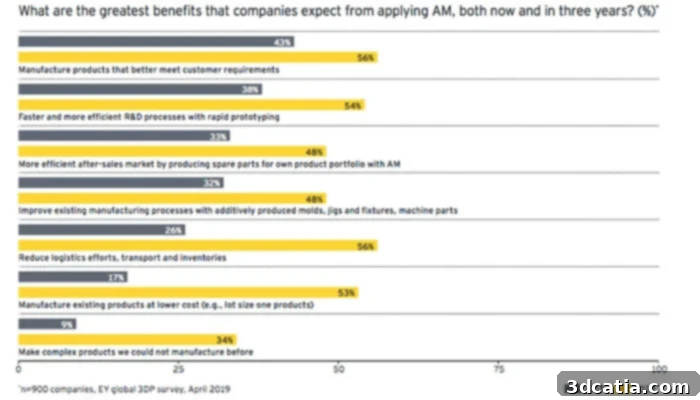
Image via EY
Despite the numerous and compelling benefits that 3D printing technology offers, its widespread adoption is still confronted by several significant limitations and challenges, primarily centered around cost. A striking 90% of the participants in the EY survey identified the high cost of 3D printing materials as a major impediment, directly hindering broader market penetration and scaling efforts. The specialized nature of these materials and their relatively lower production volumes compared to conventional manufacturing materials contribute to this issue. Similarly, the initial investment required for the systems themselves remains a substantial barrier, with 87% of respondents considering the cost of additive manufacturing equipment to be excessively high. These significant financial hurdles often deter smaller businesses or those with limited capital from investing in the technology, thus limiting market access. Beyond cost, a pervasive lack of knowledge also restricts adoption. Whether it pertains to specialized design principles for additive manufacturing (Design for Additive Manufacturing – DfAM), the intricacies of operating and maintaining 3D production systems, or understanding the full capabilities and limitations of various AM processes, a knowledge gap prevents 50% of the surveyed companies from fully committing to investments in 3D printing solutions. However, there is an encouraging trend: various training opportunities and educational programs are actively being developed and implemented by academic institutions, industry alliances, and private companies. These initiatives are crucial for equipping the workforce with the necessary skills and expertise, thereby gradually dismantling some of the existing barriers to innovation and fostering a more skilled talent pool capable of maximizing the immense potential of additive manufacturing across diverse industrial applications.
In conclusion, the overarching sentiment gleaned from the Global 3D Printing Report 2019 is one of profound confidence regarding the sustained and accelerated growth of additive manufacturing. The report’s projections paint a robust picture of expansion, forecasting an impressive annual market growth rate of 25% until 2023. This trajectory is expected to elevate the global additive manufacturing market to a formidable $27.4 billion. This optimistic outlook heralds excellent news for the entire sector, indicating a period of dynamic innovation and widespread integration into various industrial processes. We can anticipate the continuous introduction of novel materials, expanding the scope of applications and performance characteristics to meet increasingly complex industrial demands. Concurrently, there will be ongoing advancements in additive manufacturing machines themselves, focusing on enhancing speed, improving cost-efficiency, increasing build volumes, and refining software capabilities for greater automation, ease of use, and process control. Crucially, the report predicts a significant increase in the number of 3D printed end-use parts being produced, a key indicator that additive manufacturing is progressively transcending its origins in rapid prototyping applications to become a vital, mainstream method for industrial production. This evolution signifies a coming-of-age for 3D printing, transforming it from a niche technology into a cornerstone of modern, agile, and customized manufacturing.
For those interested in delving deeper into the comprehensive findings and detailed analyses, additional information is readily available on EY’s official website HERE.
We invite you to share your valuable insights and perspectives on this latest report from EY concerning the global adoption and evolving use of 3D printing in 2019. Please feel free to let us know your thoughts in the comment section below, or engage with us on our Facebook and Twitter pages. To stay abreast of all the breaking news and latest developments in the world of 3D printing, remember to sign up for our free weekly Newsletter, delivered directly to your inbox!