
Blackbelt 3D: Ushering in the Era of Unlimited Length and Continuous FDM 3D Printing
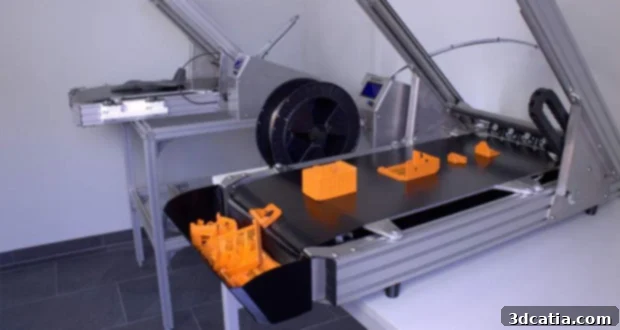
The landscape of additive manufacturing is constantly evolving, with innovations pushing the boundaries of what’s possible. A significant leap forward has been introduced by the Dutch startup Blackbelt 3D, which recently unveiled a groundbreaking 3D printer featuring an integrated conveyor belt system. This ingenious design fundamentally changes the paradigm of Fused Deposition Modeling (FDM) technology, allowing for the fabrication of objects with extraordinary length, or indeed, potentially unlimited length. This innovation is poised to redefine FDM printers as we know them, promising a “new type of industrial production machine” and potentially altering the future of 3D printing forever by introducing unprecedented capabilities in continuous manufacturing.
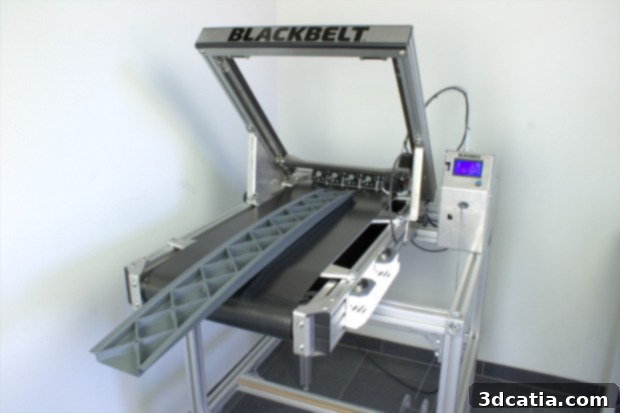
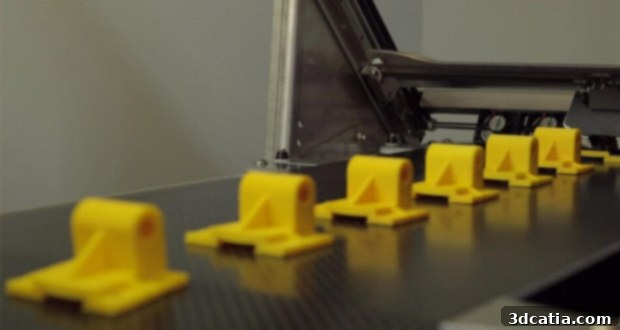
At the heart of Blackbelt 3D’s revolutionary design is a meticulously engineered conveyor belt that doubles as the printer’s Z-axis. Unlike traditional FDM printers where the build plate moves vertically, Blackbelt’s platform moves horizontally, seamlessly advancing finished parts and providing a continuous surface for new ones. This crucial mechanism enables the creation of incredibly long parts that would be impossible on a conventional build plate. Furthermore, it facilitates the continuous printing of multiple parts one after another without human intervention, significantly boosting productivity. As each print concludes, it is gently carried off the belt into a designated collection tray, establishing an autonomous workflow. This capacity for uninterrupted operation means the Blackbelt 3D printer can function independently for extended periods, paving the way for lights-out manufacturing and optimized industrial production processes.
The effectiveness of this continuous printing system largely depends on the quality and reliability of the conveyor belt itself. Blackbelt 3D addresses this by utilizing a belt crafted from a “carefully selected and well tested” carbon fiber composite. This advanced material ensures superior adhesion properties, which are critical for successful FDM printing, allowing filaments to stick securely during the printing process and ensuring clean, high-quality results. Beyond the belt, another key innovation lies in the printer’s ability to print at a unique 45° angle. This specific orientation leverages gravity and layer adhesion in a way that often eliminates the need for cumbersome and material-intensive support structures that are typically required for overhanging geometries in traditional 3D printing. The direct benefits are substantial: significant savings in both printing time and raw material costs, as well as a reduction in post-processing efforts, making the entire workflow more efficient and cost-effective.
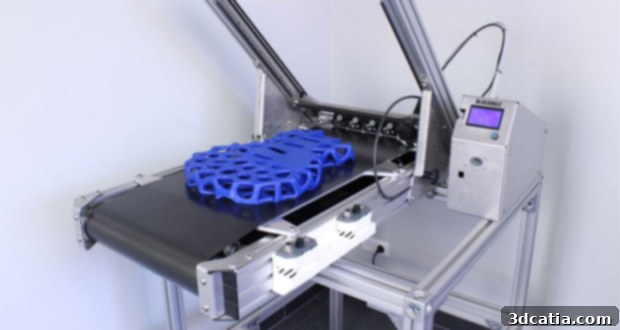
Reflecting on their design philosophy, Blackbelt emphasized, “The idea behind the entire concept was to make an FDM 3D printer as easy to use as a 2D printer that prints on paper. You simply start up the print job, and the print comes out of the machine.” This statement highlights a fundamental shift in user experience. Traditional 3D printing often involves complex setup, careful calibration, and manual removal of finished parts and support structures. Blackbelt’s approach aims to streamline this by automating critical steps, allowing users to initiate a print job and then tend to other tasks while the machine continuously produces parts and collects them. This ‘set it and forget it’ capability drastically reduces the operational burden, making advanced additive manufacturing accessible to a broader range of users, from small businesses to large-scale industrial facilities, eager to leverage the benefits of automated production.
Beyond its core innovation of continuous printing, the Blackbelt 3D printer offers remarkable versatility through its customizable and modular design. This foresight ensures the printer can adapt to diverse manufacturing needs and environments. Users have the ability to extend the printer frame to accommodate exceptionally long prints, a feature particularly beneficial for industries requiring custom-length components or large-scale prototypes. Furthermore, the system supports up to three distinct print heads, each capable of housing nozzles with different dimensions. This modularity in print heads empowers users to optimize for various applications: finer nozzles for intricate details, larger nozzles for rapid prototyping or less critical components, and the ability to work with different materials simultaneously. This adaptability makes the Blackbelt printer “easy to adapt” for “any industrial or desktop environment,” proving its value as a flexible tool that can scale with evolving production demands and integrate seamlessly into existing manufacturing workflows.
The Blackbelt 3D Kickstarter campaign, an eagerly anticipated event for the additive manufacturing community, is slated to commence in the near future. While the crowdfunding effort is on the horizon, key specifications and pricing details have already been made public, providing a clear picture for interested parties. The desktop version of this innovative machine will be available starting at €9,500, which converts to approximately $10,341 (at the time of initial announcement). This price point positions it as a significant investment, but one that promises substantial returns through increased efficiency and expanded production capabilities. For those aiming to create objects on an even grander scale or integrate the printer into more robust industrial settings, an upgrade option is available. This includes a standing frame and a roller table, designed to support and manage exceptionally long prints, at an additional cost of €12,500. These pricing tiers reflect Blackbelt’s commitment to providing flexible solutions for both professional desktop users and high-volume industrial manufacturers, enabling a broad adoption of their revolutionary continuous 3D printing technology.
Considering its unique ability to print continuously and produce objects of potentially unlimited length, Blackbelt 3D has positioned itself as a major disruptor in the FDM 3D printer market. The elimination of manual part removal, the reduction in support structures through the 45-degree printing angle, and the overall emphasis on ease of use contribute to a compelling value proposition for businesses seeking to enhance their additive manufacturing capabilities. This technology addresses critical bottlenecks often encountered in traditional 3D printing, such as limited build volume, post-processing complexities, and the need for constant supervision. Industries ranging from automotive and aerospace to consumer goods and custom prototyping stand to benefit immensely from Blackbelt’s innovative approach, which promises faster iteration, lower production costs, and the ability to bring complex designs to life with unprecedented efficiency. The modular design further enhances its appeal, allowing businesses to adapt the printer to specific project requirements, ensuring longevity and relevance in a rapidly evolving technological landscape.
Overall, Blackbelt 3D is undoubtedly a company and a campaign that demands close attention. Its unique blend of continuous production, support-free printing, and user-friendly automation marks a significant milestone in FDM technology. As the 3D printing world continues to seek more efficient, scalable, and versatile solutions, Blackbelt’s offerings could very well lead the charge in defining the next generation of industrial production machines. We, along with the broader additive manufacturing community, will be keenly observing its impact and how it shapes the future of manufacturing.
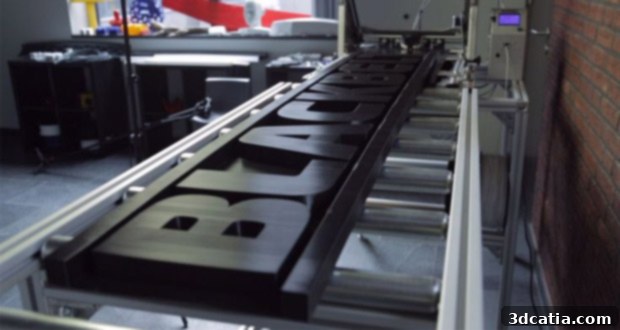
The extended version of the Blackbelt 3D printer, demonstrating its capacity for long prints.
Can Blackbelt truly revolutionize the 3D FDM printer market and establish a new standard for continuous, industrial additive manufacturing? We invite you to share your thoughts and predictions! Let us know in a comment below or join the discussion on our Facebook and Twitter pages!