
Innovative Cellulose 3D Printing: Paving the Way for Sustainable Bio-Composites
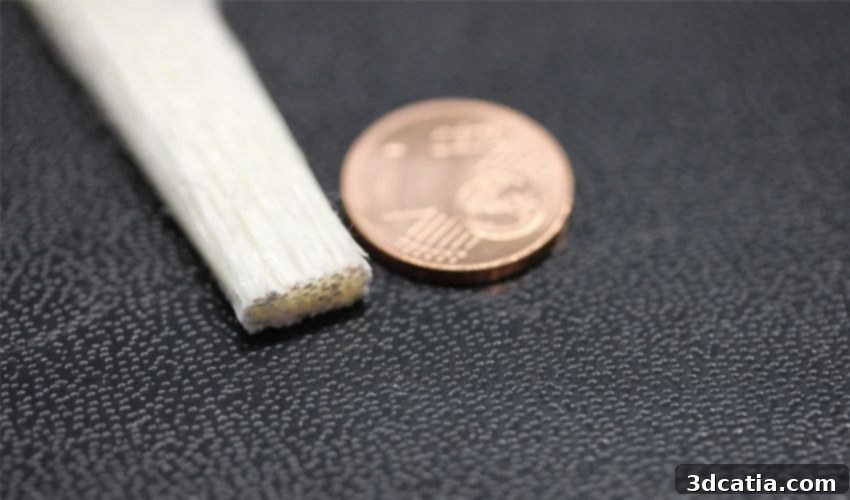
The German Institute of Textile and Fiber Research (DITF) has recently unveiled a groundbreaking research project poised to revolutionize additive manufacturing. This ambitious initiative aims to develop an innovative 3D printing method specifically tailored for composite materials, with a strong focus on sustainability. The core objective is to produce high-performance components reinforced with bio-based and environmentally friendly fibers, primarily cellulose. This marks a significant step towards leveraging the immense potential of natural resources in advanced manufacturing processes. The DITF team, in a pivotal collaboration with leading machine manufacturer Arburg, has engineered a specialized print head capable of precisely extruding continuous cellulose fibers. These fibers are meticulously embedded within a custom-formulated, cellulose-based matrix, ensuring material compatibility and enhanced structural integrity. This visionary project, backed by the German Federal Ministry of Education and Research, promises to unlock the capabilities of cellulose – a material both highly abundant and renewable – enabling the design and production of more durable, sustainable parts that fully capitalize on the advantages of composite 3D printing. The implications for various industries, from automotive to consumer goods, are immense, offering a pathway to greener, more resilient products.
This pioneering research exemplifies how profound inspiration from nature can be synergistically combined with cutting-edge additive manufacturing technologies. When we discuss additive manufacturing with composites, we often overlook the natural world that has perfected such structures over millennia. Without perhaps consciously realizing it, we are constantly surrounded by intricate natural composites: the remarkable strength-to-weight ratio of wood, the structural integrity of various plant stalks, the incredible tensile strength of spider silk, or even the complex layering of human skin. These natural fibers and matrices offer a myriad of highly desirable properties, ranging from exceptional strength and stiffness to remarkable lightness and biodegradability. The fundamental question then arises: why should we not harness these inherent advantages and integrate them directly into modern 3D printing processes?
Nature’s Design Principles: A Blueprint for Bio-Composites in 3D Printing
The concept of composite materials is far from new; nature has been engineering them for billions of years. Wood, for instance, is a complex natural composite made of cellulose fibers embedded in a lignin matrix, providing both rigidity and flexibility. Spider silk, renowned for being one of the strongest natural fibers, combines strength with elasticity. These biological structures serve as a powerful testament to the efficiency and functionality of composite design. The DITF project draws directly from this natural wisdom, seeking to replicate and even enhance these properties using additive manufacturing. By employing cellulose fibers, which are essentially the building blocks of plant cell walls, the research aims to create synthetic composites that mimic the performance and environmental benefits of their natural counterparts. This bio-inspired approach is crucial for developing materials that are not only high-performing but also sustainable throughout their life cycle.
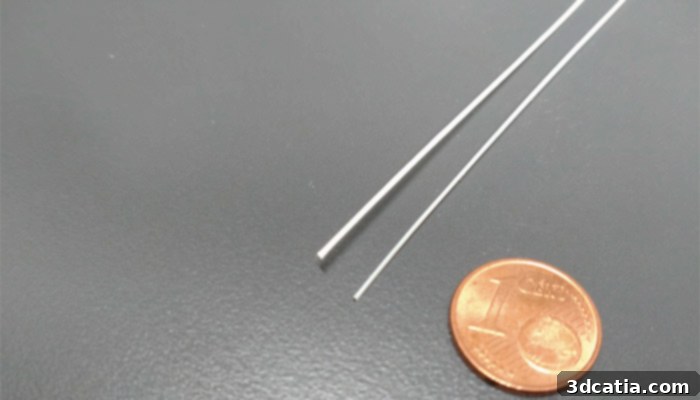
Cellulose fibers produced by pultrusion (a portmanteau of pull and extrusion; as opposed to extrusion, which pushes the material, pultrusion pulls the material)
Overcoming the Thermal Challenge: A Critical Hurdle for Natural Fibers
While the promise of natural fibers like cellulose in additive manufacturing is immense, integrating them into traditional 3D printing processes presents a formidable challenge: temperature management. Natural fibers, and cellulose fibers in particular, are inherently sensitive to high temperatures. Exposure to excessive heat during processing can lead to thermal degradation, compromising their structural integrity, mechanical properties, and overall performance. This temperature constraint immediately rules out the use of common thermoplastic matrices such as PLA (polylactic acid) or ABS (acrylonitrile butadiene styrene). These widely used plastics typically require heating to high temperatures – often above 180°C for PLA and even higher for ABS – to achieve the molten state necessary for layer-by-layer deposition in fused filament fabrication (FFF) or other thermoplastic-based additive manufacturing methods. Such temperatures would irreversibly damage the delicate cellulose fibers, making the resulting composite ineffective. Consequently, the DITF team faced the complex task of simultaneously innovating on two fronts: developing an entirely new matrix material compatible with cellulose’s thermal limitations and devising a bespoke 3D printing process capable of operating within those stringent temperature requirements.
An Ingenious Solution: A Cellulose-Based Matrix and Precision 3D Printing Process
In response to the critical temperature challenge, the DITF researchers conceived and developed an ingenious cellulose-based matrix solution. This innovative approach ensures compatibility with the natural fibers, circumventing the thermal degradation issues associated with conventional thermoplastics. The official press release meticulously details the process: “The cellulose fiber strand is first stabilized with a binder to be processed in the printer. The specially developed print head converts the binder into a matrix with which the continuous cellulose fibers are coated. Since the cellulose fibers and the matrix have similar chemical structures, the composite component is particularly stable.” This statement highlights a key aspect of the innovation: the inherent chemical synergy between the cellulose fibers and the cellulose-based matrix. This similarity promotes strong interfacial adhesion, leading to a highly stable and robust composite material, far superior to composites where fiber and matrix have disparate chemical compositions.
Precision Reinforcement: The Role of Topological Optimization
Beyond material development, the DITF team also integrated advanced design methodologies into their process. Utilizing sophisticated topological optimization solutions, they were able to precisely determine the optimal placement and orientation of the continuous cellulose fibers within the composite structure. Topological optimization is a powerful computational method that allows engineers to optimize material distribution within a given design space for a set of loads and boundary conditions. In this context, it enables the team to strategically position the fibers in the exact direction required to withstand anticipated mechanical stresses and loads applied to each part. This targeted reinforcement ensures that the material is used most efficiently, maximizing the mechanical performance – such as strength and stiffness – while potentially minimizing material usage. This intelligent design approach is paramount for fully exploiting the anisotropic properties of continuous fiber composites, leading to components that are not only stronger and lighter but also designed for optimal durability and longevity under specific operating conditions.
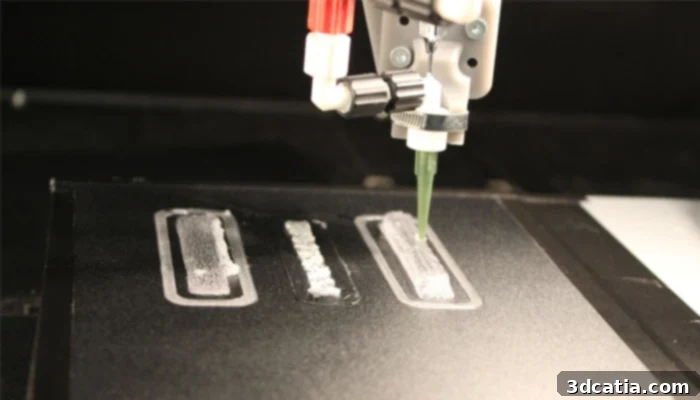
The developed 3D printing process
Exceptional Mechanical Properties and Broadened Horizons for Sustainable Manufacturing
The results obtained from this innovative cellulose 3D printing method are highly promising, particularly regarding the mechanical properties of the printed parts. Early tests demonstrate exceptionally good performance, with a notable emphasis on fracture strength. This indicates that components produced using this technique are highly resistant to breakage under stress, a critical characteristic for a wide range of industrial applications. The solution-based and energy-saving manufacturing method developed by the research team is not only effective for cellulose but also possesses significant versatility. Its inherent design makes it adaptable for use in other processes aimed at producing composite materials, especially those involving temperature-sensitive components. This is a crucial advantage, as many advanced and natural materials – beyond just cellulose fibers – suffer degradation when exposed to the high temperatures typical of conventional additive manufacturing. Therefore, this method opens doors for processing a broader spectrum of high-demand, thermally delicate materials, including various other natural fibers or bio-polymers that were previously challenging to integrate into 3D printable composites.
Looking at the impressive results, the manufactured parts exhibit superior breaking strength and an optimized strength-to-weight ratio, showcasing the effectiveness of continuous fiber reinforcement combined with topological optimization. This advanced method of composite 3D printing holds immense potential for industries striving for both performance and sustainability. Its ability to process temperature-sensitive materials efficiently means that the scope of its application extends far beyond just natural fibers. It could unlock new possibilities for customized medical implants, lightweight aerospace components, durable automotive parts, and innovative consumer products, all while reducing environmental impact. The development of such eco-friendly and high-performing composite materials aligns perfectly with the growing global demand for sustainable manufacturing practices and a circular economy. This research represents a significant leap forward in making additive manufacturing greener, more versatile, and capable of producing high-integrity components from renewable resources. Further detailed information on the project and its ongoing advancements can be found HERE.
The Future of Sustainable Additive Manufacturing with Bio-Composites
The DITF’s project on cellulose 3D printing is more than just an academic endeavor; it’s a blueprint for the future of sustainable additive manufacturing. By demonstrating a viable method to utilize abundant, bio-based cellulose fibers in high-performance composites, the research addresses critical challenges in both material science and environmental responsibility. It points towards a future where manufacturing can rely less on fossil-derived plastics and more on renewable resources, significantly reducing the carbon footprint of production processes. The implications for developing truly circular economies are profound, as cellulose-based composites offer pathways for biodegradability and easier recycling compared to many synthetic alternatives. This innovation can accelerate the adoption of advanced manufacturing in sectors keen on reducing their environmental impact while enhancing product performance. Further research will undoubtedly focus on scaling up this technology, exploring a wider range of cellulose sources, and optimizing the binder and matrix systems for even broader industrial applications. This paves the way for a new generation of sustainable materials that are robust, lightweight, and environmentally benign.
What are your thoughts on the transformative potential of cellulose in 3D printing and the broader implications for sustainable manufacturing? We invite you to share your insights and opinions in a comment below, or connect with us on our LinkedIn, Facebook, and Twitter pages! Don’t forget to sign up for our free weekly Newsletter here to get the latest 3D printing news, innovations, and trends delivered straight to your inbox! You can also find all our compelling videos and interviews on our YouTube channel for more in-depth content.
*All photos credit: DTF