
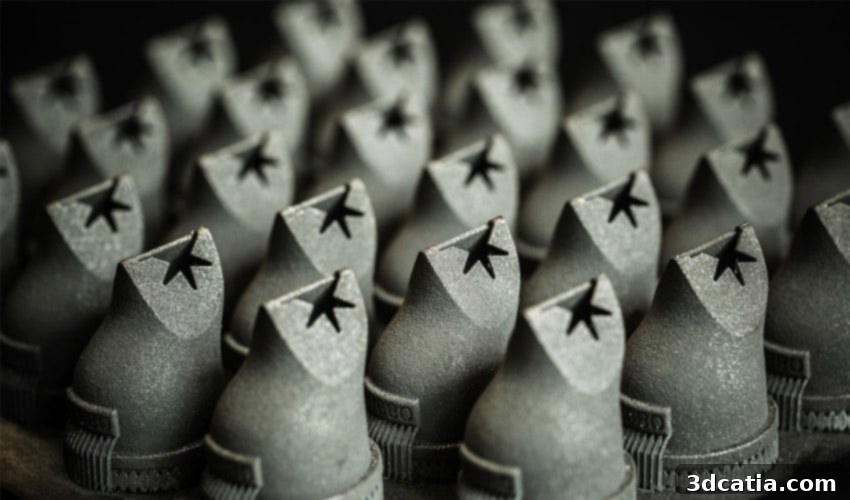
Revolutionizing Food Processing: How Bühler Meincke Leverages Metal 3D Printing for Superior Hygiene and Design Freedom
The global food industry is constantly seeking innovative solutions to enhance efficiency, safety, and product quality. At the forefront of this transformation is the strategic adoption of advanced manufacturing technologies, particularly metal 3D printing. A prime example of this pioneering spirit comes from Bühler Meincke, a result of the strategic collaboration between the Swiss-based Bühler group and the Danish machine manufacturer Haas-Meincke. Bühler, a venerable name in mechanical engineering, specializes in sophisticated machinery for the food processing sector. In 2018, its merger with Haas-Meincke, renowned for producing a vast array of cakes and cookies, solidified a powerful alliance aimed at pushing the boundaries of food production technology. This partnership has since embarked on an exciting journey, integrating metal additive manufacturing to redefine how crucial components for their cookie-making machines are designed and produced, marking a significant leap in industrial innovation for the food sector.
Initially, Bühler Meincke recognized the immense potential of metal 3D printing to address long-standing challenges in component manufacturing. Their machines, responsible for churning out countless baked goods, rely on precisely engineered nozzles to extrude dough into desired shapes. The complexity and specific requirements of these nozzles, especially regarding hygiene and durability, made them an ideal candidate for additive manufacturing. Early on, the company began equipping some of its machines with these metal 3D-printed nozzles. This approach immediately offered unprecedented freedom in design, enabling the creation of intricate geometries and optimizing part flexibility in ways impossible with traditional manufacturing methods. The critical aspect of food safety was paramount; hence, these nozzles are meticulously crafted from food-contact-compatible metals by the Danish Technological Institute, a leading research and technology organization boasting an impressive array of four state-of-the-art metal 3D printers. Today, Bühler Meincke’s commitment to additive manufacturing has deepened, moving beyond just nozzles to encompass the production of a broader range of finished, critical parts for their advanced food processing equipment.
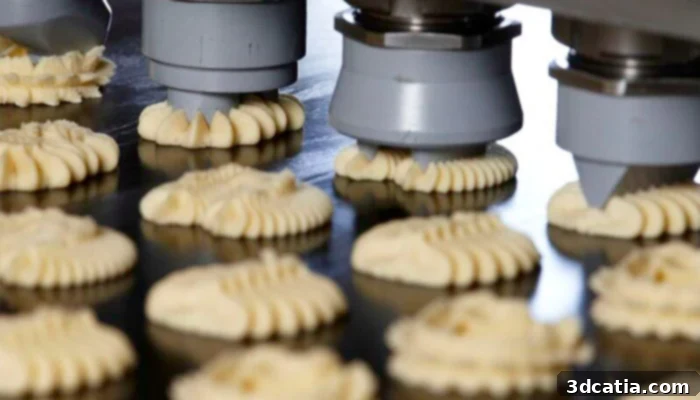
Bühler Meincke engineers machines that produce cookies with enhanced precision (Photo Credit: Bühler Meincke)
The Critical Distinction: 3D Printing for Food vs. Food Machinery
When the average person hears “3D printing in the food sector,” the immediate image that often comes to mind is that of small, desktop FDM (Fused Deposition Modeling) machines extruding dough or chocolate to craft elaborate, original dishes. While this niche of direct food 3D printing exists and holds its own fascinations, it’s frequently met with a degree of consumer hesitation when it comes to the idea of directly consuming 3D-printed foodstuffs. This article aims to pivot away from that common perception and instead shine a light on a different, yet equally revolutionary, application of additive manufacturing within the food industry: the “behind-the-scenes” innovation in food processing machinery. Bühler Meincke’s work exemplifies this crucial distinction, demonstrating how industrial 3D printing, specifically metal additive manufacturing, is transforming the efficiency, hygiene, and design capabilities of the machines that produce our everyday treats, rather than directly printing the food itself. This industrial application offers profound advantages, particularly in areas where traditional manufacturing methods face significant limitations.
The Strategic Choice of Metal Additive Manufacturing
The journey toward metal additive manufacturing for Bühler Meincke was driven by a fundamental challenge in producing cookie machine nozzles. These specialized components are responsible for extruding dough in various shapes, much like the nozzle of an FDM 3D printer extrudes plastic filament. Historically, manufacturing these nozzles involved a multi-part assembly process, often requiring welding steps. This traditional approach presented several significant drawbacks. Firstly, the complex and intricate shapes required for diverse cookie designs were incredibly difficult, if not impossible, to achieve through conventional methods like milling alone. Milling would often necessitate breaking down the design into simpler sub-components, which then had to be joined together. This brings us to the second, and arguably most critical, limitation: the welding phase. Welding creates seams and joints, which, in a food processing environment, pose a severe hygienic risk. These crevices can become breeding grounds for bacteria and other microorganisms, making thorough cleaning and sanitization exceptionally difficult and potentially compromising food safety standards. Such a limitation is simply unacceptable in the stringent world of food manufacturing, pushing Bühler Meincke to seek a more advanced and integrated solution.
In 2017, the group initially explored plastic 3D printing, quickly realizing its potential to circumvent many of the design and manufacturing constraints they had previously faced. However, for the durable, food-contact-compliant components needed in heavy-duty food machinery, plastic had its limitations. Bühler Meincke rapidly transitioned towards metal additive manufacturing, recognizing its superior capabilities regarding material properties, repeatability, production speed, and, crucially, the ability to achieve extreme design complexity. Metal AM offered a pathway to creating monolithic, joint-free components that could withstand the rigorous demands of industrial food production while adhering to the strictest hygiene standards. Today, the nozzles for their advanced cookie machines are predominantly 3D printed using high-performance metals such as Titanium Ti6Al4V (often referred to simply as Ti6A) and Stainless Steel 316L. These specific materials were chosen not only for their mechanical strength and durability but, most importantly, for their proven compatibility with food contact, resistance to corrosion, and ease of cleaning—all essential attributes in the food processing industry. This commitment to hygienic design was a non-negotiable necessity for the Danish group.
Kennie Larsen, the Head of Biscuit Feeding and Forming at Bühler Meincke, succinctly articulates the profound impact of this technological shift: “Thanks to the design freedom offered by 3D printing, we were able to solve some of the problems with organic and hygienic design, as we can now get rid of the joints and angles of traditional manufacturing. The actual production of nozzles was previously a complex matter; this is no longer the case with 3D printing.” This statement underscores a critical advantage: additive manufacturing enables the creation of smooth, integrated surfaces, eliminating the micro-crevices and impossible-to-clean areas that are inherent with welded or multi-part assemblies. This directly translates to enhanced food safety, reduced risk of contamination, and significantly simplified cleaning protocols, offering a substantial competitive edge in an industry where hygiene is paramount. Moreover, the ability to produce highly complex shapes in a single piece greatly streamlines the manufacturing process, cutting down on assembly time, material waste, and labor costs associated with traditional fabrication methods. The adoption of metal AM is not merely an incremental improvement but a fundamental paradigm shift in how food processing equipment is conceived and built.
Bühler Meincke’s Future Projects: Expanding the Additive Manufacturing Horizon
Bühler Meincke’s innovative application of metal additive manufacturing did not stop at cookie machine nozzles; the company quickly realized the broader potential of this technology to optimize other critical components within their production lines. One such success story involves the optimization of the die roll, another essential part in cookie manufacturing. Kennie Larsen further elaborates on this development: “This roller used to be a tube to weld buckets to cut the dough. When we weld, we have a lot of heat that is released and therefore parts that are deformed. By going through additive manufacturing, we are able to overcome these problems.” This highlights another crucial benefit of metal 3D printing: the ability to produce complex geometries without the thermal stresses and distortions associated with welding. Traditional welding processes introduce localized heat, which can lead to material deformation, internal stresses, and ultimately, a reduction in the dimensional accuracy and overall integrity of the part. By printing the die roll as a single, integrated component, Bühler Meincke can achieve superior precision, enhanced durability, and improved consistency in the dough-cutting process, directly contributing to higher quality and more uniform final products.
The adoption of metal additive manufacturing unequivocally allows Bühler Meincke to significantly reduce production times while simultaneously enjoying unparalleled design freedom. This dual advantage empowers the company to accelerate its innovation cycle dramatically. Engineers can now quickly design and test a prototype, rapidly validate its performance, and then seamlessly move to printing the exact same optimized part for final production. This agility in manufacturing enables faster market response, quicker implementation of new cookie designs, and continuous improvement of their machinery. The ability to iterate quickly and produce complex parts on demand also has profound implications for spare parts management and reducing downtime in production. While the benefits are clear, Bühler Meincke acknowledges that the technology, like any other, has its current limitations, particularly in terms of production volume and batch size. The company expresses a desire to scale up its additive manufacturing capabilities to design and produce larger batches of components, indicating a strong future focus on overcoming these current constraints to fully exploit the technology’s potential. Further detailed information on Bühler Meincke’s journey with metal 3D printing can be found on the Danish Technological Institute’s website HERE.
The innovative use of metal additive manufacturing in the food sector by companies like Bühler Meincke is reshaping the landscape of industrial food processing. It moves beyond mere efficiency gains, fundamentally enhancing product hygiene, expanding design possibilities for complex machinery components, and accelerating the pace of innovation within the industry. This strategic embrace of advanced manufacturing technologies is not just about making parts; it’s about making better, safer, and more adaptable food production systems. What are your thoughts on the transformative role of metal additive manufacturing in the food processing industry? Do you see other areas where this technology could make a significant impact? We encourage you to share your insights in a comment below or join the conversation on our Linkedin, Facebook, and Twitter pages! Don’t forget to sign up for our free weekly Newsletter here to receive the latest 3D printing news directly to your inbox. You can also explore all our videos and interviews on our dedicated YouTube channel.
Cover Photo Credit: Danish Technological Institute