
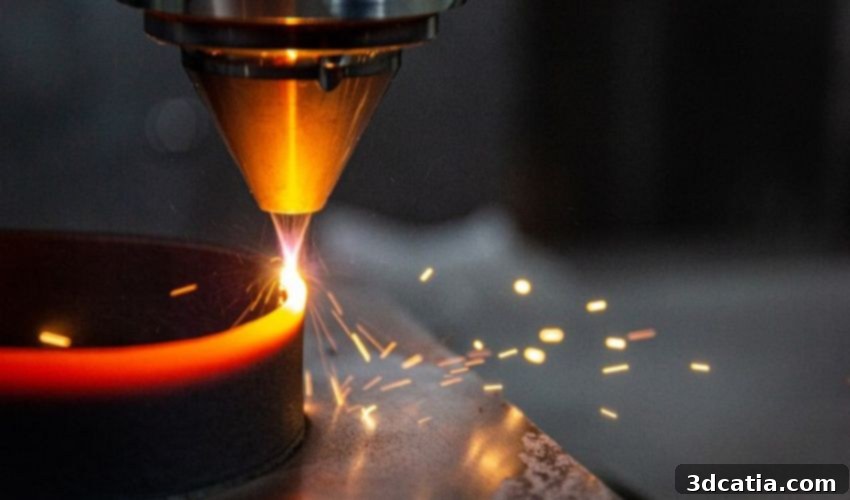
Makino & Fraunhofer ILT Unveil EHLA3D: Revolutionizing High-Speed Laser Cladding for Advanced Manufacturing and Component Repair
In a monumental leap forward for industrial manufacturing, a pioneering collaboration between two global leaders, the renowned machine tool manufacturer Makino and the esteemed Fraunhofer Institute for Laser Technology ILT, has culminated in the development of EHLA3D. This groundbreaking process represents a significant paradigm shift in additive manufacturing and advanced material processing. EHLA3D is the synergistic result of integrating ultra-high-speed laser cladding technology with state-of-the-art five-axis Computer Numerical Control (CNC) machinery. This powerful combination is poised to fundamentally transform the way complex geometries are produced, coated, and repaired, particularly when utilizing high-strength and challenging-to-process materials across a diverse spectrum of industries.
The introduction of EHLA3D brings forth a myriad of tangible benefits that address critical industry challenges. Firstly, it substantially reduces traditional production times, offering manufacturers an unprecedented acceleration in their fabrication processes. Secondly, it significantly extends the operational lifespan of components through superior material deposition and wear-resistant coatings, leading to greater reliability and reduced maintenance cycles. Beyond these immediate operational advantages, EHLA3D also strongly advocates for and promotes sustainable practices within the emerging framework of the circular economy. By enabling efficient repair and extending the life of valuable parts, it actively contributes to minimizing waste, maximizing resource utilization, and fostering a more environmentally responsible industrial ecosystem.
Laser technology has long been acknowledged as a pivotal cornerstone of the modern manufacturing sector, its importance growing exponentially, especially within the rapidly evolving domain of additive manufacturing. Recognizing the immense potential of advanced laser applications, the Fraunhofer ILT, a globally recognized powerhouse in laser technology research and development, embarked on a strategic partnership with Makino, a celebrated Japanese machine tool manufacturer with a reputation for precision and innovation. Their shared vision was ambitious: to adapt and integrate the extremely high-speed laser cladding (EHLA) process for seamless operation on a five-axis CNC platform. This intricate endeavor necessitated the meticulous development of entirely new kinematics – the sophisticated motion control systems – that would facilitate exceptionally rapid and dynamic movements of the machining head. Such advanced kinematics are crucial for enabling the flexible and precise processing of an extensive range of geometrical shapes and an array of diverse materials, unlocking unprecedented capabilities in manufacturing.
Traditional Laser Metal Deposition (LMD) processes, while effective, often face limitations in terms of speed, heat input, and material compatibility. EHLA, or Extreme High-speed Laser Deposition, stands apart by utilizing a highly focused laser beam and finely dispersed powder particles that melt and fuse onto a substrate at incredibly high speeds. This unique approach minimizes heat-affected zones, reduces distortion, and allows for rapid material deposition rates. The integration of EHLA with Makino’s sophisticated five-axis CNC machinery elevates this technology to new heights. A five-axis system provides unparalleled freedom of movement, allowing the machining head to approach a workpiece from virtually any angle. This eliminates the need for multiple setups, reduces overall processing time, and enables the creation of highly complex internal and external geometries that would be impossible with conventional three-axis systems. The synergy between high-speed laser cladding and multi-axis control is truly what defines the revolutionary nature of EHLA3D, pushing the boundaries of what is achievable in metal additive manufacturing.
While initially conceptualized and focused primarily on advanced additive manufacturing applications, the scope of the EHLA3D project swiftly expanded to embrace critical repair applications, recognizing the profound economic and environmental implications. Min-Uh Ko, who serves as the esteemed Group Leader for Additive Manufacturing and Repair LMD at Fraunhofer ILT, highlighted the immense potential of this expanded focus. “Repairs are extremely exciting,” Ko stated emphatically. “Many expensive components must be prematurely replaced even when they suffer from relatively minor defects. A flexible and sophisticated system like the one developed by Makino, distinguished by its highly versatile rotary and tilting table, offers exceptional and efficient repair options.” This approach yields significant multifaceted advantages: it drastically reduces the substantial costs typically associated with the production of new components, effectively eliminates the delays often encountered in transportation and delivery logistics, and critically minimizes costly downtimes for industrial operations. Moreover, Ko underscored a profound philosophical and practical point: “repair is a fundamental and indispensable aspect of the future circular economy,” positioning EHLA3D as a key enabler of sustainable industrial practices by extending the lifespan of valuable assets and reducing waste.
Makino’s pivotal role in this transformative project extended far beyond merely supplying cutting-edge CNC hardware. The company undertook a comprehensive and meticulous redesign of the entire process control system, a task that demanded exceptional engineering prowess. The central challenge was to precisely tailor the machine’s capabilities for achieving substantially higher accelerations while simultaneously enhancing both the intricate process control mechanisms and the overall machine kinematics. This was crucial to ensure a supremely precise and consistent interaction between the deposited material – typically in powder form – and the high-intensity laser beam, a fundamental requirement for achieving the high quality and efficiency that defines EHLA3D. This level of integration and control allows for unprecedented material utilization, microstructural integrity in the deposited layers, and the ability to process a wider array of materials with optimal results, thereby maximizing the potential of high-speed laser cladding.
Unprecedented Feed Speed and Superior Output Quality
The culmination of Makino’s relentless innovation, primarily spearheaded by their highly skilled subsidiary in Singapore, is a revolutionary machine tool that achieves an astonishing effective feed speed of up to 30 meters per minute. This represents an extraordinary improvement – often several multiples – over more traditional LMD or even advanced welding systems, setting a new benchmark for speed in material deposition. This dramatic increase in speed is not merely a quantitative enhancement; it translates into profound qualitative and economic benefits, particularly for machining large, intricately complex components. By drastically reducing production times, EHLA3D significantly improves overall manufacturing throughput and efficiency. Crucially, this accelerated production does not come at the expense of quality. The system consistently maintains exceptionally high product quality, a factor that is absolutely paramount and especially critical for high-stakes sectors such as the precision toolmaking industry and the stringent aerospace sectors, where component integrity, performance, and reliability are non-negotiable.
Dr. Johannes Finger, who serves as Makino’s dedicated project manager for this initiative, articulated the strategic significance of this advancement. “Our entry into additive manufacturing, particularly high-speed LMD, is not just an expansion but a strategic evolution of our portfolio,” Dr. Finger explained. He elaborated on the unique capabilities now at their disposal: “The new five-axis CNC machine empowers us to produce incredibly complex geometrical shapes with unparalleled speed and precision, even when utilizing materials that are notoriously difficult to weld, such as advanced high-strength steels or extremely hard carbide alloys. This capability is truly unique in the market, opening up new horizons for material engineering and design freedom.” This ability to process challenging materials efficiently and accurately broadens the scope of applications significantly, allowing engineers to leverage materials known for their superior performance characteristics that were previously impractical for additive processes, thereby unlocking new design possibilities and product innovations.
Beyond new component fabrication, a significant focus of the project was directed towards the vital areas of repairing and maintaining high-quality tools and indispensable machine parts. The finely adapted EHLA3D technology provides a robust solution for efficient repairs, offering a pathway to extend the life of capital-intensive assets. Furthermore, it excels in applying highly durable, wear-resistant coatings, which are indispensable for components operating in abrasive and harsh environments. This is particularly beneficial for sectors like mining and heavy industry, where machinery components are subjected to extreme wear and tear, leading to premature failure. By applying protective coatings or repairing damaged areas, EHLA3D significantly reduces the frequency of replacement, leading to substantial cost savings and reduced environmental impact. Makino’s remarkably swift and successful implementation of these groundbreaking results into their AML 500 processing machine serves as a powerful testament to the technology’s immediate practical applicability and its ability to deliver substantial advantages in terms of cost reduction, enhanced efficiency, and superior overall performance.
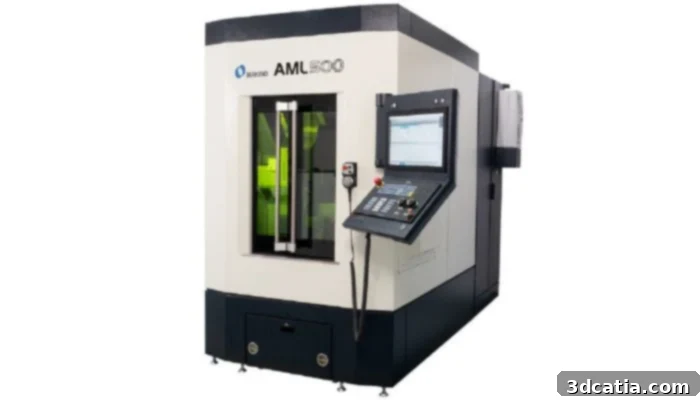
Makino’s latest innovation, the AML 500 processing machine, seamlessly incorporates the advanced outcomes of this collaborative project. It boasts an impressive effective feed rate reaching an unparalleled 30 meters per minute, redefining efficiency in laser deposition.
The future trajectory for EHLA3D is exceptionally promising, with ongoing developments poised to explore an array of new and transformative applications. Particular areas of focus include the exciting frontiers of multi-material systems and precision fine-structure printing. The inherent flexibility of the EHLA3D process in handling and integrating diverse materials opens up innovative possibilities that were previously deemed unattainable with more traditional Laser Metal Deposition (LMD) processes. This includes the potential to create functionally graded materials, where properties transition smoothly across a component, or to deposit multiple distinct materials within a single part to achieve optimized performance characteristics for different sections. Furthermore, the capacity for fine-structure printing will enable the creation of components with intricate details and higher resolutions, expanding its utility in micro-fabrication, medical implants, and advanced engineering. These advancements collectively promise to broaden EHLA3D’s industrial applications significantly, making it an even more versatile and indispensable tool in the advanced manufacturing landscape and contributing to the ongoing digital transformation of industries worldwide. To delve deeper into the specifics of this remarkable achievement and its technical underpinnings, interested parties are encouraged to click here for further information directly from Fraunhofer ILT.
What are your thoughts on the groundbreaking EHLA3D achievement and its potential impact on industrial manufacturing? We encourage you to share your insights and opinions in a comment below. You can also join the conversation and connect with us on our official LinkedIn, Facebook, and Twitter pages to stay updated on the latest developments in additive manufacturing. Don’t miss out on crucial industry news; remember to sign up for our completely free weekly newsletter here to receive the most current 3D printing news delivered straight to your inbox! Additionally, you can explore all our engaging videos and exclusive content on our dedicated YouTube channel.
*All Photo Credits: Fraunhofer Institute for Laser Technology ILT