
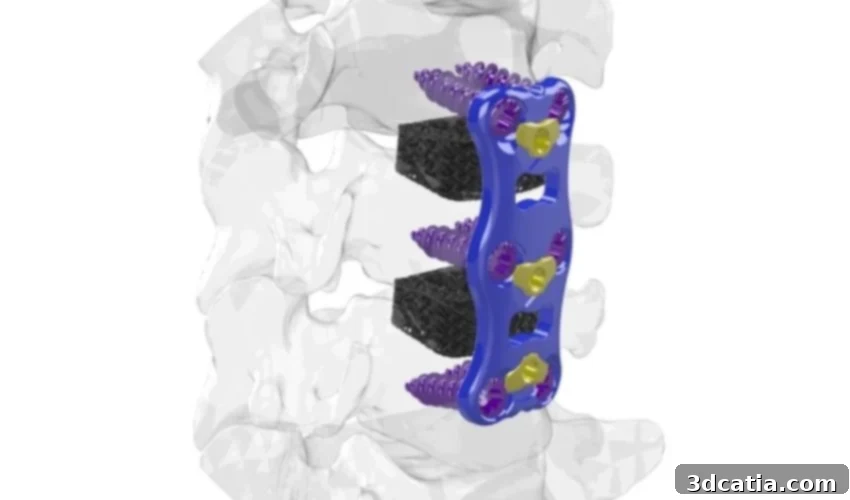
3D Printing Transforms Spinal Care: FloSpine’s Ti-Largo Cervical Cage Breakthrough
The landscape of modern medicine is continually being reshaped by technological advancements, and few innovations have had as profound an impact as additive manufacturing, commonly known as 3D printing. In the medical industry, the integration of 3D printing has revolutionized the design and production of prostheses and custom implants, significantly enhancing or fully replacing damaged or diseased parts of patients’ bodies. These bespoke 3D solutions are often instrumental in dramatically improving the comfort, mobility, and overall quality of life for patients, helping them achieve their primary goal: a return to normal, active living. While notable progress has already been achieved in crafting implants for complex areas such as the skull, hips, and knees, a recent development marks an exciting breakthrough in spinal surgery. Researchers from the Research Park at Florida Atlantic University, in collaboration with medical implant company FloSpine LLC, have announced the first successful implantations of a groundbreaking 3D printed cervical cage, signaling a new era for spinal interventions.
This innovative implant, precisely named the Ti-Largo 3D Printed Cervical Cage, represents a significant leap forward in addressing spinal degeneration and injury. Its fundamental purpose is to maintain and expand the space between two vertebral levels in the cervical spine, which are the bones that make up the neck. By preserving this crucial space, the cage creates an optimal environment for natural bone growth to occur through and around the implant, ultimately leading to a stable fusion of the adjacent vertebrae. This process, known as spinal fusion, is a standard surgical procedure used to treat a variety of spinal conditions, including degenerative disc disease, herniated discs, spinal stenosis, and instability caused by trauma or other pathologies. Traditional spinal cages are commonly employed to repair damaged spinal disks or vertebrae, restore proper bone alignment, improve posture, and increase the overall structural support of the spine. However, the advent of 3D printing introduces unprecedented capabilities in terms of design flexibility and material optimization, allowing for the creation of cages with advanced geometries and tailored properties. These implants can be fabricated from a range of high-performance materials such as PEEK (polyether ether ketone), ceramic, or robust titanium alloy. The Ti-Largo 3D Printed Cervical Cage specifically leverages the superior properties of titanium alloy, a material renowned for its biocompatibility and strength, making it an ideal choice for long-term implantation within the human body.
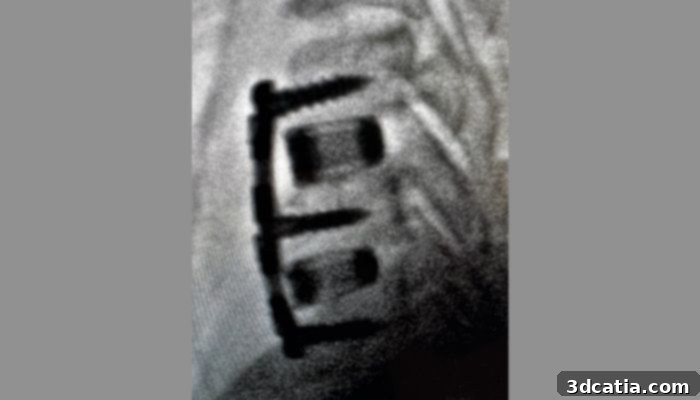
The Ti-Largo 3D Printed Cervical Cage seen after implantation (Photo credits: Research Park at FAU / FloSpine)
FloSpine’s Custom Spinal Solution: Precision Engineering for Optimal Outcomes
The innovative design philosophy behind the Ti-Largo 3D Printed Cervical Cage extends beyond its standalone functionality. It is engineered to integrate seamlessly with another sophisticated FloSpine device, the Panama Anterior Cervical Plate. Together, these two components form a comprehensive and cohesive treatment system specifically designed for the cervical spine, which encompasses the critical first seven vertebrae located directly beneath the skull. The primary focus of the Ti-Largo design paradigm is deeply rooted in addressing the unique and distinct anatomical needs of each individual patient. This patient-centric approach is made uniquely possible through the application of 3D printing technology. Unlike mass-produced implants with fixed dimensions, each Ti-Largo cage can be meticulously custom-fitted and uniquely shaped to precisely match the patient’s specific spinal anatomy and pathology. This level of customization ensures optimal fit, stability, and biomechanical compatibility, significantly enhancing the potential for successful fusion and long-term positive outcomes.
Furthermore, the dedicated team of engineers and medical professionals behind the Ti-Largo implant placed immense emphasis on achieving optimal biocompatibility. Biocompatibility refers to the ability of a material or device to exist in harmony with living tissue, eliciting the least possible adverse reaction from the surrounding biological environment. For an implant intended for permanent residence within the spine, minimizing tissue resistance and inflammatory responses is paramount for patient safety and comfort. In addition to ensuring excellent tissue integration, a core design objective was to maximize the promotion of bone growth directly within the cage area. The 3D printing process allows for the creation of highly porous, lattice-like structures within the titanium alloy. These intricate micro-architectures mimic the natural spongy texture of bone, providing an ideal scaffold for osteointegration – the direct structural and functional connection between living bone and the surface of a load-bearing artificial implant. This unique structural characteristic significantly encourages and facilitates new bone cells to grow into and through the implant, accelerating the fusion process and solidifying the stability of the spinal segment.
The installation of any cervical cage necessitates a surgical procedure, which can often present its own set of challenges and patient concerns regarding recovery and potential risks. Recognizing this, the visionary designers of the Ti-Largo have meticulously crafted the implant to be conducive to minimally invasive surgery (MIS) techniques. Minimally invasive spinal surgery involves smaller incisions, which translate to reduced muscle disruption, less blood loss, and significantly decreased post-operative pain for the patient. These benefits collectively contribute to a notable reduction in the risks commonly associated with traditional open spinal surgeries and, crucially, lead to a much faster and smoother post-surgery recovery time. Patients can often return to their normal activities sooner, experiencing less discomfort throughout their healing journey. The rigorous development and testing of the Ti-Largo device have culminated in its clearance by the Food and Drug Administration (FDA), a critical milestone that attests to its safety and efficacy for clinical use. This stringent regulatory approval has paved the way for the successful surgeries that have already been carried out over the past few months at the Research Park at Florida Atlantic University, with a profoundly positive outlook for continued and expanded patient treatments in the near future, bringing hope to countless individuals suffering from debilitating cervical spine conditions.
The initial successes following the implantation of the Ti-Largo cervical cage have garnered enthusiastic praise from leading medical experts. Dr. John Afshar from the Palm Beach Neuroscience Institute, a prominent figure in spinal surgery, remarked on the transformative potential of this innovation: “The Ti-Largo cervical cage represents a major leap forward in cervical spine surgery. Its patient-specific design and 3D printing technology have the potential to revolutionize the way we approach these procedures, offering greater precision and improved outcomes for our patients.” Dr. Afshar’s statement underscores the significant paradigm shift that technologies like 3D printing are bringing to specialized surgical fields. The ability to create implants that are perfectly tailored to an individual’s anatomy not only enhances the immediate success of the surgery but also contributes to long-term patient well-being, reducing the likelihood of complications and the need for revision surgeries. This precision engineering, combined with the inherent benefits of titanium and thoughtful surgical considerations, positions the Ti-Largo as a benchmark for future medical implant design. For those interested in delving deeper into the specifics of the Ti-Largo 3D Printed Cervical Cage and its groundbreaking capabilities, a comprehensive report is available for review HERE.
The introduction of FloSpine’s Ti-Largo 3D Printed Cervical Cage marks a pivotal moment in medical device innovation, demonstrating the incredible potential of additive manufacturing to transform patient care. This breakthrough not only promises better surgical outcomes and faster recovery times for individuals undergoing cervical spine surgery but also paves the way for further advancements in personalized medicine across various specialties. As 3D printing technology continues to evolve, we can anticipate even more sophisticated and patient-specific solutions that will push the boundaries of what is medically possible, offering renewed hope and improved quality of life for countless patients worldwide. The collaboration between research institutions and innovative companies like FloSpine is crucial in driving these advancements from concept to clinical reality, ultimately shaping a healthier future.
What are your thoughts on FloSpine’s Ti-Largo 3D Printed Cervical Cage and its groundbreaking design? We invite you to share your insights and comments below, or engage with us on our social media platforms. Join the conversation on our LinkedIn, Facebook, and Twitter pages! Don’t miss out on the latest advancements in additive manufacturing—be sure to sign up for our free weekly Newsletter here, delivering the most current 3D printing news straight to your inbox! You can also find all our compelling videos and interviews on our dedicated YouTube channel, where we explore the fascinating world of 3D printing in depth.
*Cover Photo Credits: Research Park at FAU / FloSpine