
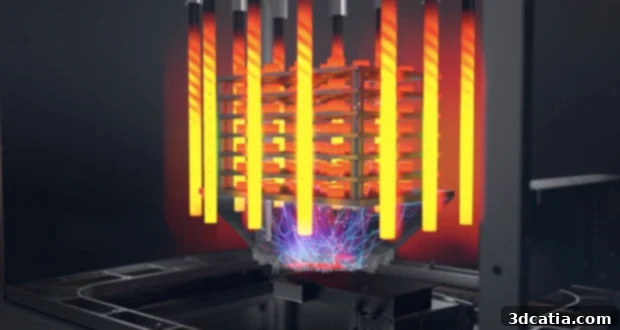
Driving Innovation: 3D Printing’s Transformative Shift Towards Industrial Mass Production
3D printing, or additive manufacturing, has evolved dramatically from its early stages, transcending its initial role as a niche prototyping tool to become a pivotal technology for industries worldwide. Major corporations and forward-thinking companies are increasingly recognizing its immense potential, strategically investing in its development, integrating it into their core production processes, and financing promising new ventures. This paradigm shift signals a broader acceptance and demonstrates the true power and vast capabilities of additive manufacturing to reshape global industries.
In this edition of ECO 3D, we delve into the most impactful business and financial news from across the dynamic 3D printing sector. Our focus today is on the significant trend of moving beyond rapid prototyping to embrace additive mass production, showcasing pioneering companies and groundbreaking projects that are turning this vision into a tangible reality. Join us as we explore the latest investment announcements, crucial financial reports, strategic company acquisitions, and ambitious expansion strategies from key players driving this industrial revolution.
From Rapid Prototyping to Industrial Manufacturing: The Dawn of Mass Additive Production
The journey from merely creating prototypes to enabling full-scale industrial manufacturing is a testament to 3D printing’s maturity. This transition is marked by innovative collaborations and technological breakthroughs designed to overcome previous limitations in speed, cost, and material versatility.
NextGenAM: Automating Metal Additive Manufacturing
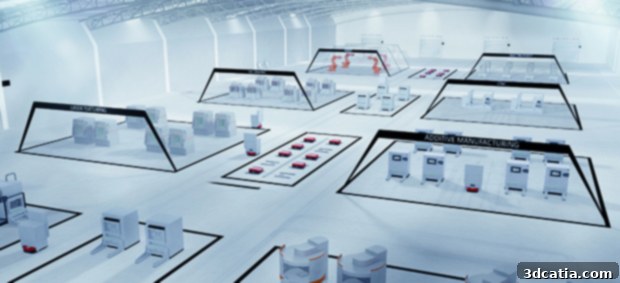
A prime example of this industrial shift is NextGenAM, a pioneering facility born from a powerful collaboration between EOS, a global leader in selective laser melting (SLM) systems, and industrial giants Daimler and Premium AEROTEC. This state-of-the-art facility is dedicated to the mass production of metal parts, with a particular emphasis on the comprehensive automation of both upstream and downstream processes. These often-overlooked stages, from powder preparation to post-processing, traditionally account for a staggering 70% of total production costs in additive manufacturing. By pooling their collective expertise and investing several million euros, these partners have successfully brought a highly automated, cost-efficient metal additive manufacturing facility to life. This initiative highlights the critical importance of integrating automation to unlock the true potential of additive manufacturing for serial production, making it economically viable for complex, high-performance metal components in demanding sectors like automotive and aerospace.
Desktop Metal: Disrupting Production with Speed and Scale
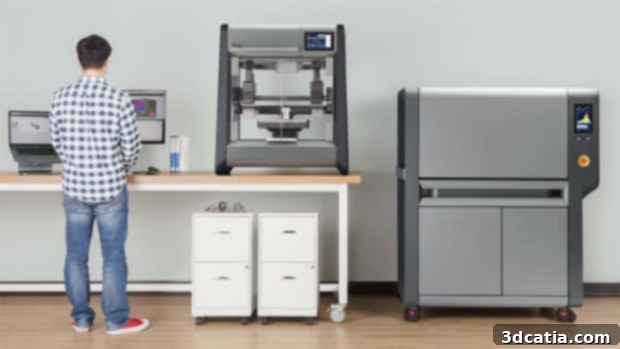
Further accelerating the move towards additive mass production is Desktop Metal, a New York-based startup that made significant waves with the introduction of two revolutionary new machines. Bolstered by an impressive $97 million in investment from industry heavyweights such as BMW, GE, and Google, Desktop Metal has launched both a prototyping desktop system based on metallic FDM printing and an innovative production system utilizing “Single Pass Jetting” technology. The latter, in particular, represents a monumental leap, with Desktop Metal claiming it enables a production process that is up to 100 times faster than conventional methods. These groundbreaking machines, initially slated to hit the market in 2018, promised to redefine the economic landscape of metal 3D printing, making it accessible and efficient for high-volume manufacturing. The substantial investment from leading global companies underscores their confidence in Desktop Metal’s potential to revolutionize how metal parts are designed and produced across various industries.
Catalonia’s Strategic Investment in 3D Printing Excellence
Governments and regional authorities are also playing a crucial role in fostering additive manufacturing. The Catalan government, for instance, has announced a significant investment of €28 million to establish a cutting-edge 3D printing center at the prestigious Polytechnic University in Barcelona. This strategic initiative aims to solidify Catalonia’s position as a hub for advanced manufacturing. Partnering with global technology leaders like HP, Renishaw, and Ricoh, the center will serve as a vital ecosystem for integrating additive manufacturing into local industries. It will provide access to an extensive array of advanced 3D printing machines, fostering innovation and enabling companies to experiment with and adopt new production techniques. Crucially, the center will also offer professional training programs, equipping the workforce with the specialized skills needed to operate and innovate within the additive manufacturing landscape, thereby supporting regional economic growth and technological competitiveness.
GE Additive’s Bold Vision: Expanding Global Additive Production Capabilities
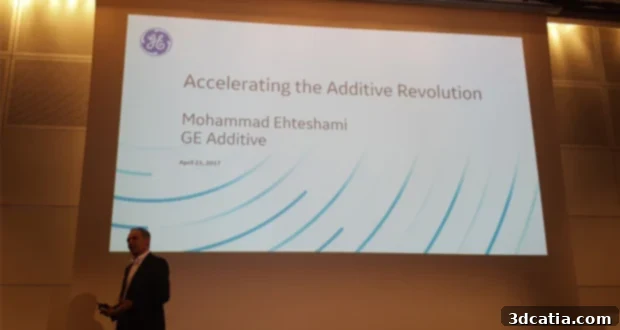
GE Additive, a dominant force in the additive manufacturing space and the primary shareholder of industry stalwarts Concept Laser and Arcam, continues to lead with ambitious expansion plans. Demonstrating its unwavering commitment to scaling additive production, GE Additive has invested a remarkable €100 million into expanding Concept Laser’s facilities in Lichtenfels, Germany. This substantial investment is projected to significantly boost production capacity, drive technological advancements, and create substantial employment opportunities, with the number of employees expected to grow from 200 to 300 by the end of the year. The company anticipates exponential sales growth in the coming years, targeting the sale of 10,000 machines. Furthermore, to democratize access to this transformative technology and foster wider adoption, GE Additive is establishing a state-of-the-art Customer Experience Center near Munich. This center will serve as an interactive hub, enabling more companies to explore additive manufacturing capabilities and receive hands-on training, showcasing how GE itself leverages these technologies for innovation and efficiency.
Key Industry Developments and Innovations Across Sectors
Beyond major investments and facility expansions, the 3D printing landscape is continuously shaped by a diverse range of innovations and strategic moves from various industry players:
- Thyssenkrupp’s Foray into 3D Printing Services: During Hanover Fair 2017, industrial giant Thyssenkrupp unveiled plans for a new 3D printing center. This facility is designed to empower customers to produce their own parts using additive manufacturing, signaling a move by traditional industrial companies into providing advanced manufacturing services. The center was slated to open in September of that year, further broadening the accessibility and application of 3D printing.
- Advancements in 3D Bioprinting: The medical and biotechnology sectors are witnessing rapid progress. The “Center for Engineering Complex Tissues,” a US-based entity, received substantial funding of $6.25 million from the National Institute of Health to intensify its focus on 3D bioprinting. This critical funding will accelerate research and development in creating complex biological structures. Similarly, Biolabor, a collaborative venture founded by the University of Maryland, Wake Forest College, and Rice University, announced its specialization in developing novel technologies specifically for the 3D bioprinting of tissues. These initiatives highlight the growing potential of additive manufacturing to revolutionize personalized medicine, regenerative therapies, and drug discovery by enabling the creation of functional biological constructs.
- Boeing’s HorizonX Venture: Aerospace titan Boeing introduced HorizonX, an initiative dedicated to identifying and investing in promising new technologies and innovations. 3D printing is a core focus area for HorizonX, alongside autonomous vehicles and artificial intelligence. This strategic move by Boeing underscores the aerospace industry’s profound interest in leveraging additive manufacturing for lightweight, complex parts, improved supply chains, and advanced material development, ensuring future competitive advantage.
- Prodways’ Successful Stock Market Debut: Prodways, the French subsidiary of Group Grogé, successfully entered the stock market, with shares priced at €4.80 each. This initial public offering (IPO) generated substantial capital, with 50.7 million euros invested, demonstrating strong investor confidence in the growth potential of additive manufacturing companies and providing Prodways with significant resources for future expansion and R&D.
Significant Investments and Fundraising Fueling Industry Growth
The constant flow of capital into 3D printing companies and projects is a clear indicator of a robust and rapidly expanding market. These investments span acquisitions, venture capital, and government initiatives, each contributing to the industry’s sustained growth and innovation:
- Klöckner & Co Acquires BigRep: The German steelmaker Klöckner & Co made a strategic move by acquiring large-format 3D printer manufacturer BigRep GmbH for less than €10 million. This acquisition by a traditional materials giant signals the convergence of conventional manufacturing with additive technologies, highlighting the increasing demand for industrial-scale 3D printing solutions and the diversification strategies of established firms.
- Onkos Surgical Secures Major Funding: Onkos Surgical, a New York-based startup specializing in personalized implants, special instruments, and anatomical models created using 3D printing, successfully completed a second round of financing. This round, led by 3D Systems, amounted to a significant $17.6 million, further empowering Onkos Surgical to advance its mission of delivering patient-specific medical solutions through additive manufacturing.
- Nectar’s Entry into the 3D Printer Market: Dutch startup Nectar is set to launch its first printer, the Nector One, a delta FDM 3D printer, within a few months. This launch is made possible by over €1 million in financing from investment companies TINN Capital and PPM Oost. The Nector One, expected to be available for €5,999, promises to bring a competitive and innovative offering to the FDM market, reflecting the continuous entry of new players and technologies.
- South Korea’s National Investment in 3D Printing: The Ministry of Science in South Korea has committed a substantial $37 million investment specifically for the development of 3D printing across multiple sectors. This significant government backing aims to enhance the international competitiveness of Korean companies by integrating advanced additive manufacturing technologies into their operations and fostering national leadership in this critical industrial domain.
In summary, the previous month alone saw approximately $9.33 million invested in various companies and projects connected to the flourishing 3D printing industry, underlining its dynamic growth trajectory.
Financial Insights and Market Growth: A Thriving Industry
Financial reports and economic analyses provide crucial insights into the health and trajectory of the 3D printing market, consistently demonstrating robust growth and strong prospects:
- ArcamAB’s Strong Performance and Expansion: Swedish company ArcamAB, a pioneer in electron beam melting (EBM) technology, recently released its annual report, revealing a total turnover of €68.6 million. This represents an impressive growth of 12.5% compared to the previous year, underscoring the increasing demand for its metal additive manufacturing solutions. For the remainder of the year, the Arcam Group outlined ambitious plans, including further expanding its metal powder production capabilities and establishing a new operational plant in Canada, reinforcing its global footprint and supply chain.
- Dassault Systèmes Powers Design and Innovation: Dassault Systèmes, the powerhouse behind widely used CAD programs like CATIA and Solidworks, delivered a strong first quarterly report for 2017. The company generated impressive sales of €759.8 million, with sales of its Solidworks software suite showing a notable increase of 12%. As foundational tools for product design and engineering, the strong performance of Dassault Systèmes directly reflects the growing activity in product development across industries, many of which leverage 3D printing in their design and validation phases.
- Wohlers Associates Report Confirms Robust Market Growth: This month, the highly anticipated 22nd Annual Report on the 3D printing industry was published by Wohlers Associates. Widely regarded as one of the most comprehensive and authoritative analyses of the sector, the report revealed that the industry experienced a significant growth rate of 17.4% in 2016. This expansion pushed the total market value to a little over $6 billion, firmly establishing 3D printing as a major force in global manufacturing and an industry with immense potential for continued rapid expansion.
Stay informed on all the latest developments, innovations, and financial news in the world of 3D printing by following us on our Facebook and Twitter pages!
Cover image // Courtesy of Desktop Metal