
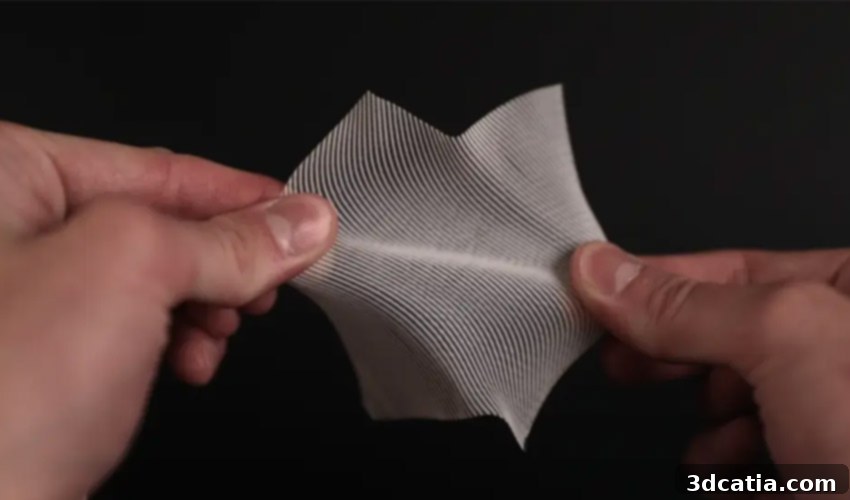
DefeXtiles: MIT’s Breakthrough in 3D Printed Textiles by Mastering Under-Extrusion
At the forefront of innovation, researchers and engineers at the Massachusetts Institute of Technology (MIT) consistently push the boundaries of what’s possible, particularly in the realm of advanced manufacturing and innovative products rooted in 3D technologies. Their latest endeavor introduces a paradigm shift in how we perceive common 3D printing challenges. Recently, Jack Forman, a brilliant graduate student at the institution, unveiled a revolutionary new type of textile. His innovation stems from an unexpected source: deliberately exploiting one of the most common mistakes in 3D printing – under-extrusion. Instead of viewing this phenomenon as a flaw, Forman meticulously controlled it, transforming a typical printing error into a powerful design tool. The result is DefeXtiles, a unique tulle-like material that can be precisely modeled into intricate, complex shapes and geometries. This groundbreaking approach has already led to the creation of various interactive and functional items, including an innovative lampshade, delicate skirts, intricate lace pieces, and even a functional badminton shuttlecock, showcasing the immense versatility of this novel material.
Understanding Under-Extrusion: From Flaw to Feature
To truly appreciate the genius behind DefeXtiles, it’s essential to understand its origin. Under-extrusion is a widely recognized and often frustrating phenomenon in Fused Deposition Modeling (FDM) 3D printing. It occurs when the 3D printer fails to extrude an adequate amount of filament, leading to insufficient material deposition. This deficiency results in the formation of unwanted voids or gaps between the printed layers, preventing them from bonding properly and severely compromising the structural integrity and aesthetic quality of the printed object. For most 3D printing enthusiasts and professionals, under-extrusion is a problem to be diligently avoided, often tackled through meticulous calibration, optimized print settings, and careful material selection. It typically manifests as weak, brittle, and visually imperfect prints that are far from the desired outcome. The battle against under-extrusion is a common rite of passage for many in the 3D printing community, signifying the difference between a successful print and a failed attempt.
However, in the hands of Jack Forman, this pervasive FDM defect ceases to be a problem. Instead, it transforms into a controlled variable, a design parameter meticulously engineered to yield an entirely new form of material. Forman’s innovative methodology doesn’t seek to eliminate under-extrusion but rather to harness and direct its characteristics. By carefully modulating the extrusion process, he has managed to convert what was once a disruptive force into a constructive one. Remarkably, this revolutionary technique doesn’t demand exotic equipment or specialized software. All that was required was a relatively inexpensive, off-the-shelf desktop FDM 3D printer, typically costing around $250, and standard, readily available filament materials. Forman emphasizes the accessibility of his innovation, stating, “Unlike previous work, the fact that no custom software or hardware is needed — just a relatively cheap $250 printer, the most common type of printer used — really makes this technique accessible to millions of people.” This democratic approach democratizes advanced material creation, making it available to a wide audience of makers, designers, and researchers globally.
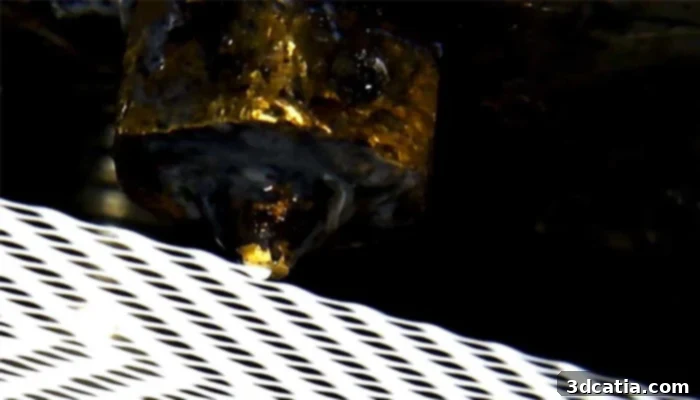
Image credits: MIT Media Lab
DefeXtiles: A Material Like No Other – The “Glob-Stretch” Method
By meticulously mastering various 3D printing parameters, Jack Forman successfully developed a unique under-extrusion process he aptly named “glob-stretch.” This ingenious method underpins the creation of DefeXtiles. The process works by precisely controlling the extrusion of the material. During printing, instead of a continuous, uniform filament line, small “drops” or “globs” of material are intentionally formed at specific points. These individual drops are then subtly linked together by extremely fine threads that maintain delicate contact with the layer below. The true innovation lies in Forman’s ability to align all these minuscule drops into a single, cohesive column, which ultimately produces the distinctive tulle-like effect. The resulting material exhibits a clear warp and weft-like structure, reminiscent of traditional woven textiles, despite being fabricated through an additive manufacturing process. This intricate internal architecture is what grants DefeXtiles its remarkable characteristics.
What truly sets DefeXtiles apart is its exceptional flexibility and stretchiness, properties rarely achieved with conventional 3D printing methods using standard materials. The delicate, interconnected structure allows the material to bend, stretch, and deform significantly without breaking, opening up a plethora of design possibilities. Jack further elaborates on the advantages of his technique: “Not only are these textiles thinner and faster to print than other approaches, but the complexity of demonstrated forms is also improved. With this approach we can print 3D dimensional shell forms with a normal 3D printer and no special slicer software.” This statement underscores several key benefits: efficiency in production due to thinner layers and faster print times, and the ability to create highly complex, three-dimensional shell structures that would typically require specialized software or more advanced, expensive hardware. This simplification of the design and manufacturing process significantly lowers the barrier to entry for innovators and researchers looking to explore the potential of 3D printed textiles.
Versatility and Future Potential: Beyond Basic Structures
The versatility of DefeXtiles extends far beyond its inherent flexibility. Jack Forman highlights that this novel textile can be easily integrated with traditional textile crafting techniques. It can be sewn, allowing for hybrid designs that combine 3D printed components with conventional fabrics. Furthermore, the material can be de-pleated, indicating its ability to hold and release complex folds, and it can be heat-bonded, opening avenues for multi-material integration and robust assembly methods. These features make DefeXtiles not just a curiosity but a practical material for designers and manufacturers. The future potential is even more exciting, as Forman envisions incorporating other base materials to imbue DefeXtiles with enhanced functionalities, such as magnetic or optical properties. Imagine textiles that can interact with magnetic fields or subtly change their appearance based on light, paving the way for smart fabrics in various applications.
Perhaps one of the most compelling future directions is the potential for sustainable production. Jack is actively exploring the creation of biodegradable textiles using organic waste materials like algae, coffee grounds, or wood. This forward-thinking approach aligns with the global push for eco-friendly manufacturing and could significantly reduce the environmental footprint of textile production. In terms of immediate applications, Forman has already produced several captivating prototypes. Among these is an innovative lampshade, which showcases the material’s structural and aesthetic qualities. More impressively, this lampshade incorporates a conductive filament, allowing the lamp to be illuminated directly by touching its folds – a prime example of DefeXtiles’ capability to create interactive and smart objects. This demonstration clearly illustrates how 3D printing can move beyond static forms to dynamic, responsive interfaces.

In the deformation-sensing lamp, the solid supports, textile lampshade, and sensing conductive pads were created as a single print. (Image credits: Jack Forman)
The Vision of “Radical Atoms”: Programmable Matter for the Future
The research project leading to DefeXtiles was supervised by Professor Hiroshi Ishii, a visionary leader at MIT’s Media Lab. Professor Ishii concludes with a profound statement that frames DefeXtiles within a larger, transformative philosophy: “We envision that the materials of the future will be dynamic and computational. We call it ‘Radical Atoms.’ DefeXtiles is an excellent example of Radical Atoms, a programmable matter that emulates the properties of existing materials and goes beyond. We can touch, feel, wear, and print them.” This concept of “Radical Atoms” suggests a future where materials are no longer passive but active, capable of changing their properties, forms, and functions in response to external stimuli or programmed instructions. DefeXtiles perfectly embodies this vision, demonstrating how a material can be engineered at a micro-level to exhibit macro-level properties like flexibility, stretchability, and even interactivity, mimicking natural textiles while offering capabilities that go far beyond. It represents a tangible step towards programmable matter, where the material itself holds computational qualities, adapting and responding in ways that were once only conceptual.
This breakthrough from MIT not only provides a fresh perspective on what constitutes a “defect” in 3D printing but also opens up vast new territories for material science, industrial design, and creative expression. By making advanced textile-like structures accessible through common FDM technology, DefeXtiles is poised to inspire a new generation of designers and engineers. Its low production cost and reliance on widely available hardware make it an ideal candidate for rapid prototyping, personalized manufacturing, and educational applications. From fashion and wearable technology to advanced composites and soft robotics, the implications of a truly flexible, customizable, and potentially interactive 3D printed textile are immense. DefeXtiles exemplifies how embracing the unexpected, even a manufacturing flaw, can lead to remarkable innovations that redefine our understanding of materials and their capabilities.
What are your thoughts on DefeXtiles, this new 3D printed quasi-textile that leverages controlled under-extrusion to create flexible, intricate structures? We’re eager to hear your opinions on this groundbreaking development. Share your insights in a comment below or connect with us on our Facebook and Twitter pages! Don’t miss out on the latest advancements in additive manufacturing – sign up for our free weekly Newsletter to get all the news in 3D printing delivered straight to your inbox!