
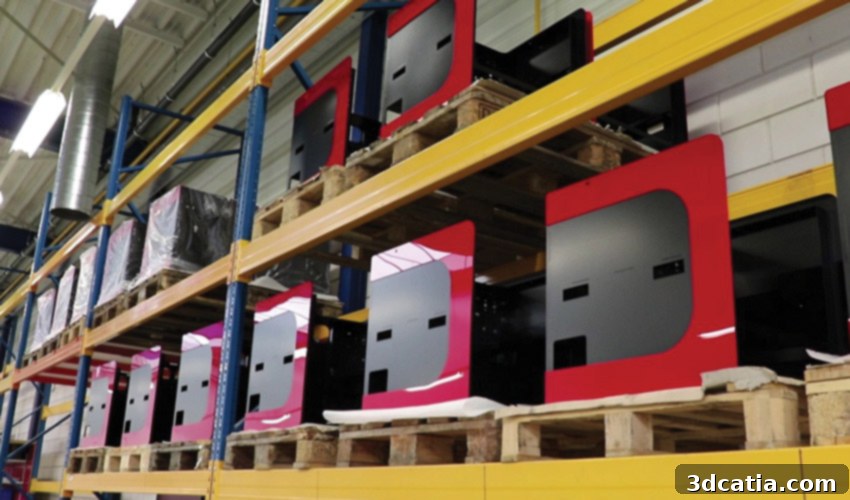
dddrop: Powering Industrial 3D Printing Innovation from the Netherlands
The Netherlands has long been recognized as a formidable powerhouse within the European 3D printing industry. Visionary companies like Ultimaker, 3D Hubs, and ColorFabb have achieved global recognition, showcasing the incredible innovation and entrepreneurial spirit inherent in Dutch manufacturing. Amidst this vibrant “Dutch 3D printing golden era,” one particular company, FDM 3D printer manufacturer dddrop, has steadily risen, often operating just beneath the mainstream radar. Despite its understated presence, dddrop’s professional 3D printers, including the acclaimed Leader TWIN and Leader PRO models, have consistently impressed businesses and garnered significant acclaim across various industrial sectors. This article delves into the transformative impact of dddrop’s technology by exploring real-world applications and speaking directly with the CEO about the company’s unique philosophy and future vision.
Accelerating Industry Parts Rapid Prototyping: The Ejair Engineering Success Story
Ejair Engineering specializes in the critical field of rapid prototyping for industrial machine parts. This niche is perfectly suited for advanced 3D printing technology, as it enables the swift creation of custom, high-precision components scaled accurately for immediate testing and validation. Traditional manufacturing methods often involve lengthy lead times and significant costs for producing prototypes, making 3D printing an indispensable tool for accelerating product development cycles.
Erik-Jan Roosen, an accomplished engineer and the visionary founder of Ejair Engineering, dedicates a substantial portion of his professional life to crafting intricate scale models and functional prototypes. These are meticulously developed from complex technical designs provided by his diverse clientele, often comprising leading industrial machine manufacturers. The demand for these custom-made, on-demand parts necessitates a rapid, reliable, and highly precise production method.
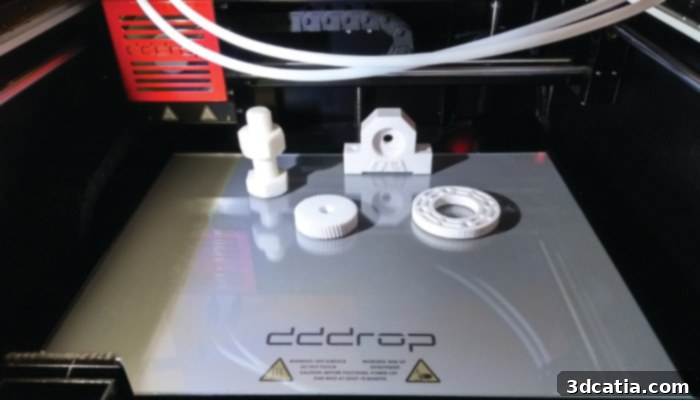
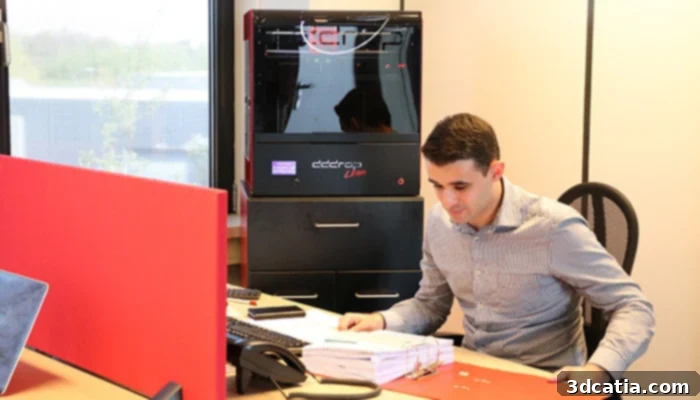
Ejair Engineering leverages dddrop 3D printers to meticulously craft custom machine parts tailored for rigorous industrial applications, demonstrating precision and efficiency.
The Imperative for a Professional-Grade 3D Printer
For the exacting demands of industrial prototyping, a robust and highly capable 3D printer was not merely an advantage but an absolute necessity. While Erik-Jan, an enthusiastic hobbyist, already possessed a self-built Vertex 3D printer, he quickly recognized its limitations for professional-grade output. The need for superior precision, consistent reliability, and the ability to work with advanced engineering materials led him to invest in a dddrop 3D printer. This strategic acquisition allowed him to seamlessly integrate additive manufacturing into his established workflow, combining 3D printing with a meticulous machining post-process to produce components perfectly suited for the most demanding industrial environments.
Given the nature of Ejair Engineering’s projects, Erik-Jan primarily utilizes Polycarbonate (PC) filament for his prints. This material is highly favored for its exceptional mechanical properties, including high strength, impact resistance, and thermal stability, which are crucial for industrial machine parts. Furthermore, Polycarbonate lends itself well to subsequent machining processes such as turning and milling, ensuring a flawless finish. Many consumer-grade 3D printers are restricted to more common materials like PLA, severely limiting their applicability in professional settings. However, the dddrop 3D printer stands out for its remarkable material versatility, capable of reliably printing with Polycarbonate, as well as a comprehensive range of other filaments including PLA, ABS, PET-G, FLEX, HIPS, PVA, and many more. This broad compatibility provides Ejair Engineering with unparalleled flexibility in material selection, optimizing each part for its specific functional requirements.
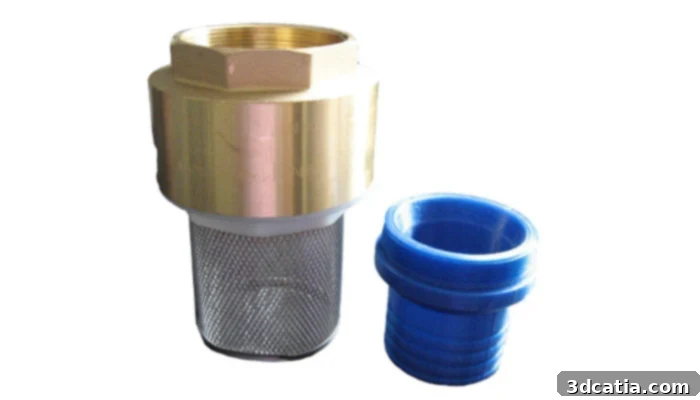
An exemplary industrial part, meticulously crafted from Polycarbonate filament by Erik-Jan Roosen, showcasing the robust capabilities of dddrop printers for demanding applications.
The capabilities of the dddrop printer empower Ejair Engineering to consistently produce functional, end-use products that meet the highest industry standards. A significant advantage is Erik-Jan’s ability to handle the entire production chain internally: from drafting the technical designs to the final 3D printing of the finished parts. This complete in-house control is a tremendous boon for a small company, as it eliminates the need to outsource critical stages of the production process. The integration of Erik-Jan’s dddrop 3D printer has not only streamlined his entire production workflow but has also significantly reduced costs, ensured stringent quality control, and dramatically accelerated overall production times, giving Ejair Engineering a distinct competitive edge.
Driving Innovation with 3D Printing at WB Automation
Another pioneering company benefiting immensely from dddrop’s technology is WB Automation. This innovative firm prides itself on creating bespoke machinery and automated solutions for challenges that currently lack existing answers. Serving both the food and non-food industries, WB Automation designs and builds a vast array of specialized machines, often incorporating advanced robotics and sophisticated Pick & Place systems to optimize various manufacturing processes.
In a notable collaboration with Westerveld & Nederlof, WB Automation was tasked with developing a solution to significantly reduce manual labor time – specifically by a factor of three to four – in a crucial part of their process. The challenge involved automating the precise gluing of stone strips onto walls. Leveraging the versatility and reliability of their dddrop 3D printer, WB Automation successfully engineered a robotic system for this task. However, during the project’s execution, an unexpected hurdle arose: the glue supplier, contrary to initial specifications, could not deliver the adhesive in large barrels, but only in smaller tubes.
Agile Reinvention of the Design Model
This unforeseen change in glue packaging necessitated a complete redesign of the robotic system’s dispensing mechanism. The new design had to efficiently accommodate and empty the smaller glue tubes. To achieve this, WB Automation embarked on a rapid development cycle, focusing on two key elements: creating a secure tunnel to enclose the glue tubes, while simultaneously ensuring they could be easily refilled or replaced from the outside. This iterative design process was greatly facilitated by the dddrop 3D printer. The team printed multiple variations and sizes of the tube housing, allowing for quick physical testing and evaluation of each iteration. This hands-on approach enabled them to pinpoint the perfect fit and the most effective design for seamless integration into the robotic system. Through this agile prototyping, they ultimately produced a precisely engineered component that effectively solved the dispensing challenge, preventing significant project delays and costs.
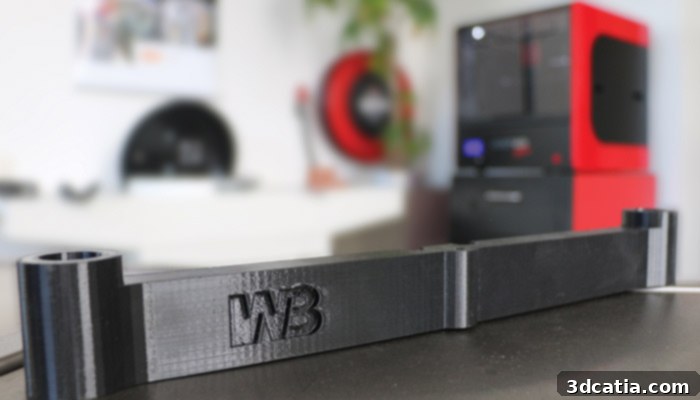
A bespoke industrial component, meticulously fabricated by WB Automation utilizing dddrop 3D printers, demonstrating their capability for custom solutions.
Diverse Applications of the dddrop Printer at WB Automation
WB-Automation’s utilization of dddrop technology extends far beyond simple prototyping. They also integrate dddrop-printed parts directly into their final machines. A compelling example is their development of custom suction cups for handling the stone bricks. Standard suction cups available on the market proved unsuitable, as their dimensions were either too small or too large for the specific bricks being glued. There was a critical void for a size in between, which suppliers simply couldn’t provide. Leveraging the design freedom offered by dddrop 3D printers, WB-Automation engineered and produced precisely dimensioned suction cups that perfectly matched their unique requirements, ensuring optimal adhesion and placement of the bricks.
At WB-Automation, dddrop 3D printers are integral to their entire development pipeline, from initial conceptual prototypes to creating functional parts and meticulously verifying component fit with customer products. The key advantages of the dddrop 3D printer that resonate most with WB-Automation are its dual nozzles and the close proximity of the filament drive to the nozzles. The dual nozzle system allows for complex geometries requiring support structures to be printed with dissolvable materials, or for multi-material components to be created in a single print job. The short distance between the filament drive and the nozzle significantly enhances printing reliability, particularly with challenging or flexible materials like TPU and TPE, which often struggle with longer filament paths. This inherent design advantage enables WB-Automation to confidently print with a wide spectrum of flexible materials, expanding their design possibilities. Furthermore, the dddrop’s fully enclosed print chamber is crucial for printing with temperature-sensitive materials such as ABS, preventing warping and ensuring dimensional accuracy by maintaining a stable internal temperature. The printer is also equipped with an intelligent smart module, allowing for remote power control (on/off) and comprehensive monitoring from any location. This remote capability is further enhanced by an automated email notification system, which alerts the responsible personnel immediately upon print job completion, optimizing workflow and reducing manual oversight.
Insights from the CEO: Alfred Uytdewilligen on dddrop’s Vision
Alfred Uytdewilligen is a prominent figure in the 3D printing and CAD/CAM industries, serving not only as the CEO of dddrop 3D printers but also presiding over CAD2M, a leading SolidWorks distributor. His decision to venture into 3D printer manufacturing was born out of a personal frustration: a glaring gap in the market for professional-grade 3D printers that could effectively address his own production challenges. This firsthand experience fueled his drive to create a solution. We had the opportunity to speak with Alfred about dddrop’s journey, its core philosophy, and his exciting vision for the company’s future and upcoming innovations.
3DN: Why did you embark on the journey of founding dddrop and manufacturing professional 3D printers?
I initiated the development of dddrop 3D printers in 2014. After many successful years distributing another prominent brand, we began a thorough search for a new professional 3D printer that could meet the evolving needs of our clients. To our surprise, we found a significant void in the market: there were either open-source, less professional machines, or prohibitively expensive, closed-material printer brands. Neither option provided the optimal balance of price, performance, and versatility that the industrial market truly required. This critical observation underscored the necessity for dddrop.
Driven by this market gap, we meticulously studied the landscape and conducted extensive surveys among design firms and existing 3D print shops to understand their precise requirements. This exhaustive research guided the initial design and development phases, culminating in the production of the first 35 dddrop prototypes in 2015. The positive reception was immediate. By 2016, we had successfully sold hundreds of machines across the Benelux region, demonstrating strong market validation. Building on this momentum, we strategically expanded our reach to the rest of Europe, Asia, Brazil, Africa, and the USA by the second half of 2017. A point of immense pride for us is that all dddrop 3D printers are meticulously designed, precisely built, and rigorously tested right here in the Netherlands, ensuring unparalleled quality and reliability.
From the initial dddrop prototypes, the Dutch company has achieved remarkable global expansion, successfully distributing hundreds of its innovative 3D printers worldwide.
3DN: What are the overarching goals you aim to achieve with dddrop 3D printers?
At CAD2M, we boast a rich history spanning over 25 years in 3D CAD/CAM software, establishing ourselves as one of the Benelux’s preeminent companies in this field. This deep experience grants us invaluable insight into precisely what our users require for their designs and 3D printing endeavors, and critically, how to best support them throughout their journey.
Our fundamental objective at dddrop is to deliver 100% customer-driven 3D printers. Every innovation and feature we implement is a direct response to user demands and feedback. A prime example is our commitment to open filament systems, which provide users with unparalleled freedom and flexibility, avoiding vendor lock-in. This enables our printers to consistently run for over 10,000 printing hours using demanding, high-tech engineering plastics such as carbon-fiber reinforced materials, Polycarbonate (PC), Polyamide (PA), Polypropylene (PP), and PETG. We aspire to become the undisputed leading professional 3D printer brand within the highly competitive €4,000-€15,000 price range, setting industry benchmarks not only for performance but also for the very best customer support and a comprehensive 100% print warranty. Our printers are equipped with advanced SMART control capabilities, allowing users to remotely check and manage their printers from anywhere in the world. This intelligent system integrates predictive maintenance analytics, cloud-based slicing, and instant live assistance, ensuring seamless operation. No specialized IT skills are required; connecting your dddrop printers is an effortless, automated process. Furthermore, we are dedicated to frequently updating our SMART control platform, continually adding new features and enhancements to improve the user experience and expand functionality.
3DN: Which industries do you believe dddrop 3D printers are best suited for, and what makes them ideal?
The versatility of 3D printing means it serves a vast spectrum of creative and industrial applications – from designers and artists to architects, and crucially, for production and rapid prototyping. At dddrop, we proudly serve all these industries. However, our primary focus is on empowering product developers and toolmakers to achieve their most ambitious goals. Our profound understanding of the market and the specific needs of these professionals allows us to develop and react with tailored solutions. dddrop 3D printers are engineered to produce both high-quality production parts in series and intricate one-off components, consistently delivering on the critical promises of quality, reliability, and repeatability for our customers. Our diverse client base spans a wide array of demanding sectors, including aerospace, automotive, military, shipbuilding, consumer products, and the medical industries, all of whom benefit from our robust and precise additive manufacturing solutions.
3DN: What are dddrop’s strategic goals for the future in the dynamic landscape of 3D printing?
Following the successful launch of the dddrop SMART printing app and platform, our strategic focus will shift towards enabling “production at your customer’s location.” This revolutionary concept means that a user could have a dddrop printer stationed in Japan and seamlessly operate and manage print jobs remotely from, for instance, a tablet, smartphone, or PC located in France. This innovative method of “beaming” digital part files around the world for local production fundamentally transforms traditional supply chains. It virtually eliminates costly shipping expenses, significantly reduces logistical complexities, and drastically cuts down on time delays typically associated with international transport. The dddrop SMART printer app already incorporates many of these advanced features, and we have ambitious plans for further improvements, particularly in refining the remote control capabilities for unmanned printing operations, making global, distributed manufacturing a tangible reality.
What are your thoughts on dddrop products? Have you had the opportunity to test their innovative 3D printers? We invite you to share your experiences and insights in the comments section below, or connect with us on our Facebook and Twitter pages! Don’t forget to subscribe to our free weekly Newsletter to receive all the latest news and developments in the world of 3D printing delivered directly to your inbox!