
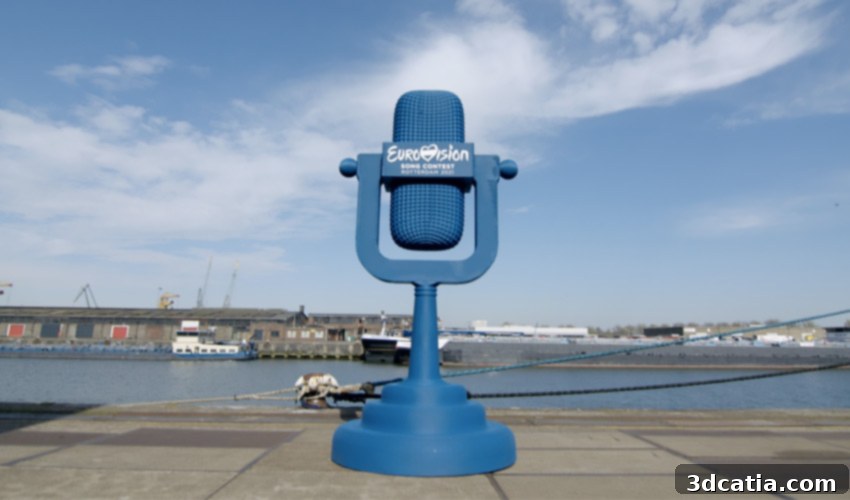
Eurovision’s Sustainable Triumph: Rotterdam’s 3D Printed Trophy Forges a Path to a Circular Economy
The Eurovision Song Contest stands as one of the world’s most enduring and widely watched non-sporting events, annually uniting diverse artists and performers from countries affiliated with the European Broadcasting Union. Beyond its spectacle of music and culture, the contest often provides a unique platform for its host city to showcase its values and innovations. This year, as the Netherlands proudly hosted the event, the vibrant city of Rotterdam seized this global spotlight to unveil an extraordinary symbol of its commitment to environmental stewardship: a monumental 3D printed trophy crafted entirely from recycled PET. This innovative creation, prominently displayed at one of Rotterdam’s key locations, was far more than a decorative piece; it was a powerful statement promoting the principles of a circular economy. The overarching goal was to demonstrate how waste materials can be ingeniously transformed into valuable resources for manufacturing, ultimately contributing to a zero-waste production cycle. In pursuing this ambitious vision, additive manufacturing, commonly known as 3D printing, emerged as the ideal production method due to its inherent efficiency and minimal waste generation.
Rotterdam has long been recognized as a dynamic urban center, but its dedication to sustainability is increasingly defining its global identity. This characteristic, deeply embedded in the city’s ethos, was precisely what officials aimed to highlight for the millions of Eurovision spectators worldwide. As the proud host city, Rotterdam embraced the slogan “Open to the Future,” a motto that encapsulates its proactive journey towards achieving a truly waste-free society. The city’s advancements in this area are remarkable; an impressive 90% of Rotterdam’s current urban infrastructure and materials are now integrated into circular systems. This dedication positions Rotterdam as a beacon of sustainability, aspiring to set an inspiring example for other cities across the globe. This pioneering spirit has historically been propelled by a potent combination of its world-renowned port, continuous innovation in various sectors, and a strong culture of collaboration among its public and private entities. These pillars have collectively fostered an environment ripe for groundbreaking projects like the Eurovision trophy, underscoring Rotterdam’s role as a leader in green urban development.
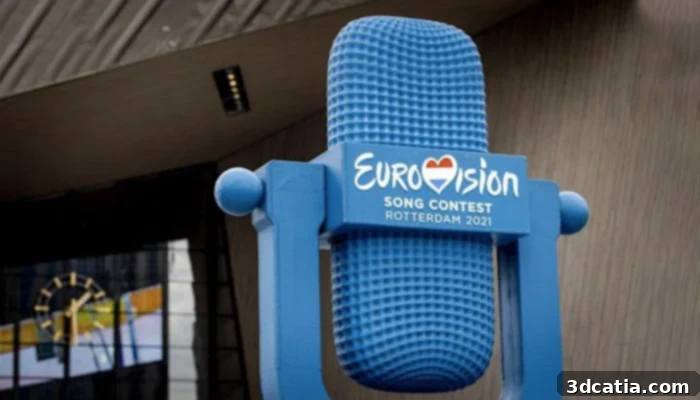
The conceptualization and fabrication of the 3D printed Eurovision trophy involved a multi-faceted approach, commencing with the development of a specialized material based on recycled PET. The journey of this material began with the entrepreneurial spirit of Wesley dos Santos, the visionary founder of iKapitein. His company operates an electric eco-sloop, meticulously designed with an integrated waste collection system, which silently navigates the waterways of Rotterdam. This innovative vessel plays a crucial role in extracting plastic pollution directly from the city’s canals and rivers. Once this invaluable plastic waste is retrieved from the aquatic environment, it undergoes a transformative process. The collected waste is then meticulously processed and converted into high-quality 3D printing material. This crucial step is undertaken by Royal3D, a company renowned for its expertise in leveraging additive manufacturing solutions. With this newly created recycled material, Royal3D possesses the capability to produce a diverse range of new models and products, demonstrating the profound potential of upcycling. The very foundation of the Eurovision trophy is this recycled, sustainable material, a testament to its circular design. Furthermore, a key advantage of this material is its complete reusability, even in scenarios where a print job might fail. This inherent recyclability further reinforces the project’s commitment to minimizing waste and maximizing resource efficiency, ensuring that every effort contributes to a truly sustainable production cycle.
The large-scale development and fabrication of this impressive model were facilitated by the CFAM 3D printer, a sophisticated piece of machinery engineered by CEAD specifically for Royal3D. CFAM stands for Continuous Fiber Additive Manufacturing, a cutting-edge technology that revolutionizes the capabilities of industrial 3D printing. Unlike conventional FDM processes, CFAM integrates a continuous fiber – in this particular application, glass fiber – directly into the printing material during the extrusion process. This continuous addition of reinforcing fibers yields parts with significantly enhanced mechanical properties. The resulting components are substantially stronger, possess greater stiffness, and exhibit superior durability compared to parts produced without fiber reinforcement. This technological advancement was critical for a trophy of such considerable size and public prominence, ensuring its structural integrity and longevity. By employing CFAM technology, the project not only embraced sustainable materials but also utilized advanced manufacturing techniques to produce a high-performance, visually striking object. This combination underscores the potential for industrial 3D printing to create robust and reliable products from recycled content, pushing the boundaries of what is achievable in both sustainability and engineering.
The impact of this sustainable Eurovision trophy extends far beyond the duration of the contest itself. Once the final notes have faded and the celebration concludes, the unique 3D printed trophy will embark on a new mission: it will be placed up for auction. This initiative serves as a powerful fundraising tool, with all proceeds dedicated to supporting RanMarine, a highly innovative Rotterdam-based company. RanMarine is at the forefront of environmental conservation, passionately committed to improving the well-being of the planet’s vital oceans and waterways. Their crucial work involves deploying advanced robotic solutions to detect, track, and eliminate plastic and other waste materials from marine environments, thereby mitigating pollution and protecting aquatic ecosystems. By directing the auction’s funds to RanMarine, the Eurovision trophy project ensures a lasting legacy, transforming a temporary symbol of celebration into a tangible contribution towards global ecological health. This circular approach not only highlights the trophy’s sustainable origins but also its continued role in fostering a greener future. It’s a compelling example of how collaboration between event organizers, innovative companies, and environmental initiatives can create significant positive change, inspiring individuals and industries alike to embrace more responsible practices. For those eager to delve deeper into the specifics of this groundbreaking project and its far-reaching implications, additional information can be found HERE.
The creation of the 3D printed trophy for Eurovision represents a remarkable convergence of entertainment, innovation, and environmental responsibility. It serves as a tangible demonstration of how advanced manufacturing technologies, particularly 3D printing, can be effectively leveraged to champion sustainability and promote circular economy principles on a global stage. This project is a testament to what can be achieved when cities, businesses, and cultural events align their efforts towards a common goal of a greener, more resilient future. We are eager to hear your thoughts on this inspiring initiative and the role of sustainable 3D printing in major international events like Eurovision. What do you think about the potential for such projects to drive widespread environmental awareness and technological adoption? Share your insights and opinions in a comment below, or connect with us on our Facebook, Twitter and LinkedIn pages! Don’t miss out on the latest advancements and news from the world of additive manufacturing; sign up for our free weekly Newsletter here, delivering the freshest 3D printing updates straight to your inbox!