

Beyond the Ordinary: Exploring 12 Surprising Materials Revolutionizing 3D Printing
The landscape of 3D printing materials has undergone a dramatic transformation in recent years, pushing the boundaries of what’s possible with additive manufacturing. No longer confined to conventional plastics and metals, the industry now embraces an astonishing array of substances. Innovators are successfully processing materials like glass, concrete, and ceramics, opening up new horizons for various applications. This expansion isn’t just about novelty; it’s also deeply intertwined with the global shift towards a circular economy. A growing number of material manufacturers are channeling their efforts into recycling waste streams and transforming them into valuable 3D printing filaments and powders. This commitment to sustainability has led to the emergence of recycled ocean waste, industrial by-products, and even wood-based materials as viable options for additive manufacturing. But beyond these practical, eco-conscious innovations, a fascinating trend is taking hold: the exploration of truly unconventional materials that, at first glance, seem utterly surprising in the context of 3D printing. From delicious edible items like chocolate and repurposed food waste to more esoteric substances like cigarette butts and even lunar dust, the possibilities are becoming endless. In this article, we delve into some of the most unusual and innovative materials that are redefining the capabilities and applications of 3D printing.
Chocolate: The Sweetest Innovation in 3D Printing
While perhaps not as extraordinary as some of the other entries on this list, chocolate stands out as one of the most widely adopted and beloved unconventional 3D printing materials. The process for 3D printing with chocolate shares similarities with traditional Fused Deposition Modeling (FDM) technology, where material is extruded layer by layer. However, chocolate’s unique thermal properties necessitate a carefully controlled environment. Unlike plastic, chocolate requires precise temperature management – warm enough to flow smoothly but cool enough to solidify quickly once deposited. This often means a slower printing process to ensure structural integrity and prevent melting or deformation. The growing popularity of this delicious technology has spurred significant interest and investment, leading numerous companies to develop specialized projects and even dedicated chocolate 3D printers. The Cocoa Press, for instance, has garnered considerable attention and a dedicated following among 3D printing enthusiasts for its user-friendly approach to crafting intricate chocolate designs. Beyond custom confectionery, chocolate 3D printing is inspiring diverse research and commercial ventures. Companies like More Than Shape are leveraging this technology to explore new sensory and taste experiences, creating innovative confections that combine art and gastronomy. Simultaneously, researchers are investigating how 3D printing can be used to produce healthier chocolate formulations by precisely controlling ingredient distribution and structure. The versatility and inherent appeal of chocolate make it a truly sweet and exciting material in the additive manufacturing world.
Creating Mementos from Ashes: 3D Printing for Cherished Memories
In a remarkably innovative and deeply personal application of additive manufacturing, the Spanish company Narbón is pioneering new frontiers within the funeral sector. Through their “3DMemories” service, they offer a unique and heartfelt way to remember departed loved ones by transforming their ashes, hair, DNA, or skeletal remains into bespoke ceramic jewelry. This service provides an extraordinary opportunity for individuals to carry a tangible piece of their loved one with them, offering comfort and a lasting tribute. The intricate process begins with the careful preparation and processing of the remains. These delicate materials are then expertly combined with high-quality porcelain, forming a specialized composite ready for 3D printing. Using advanced ceramic 3D printing techniques, the personalized jewelry pieces are meticulously crafted layer by layer, ensuring each design is original and exclusive. After the printing phase, the pieces undergo a meticulous finishing process, including the application of durable enamel and precise firing to fix and harden the ceramic. The result is a stunning, unique piece of jewelry that serves as a profound symbol of remembrance. Narbón’s 3DMemories service extends a diverse range of products for both men and women, reflecting various styles and preferences. This compassionate application of 3D printing truly exemplifies how technology can provide solace and preserve memories in an unprecedented and meaningful way, transforming grief into tangible keepsakes.
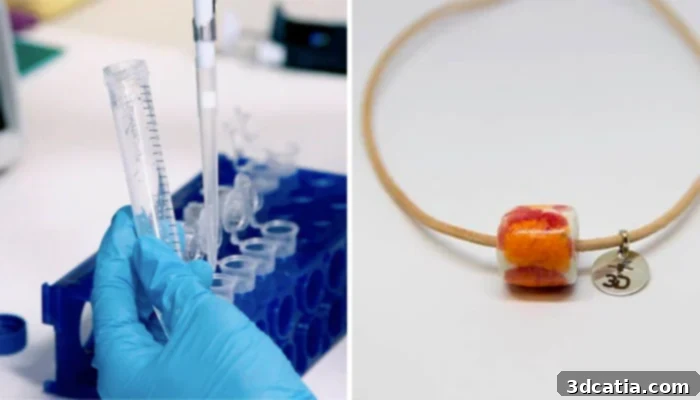
Photo Credits: Narbón
Linen: A Sustainable and Versatile 3D Printing Composite
As the demand for sustainable 3D printing materials grows, innovative alternatives to traditional plastics are gaining traction. One such notable development comes from the French manufacturer Nanovia, which has introduced a composite material made from a blend of PLA (Polylactic Acid) and flax fibers. This unique composite not only positions itself as an environmentally friendly option but also offers remarkable aesthetic versatility. Nanovia highlights its commitment to sustainability by utilizing natural, renewable flax, thereby reducing reliance on petroleum-based plastics. A particularly fascinating feature of this flax-PLA composite is its ability to produce various shades of brown in the final printed object. This is achieved by simply altering the printing temperature during the manufacturing process. Higher temperatures can cause a subtle thermal degradation of the natural flax fibers, leading to darker, more pronounced brown tones, while lower temperatures result in lighter hues. This allows designers and users to achieve unique visual effects without needing to change materials or dyes. For optimal longevity and to maintain the integrity and aesthetic appeal of the printed parts, Nanovia strongly recommends sealing them with a UV protection treatment. This protects the natural fibers from degradation caused by ultraviolet light exposure, ensuring the finished products remain durable and vibrant for as long as possible. This flax-PLA composite showcases how natural fibers can be integrated into additive manufacturing to create sustainable, aesthetically pleasing, and functionally diverse materials.
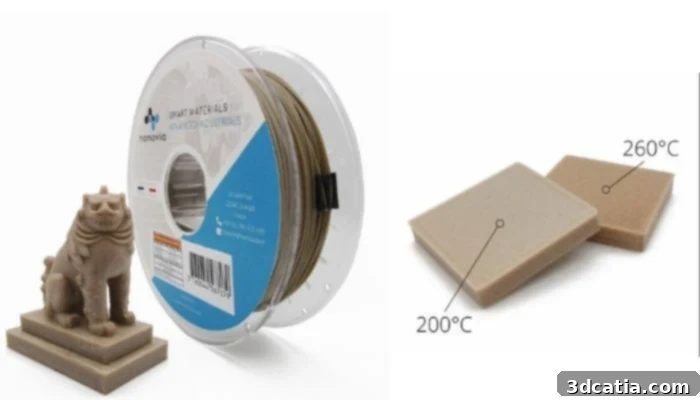
Photo Credits: Nanovia.
3D Printing with Sugar: Crafting Sweet Delights with Precision
Sugar, another edible marvel, has found its niche in the world of 3D printing, primarily for creating intricate and customizable confections. The Sugar Lab, originally a venture under 3D Systems, pioneered much of this development. After being acquired almost a decade ago, it later spun out in 2020 to re-establish itself as a direct-to-consumer specialty confections company. The Sugar Lab leverages the advanced Brill 3D Culinary Studio, a technology initially developed by 3D Systems (known then as ChefJet Pro), to produce an impressive array of candies and decorative elements in incredibly complex shapes and vibrant colors. This Los Angeles-based company boasts the capability to create custom confections in virtually any flavor and hue, making them a popular choice for personalized gifts and events. Whether for birthdays, weddings, or Christmas parties, The Sugar Lab offers a unique way to present sweets, transforming ordinary sugar into edible works of art. The efficiency of their 3D printing systems allows for the production of hundreds of intricate confections daily, demonstrating the scalability of this innovative approach. While The Sugar Lab remains the most prominent player in sugar 3D printing, other culinary innovators, such as The Modernist Cuisine, are also actively experimenting with this sweet medium, exploring its potential for high-end gastronomy and food artistry. This application highlights the potential of 3D printing to merge technology with traditional crafts, creating new possibilities in the culinary world.
Digory: A 3D Printing Material Inspired by Ivory for Restoration
Among the constantly expanding range of 3D printing materials, some are developed with highly specific and noble purposes in mind, aiming to address long-standing challenges with innovative solutions. One such remarkable material is Digory, a groundbreaking synthetic alternative to natural ivory. Developed through a collaborative effort between the University of Vienna and Cubicure GmbH, Digory was conceived to meet the critical need for restoring ancient monuments and precious objects traditionally crafted from ivory. The ethical and legal restrictions surrounding the use of natural ivory make its replacement a significant advancement in heritage conservation. Digory is an advanced synthetic resin, meticulously engineered to mimic the aesthetic and mechanical properties of genuine ivory. Its composition includes carefully selected calcium phosphate particles and silicon oxide powder, which contribute to its ivory-like texture, color, and density. Researchers painstakingly formulated this new material to achieve an almost indistinguishable resemblance to natural ivory. This enables seamless restoration using SLA (Stereolithography) 3D printing, a technology renowned for its exceptional precision and ability to create intricate details. The ability to 3D print with Digory allows conservators to recreate missing parts of historical artifacts with unparalleled accuracy, ensuring that repairs are both faithful to the original and durable. The striking similarity between Digory and real ivory is truly remarkable, offering a sustainable and ethical solution for preserving cultural heritage without compromising on authenticity or quality.
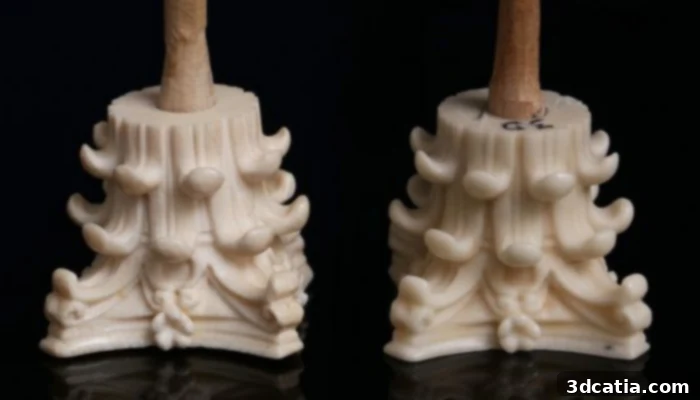
The Digory material on the right, is very similar to the real ivory on the left (photo credits: Vienna University of Technology)
Diamond Composite: 3D Printing the Hardest Material on Earth
The notion of 3D printing diamond might come as a significant surprise to many, given its reputation as the hardest natural material on Earth. However, in a truly revolutionary breakthrough, Sandvik Additive Manufacturing announced in 2019 that it had successfully created the first-ever 3D printed diamond composite. It’s crucial to clarify that this isn’t a sparkling gem-quality diamond, but rather a composite material where diamond particles are integrated into a matrix, harnessing diamond’s incredible hardness and wear resistance. This innovation holds immense potential to transform various industrial sectors, particularly the tooling industry. Diamond’s unparalleled wear-resistant properties have long made it indispensable in applications ranging from mining and drilling to precision machining and even medical implants. However, its extreme hardness also makes it notoriously difficult and expensive to machine into complex shapes using traditional manufacturing methods. Sandvik’s composite breakthrough addresses this fundamental challenge. The company claims that it is now possible to 3D print this super-hard material into highly complex geometries, which was previously unfeasible. This capability opens doors to creating custom tools, wear parts, and components with optimized designs that can withstand extreme conditions and extend product lifespan. Sandvik has expressed high hopes for the near-future applications of this material, anticipating its widespread adoption in industries where durability and precision are paramount, ultimately leading to more efficient and robust manufacturing processes.
3D Printing Materials for Space Exploration: Lunar Regolith
The dream of establishing human outposts beyond Earth is driving intense research into utilizing extraterrestrial resources for construction. Lunar regolith, the fine, grayish dust that covers the Moon’s surface, is emerging as a prime candidate for 3D printing materials in space. The concept revolves around “in-situ resource utilization” (ISRU), where materials found on the Moon are used to build infrastructure, dramatically reducing the cost and logistical challenges of transporting supplies from Earth. A study conducted by the University of Central Florida, for instance, successfully developed 3D-printed bricks composed of lunar regolith and salt water. These bricks are specifically designed to be suitable for the construction of habitats and other structures at future lunar bases, such as the proposed Artemis base camp. Researchers meticulously carried out various tests to assess the bricks’ structural integrity and suitability for constructing homes in the extreme conditions of space, including vacuum, radiation, and vast temperature swings. The production process leveraged binder jetting, an additive manufacturing technique particularly advantageous for ceramic-like materials due to its ability to process powders without high melting temperatures. The bricks were printed using regolith simulant from the UCF Exolith laboratory, combined with a saltwater binder. Despite the inherently theoretical nature of constructing on the Moon today, the promising results indicate that these 3D-printed regolith bricks possess the resilience to withstand harsh extraterrestrial environments. Another significant project involves ESA and NASA, as part of the broader Artemis program, which is actively investigating whether authentic space materials like regolith can be effectively processed into building blocks for constructing habitats, launch pads, or vital support structures on the Moon. To engage the public and raise awareness, 15 of these regolith-based bricks were even made available in LEGO stores worldwide. While 3D printing with moon dust remains largely experimental and hypothetical, the rapid advancements in this field suggest that it could become a critical component of future lunar and Martian missions.
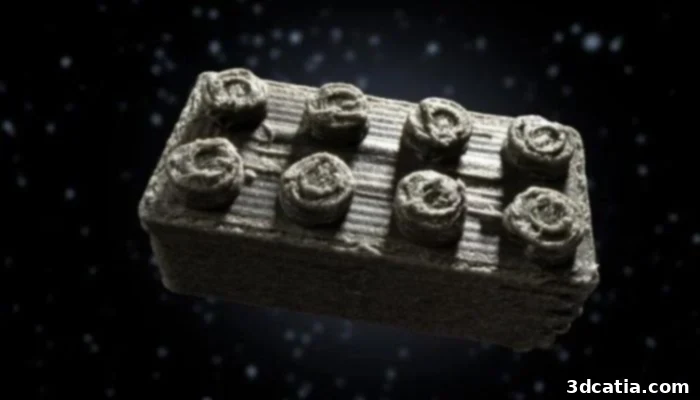
Photo Credits: LEGO
3D Printing with Wool: Transforming Textile Waste into Innovative Designs
In a remarkable step towards sustainable manufacturing and circular economy principles, designers and researchers are exploring the potential of wool, particularly wool deemed unusable by the textile industry, as a viable 3D printing material. Typically, wool that is too fine or has other characteristics unsuitable for conventional fabric production often ends up as waste. However, an innovative project spearheaded by Dutch designer Christien Meindertsma, in collaboration with the TFT company, offers a promising solution. Their custom-designed robotic arm, aptly named FLOCKS Wobot, employs an additive manufacturing-like process to deposit layers of wool. This robotic system precisely shapes various objects without the need for additional binders, chemicals, or even water, making the process incredibly eco-friendly. This pioneering project represents a significant contribution to the circular economy, demonstrating how overlooked natural resources can be repurposed into high-value products. Wool itself possesses numerous advantageous properties: it is inherently recyclable, biodegradable, and offers excellent insulating capabilities. These characteristics unlock immense potential for future applications in diverse fields such as acoustics (for sound-absorbing panels), thermal insulation, sustainable design objects, and bespoke furniture construction. Furthermore, other organizations are actively exploring wool’s additive manufacturing potential. D-House, for example, is researching 3D printing with merino wool. In collaboration with The Woolmark Company and Stratasys, they launched the “Knitting the Future” project, engaging students from the Royal College of Art in London to develop 3D-printed designs from knitted wool. Designers are particularly enthusiastic about wool as a material because it allows for a wide spectrum of color variations, subtle gradients, and captivating shimmer effects, all while significantly reducing material waste compared to traditional textile manufacturing. This marks a pivotal moment in sustainable design and material innovation.
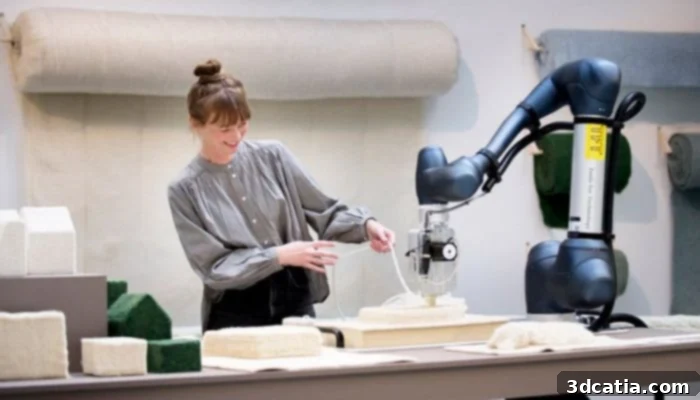
Photo Credits: TFT Tools for Technology, Sara Alvarez, Bart Harteloh, Doosan Robotics, Dormac Cobots, Martin Oosthoek, De Wassum, Havivank, Gelderland, Rotterdam Circulair, Lisa Hardon, Creative Industries Fund NL et Stichting DOEN
Food Waste as a Sustainable 3D Printing Material
The global imperative for sustainability has spurred an incredible wave of innovation in 3D printing, particularly in the ingenious repurposing of food scraps and waste from agricultural and food production processes. This approach not only diverts waste from landfills but also creates valuable new materials, embodying the true spirit of the circular economy and “upcycling.” Orange peel serves as a prominent example. The Italian design studio Krill Design has brilliantly transformed dried orange peel into a biomaterial for 3D printing, which they use to produce distinctive 3D-printed lamps. The process involves grinding the peels into a fine powder, which is then processed and extruded into innovative designs. A similar concept, “Feel the Peel,” was developed by WASP in collaboration with architect Carlo Ratti. This remarkable installation functions as both a juice bar and a 3D printer: oranges are squeezed for juice, and their leftover peels are collected, dried, mixed with PLA (Polylactic Acid), and subsequently 3D printed into biodegradable cups, closing the loop on consumption. The innovation extends beyond citrus waste. In the Cacao Eco Village project, cocoa bean shells, typically a waste product of chocolate production, were processed into bioplastics to construct 3D printed buildings, showcasing large-scale architectural applications. Furthermore, the marine industry’s waste stream is also being tapped. Several manufacturers now offer filaments derived from oyster or mussel shells. Smartmaterials provides such biological printing materials, and the French filament producer Francofil sells PLA filaments enriched with mussel, scallop, or oyster waste, lending unique textures and properties to the printed objects. Francofil has also pioneered a filament made from beer waste, transforming the brown by-product of brewing into a novel 3D printing material when combined with PLA. These diverse examples powerfully illustrate the vast potential for transforming food production waste into valuable 3D printing materials, driving both environmental responsibility and material innovation within the additive manufacturing sector.
Coffee Grounds: A New Life for Billions of Cups
Coffee, a daily ritual for billions, generates an enormous amount of waste in the form of spent coffee grounds. With an estimated 2.5 billion cups consumed worldwide every single day, the environmental impact of coffee waste is substantial. Recognizing this, a surge of ingenious initiatives has emerged to repurpose these coffee grounds into sustainable 3D printing materials. The core idea involves collecting the residue from coffee percolation and incorporating it into a polymer base, typically resulting in a filament ready for additive manufacturing. This innovative approach not only tackles waste management but also imbues printed objects with unique aesthetic qualities, including a natural brown hue and a subtle coffee aroma. Lowpoly, for instance, has successfully designed and 3D printed furniture for cafes using coffee grounds, creating pieces that are both functional and thematically relevant to their environment. Other notable examples of this sustainable transformation come from academic and design sectors, including research from the University of Colorado and projects by Krill Design, who are actively exploring various applications for coffee-based filaments. These efforts highlight how a ubiquitous waste product can be transformed into a valuable resource, contributing to a more circular economy and offering designers a novel, eco-friendly material with distinctive characteristics. The ability to turn a discarded byproduct into a tangible, useful object underscores the transformative power of sustainable 3D printing.
Organic 3D Printing Materials: Harnessing Nature’s Building Blocks
When considering materials for additive manufacturing, organisms like algae and fungi might not immediately spring to mind. Yet, in recent years, these organic powerhouses have emerged as incredibly promising and sustainable 3D printing materials, pushing the boundaries of what “green” manufacturing can achieve. Fungi, particularly mycelium (the root-like structure of mushrooms), is gaining significant attention for its potential as an eco-friendly building material. Mycelium composites are being researched for their structural integrity, biodegradability, and natural insulating properties, making them ideal for sustainable architecture. Beyond construction, mycelium is also finding applications in interior design, consumer goods, and even healthcare, offering a truly renewable and compostable alternative to conventional materials. Meanwhile, algae, with its rapid growth rate and ability to sequester carbon dioxide, is proving to be remarkably versatile. It has been successfully used to create everything from 3D printed organic tiles for sustainable architecture to more sustainable medicine delivery systems. Perhaps most intriguingly, algae ink is being developed to help create nutritious food products, including innovative approaches to cultured meat production, leveraging algae’s protein-rich composition. Both fungi and algae stand as incredible examples of how biotechnology and additive manufacturing can intersect to create genuinely sustainable processes and materials, offering a pathway to a more environmentally responsible future across multiple industries.
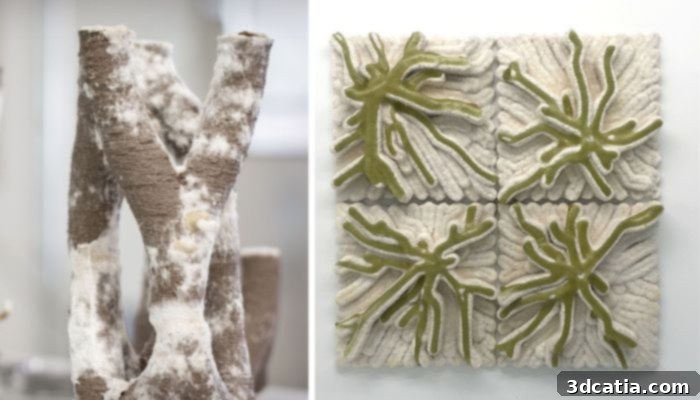
On the left, 3D printed mycelium (photo credits: WASP); on the right, craft tiles made with 3D printed algae (photo credits: bioMATTERS)
Cigarette Butts: From Pollution to 3D Printing Filament
It might sound almost unbelievable, but yes, you read that correctly: cigarette butts are being transformed into a viable 3D printing material, offering a groundbreaking solution to a pervasive environmental problem. This initiative represents a profound step forward for our planet, aiming to tackle the staggering volume of cigarette butts discarded into natural environments daily. These tiny, seemingly innocuous items are in fact highly detrimental to our ecosystems. A single cigarette butt can contaminate up to 500 liters of water or a cubic meter of snow, leaching toxic chemicals into the environment. When scaled globally, the impact is immense. Filaret3D is a pioneering company at the forefront of this green revolution. They specialize in collecting discarded cigarette butts and transforming them into a range of new materials, from paper to high-quality 3D printing filament. The intricate process begins with meticulously extracting the cellulose acetate filter from the butt. This material then undergoes a rigorous detoxification and washing procedure to remove harmful residues. Subsequently, the cleaned filter material is blended with various polymers and other additives to achieve the desired properties for additive manufacturing. This composite material is then processed into pellets, which are ultimately extruded into usable 3D printing filament. By converting this abundant and hazardous waste product into a valuable resource, Filaret3D not only helps clean up our environment but also provides a sustainable alternative for the 3D printing industry. This innovative approach exemplifies how creativity and technology can address urgent ecological challenges, turning pollution into progress.
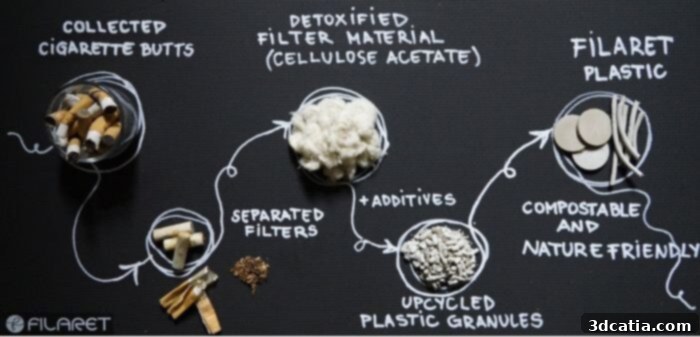
The process of making filament from cigarette butts (photo credits: Filaret3D)
The world of 3D printing is continuously evolving, demonstrating an incredible capacity for innovation, sustainability, and sometimes, pure surprise. From delicious confections to vital space infrastructure, and from poignant memorials to impactful environmental solutions, the range of materials being explored showcases the boundless potential of additive manufacturing. These developments not only expand the technical capabilities of 3D printing but also challenge our perceptions of what constitutes a “material” in the manufacturing process. As we look to the future, the drive for new, sustainable, and unconventional materials will undoubtedly continue to push the boundaries of design, engineering, and environmental stewardship.
What do you think of our list of surprising 3D printing materials? We’d love to hear your thoughts! Let us know in a comment below or connect with us on our LinkedIn, Facebook, and Twitter pages! Don’t forget to sign up for our free weekly newsletter here for the latest 3D printing news straight to your inbox! You can also find all our videos on our YouTube channel.