
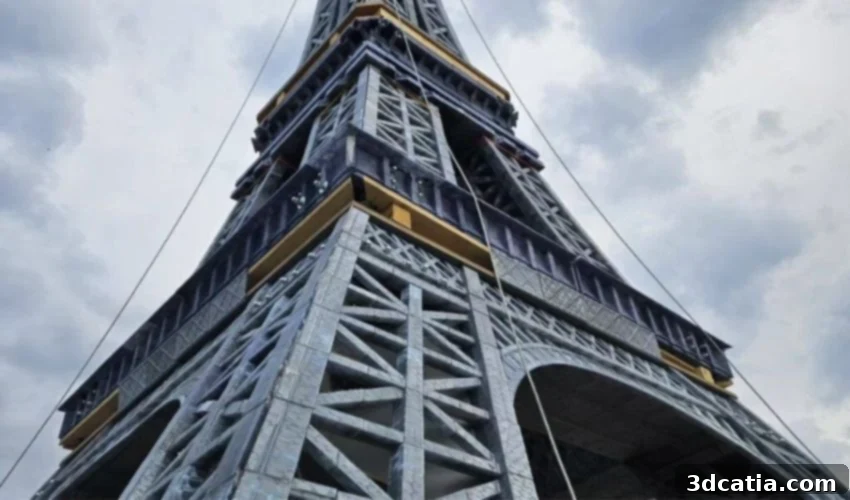
From Ocean Waste to Olympic Icon: Czech Republic’s Sustainable 3D Printed Eiffel Tower for Paris 2024
The excitement surrounding the Paris 2024 Summer Olympic Games officially commenced on Friday, July 26th, 2024, marking the beginning of an extraordinary spectacle of human achievement. Since the grand opening, athletes from across the globe have been showcasing incredible feats of prowess, competing fiercely in approximately 40 diverse sports. While the heart of the games pulsates in France, not everyone can journey to Paris to partake in the celebrations. This raises a compelling question: how do different nations express their solidarity and cheer for their champions from afar? The Czech Republic has unveiled a truly unique and environmentally conscious tribute: a magnificent, scaled-down Eiffel Tower, innovatively 3D printed entirely from marine waste. This symbolic structure now stands proudly on display at the country’s official Olympic Festival, captivating visitors and embodying the spirit of sustainability.
This ambitious project, initially announced in April 2024, is the visionary collaboration between the pioneering Czech company 3DDen and the Czech Olympic team. Erected near the picturesque Lake Most in North Bohemia, this 12.5-meter (approximately 41-foot) tower serves as the breathtaking centerpiece of the Olympic Festival. Situated on the scenic shores of the pit lake, the festival offers a vibrant hub where attendees can immerse themselves in the Olympic spirit by trying out various sports and cheering on Czech athletes as they compete. Far more than just an architectural marvel, this installation is a glorious homage to France and a profound statement aligned with the increasing global commitment to environmental sustainability within the Olympic movement. Its construction, entirely from plastic reclaimed from the ocean, underscores a powerful message about responsible resource management and ecological innovation.
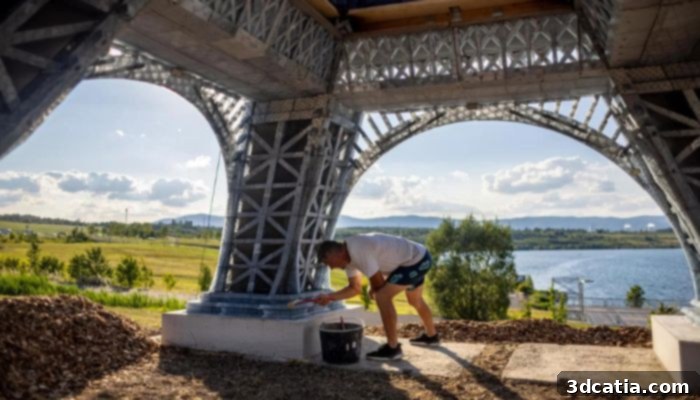
Installation of the 3D printed Eiffel Tower on the shores of Lake Most (photo credits: Martin Divisek/EFE)
Crafting an Icon: The Genesis of the 3D Printed Eiffel Tower
The Paris 2024 Olympics has set a new benchmark for environmental responsibility, with French authorities diligently working to make these games as eco-friendly as possible. This commitment manifests in various initiatives, including a notable increase in plant-based food options (despite some initial feedback), the utilization of recycled materials for temporary arenas and essential equipment like beds, a strong emphasis on public transportation, and the introduction of new bike lanes. This dedication to “green” practices resonates deeply with the ethos behind the Czech Republic’s 3D printed Eiffel Tower. At its core, the project was conceived with sustainability as a guiding principle. Jan Hřebabecký, the CEO of 3DDen, highlighted the extraordinary effort, confirming that the impressive structure was meticulously crafted from approximately 1.3 tons of ocean waste – a monumental undertaking that transformed discarded plastic into a symbol of hope and innovation.
The escalating crisis of plastic pollution stands as one of the most pressing environmental concerns confronting our planet today. Alarming estimates suggest that anywhere from 75 to 199 million tons of plastic waste currently contaminate our oceans, posing severe threats to marine ecosystems and global health. In response to this urgent challenge, an increasing number of innovators and organizations are exploring creative and productive avenues for repurposing and recycling these vast quantities of discarded materials. 3DDen’s project is a shining example of such ingenuity. For this particular endeavor, the company ingeniously utilized roughly 800,000 plastic bottles, carefully collected from the coast of Thailand, transforming them into the raw material for this monumental structure. This not only provided a practical use for otherwise harmful waste but also highlighted the potential for a circular economy in manufacturing.
To convert these collected plastic bottles into a usable resource for 3D printing, 3DDen developed a proprietary and groundbreaking technology, aptly named OPET. This innovative process meticulously transforms the recovered plastic waste first into fine granules, which are then further processed into high-quality 3D printer filament. The journey from discarded bottle to robust building material is complex and requires significant expertise. Moreover, the subsequent 3D printing stage itself presented unique engineering challenges, necessitating the use of a specially-built printer. As Jan Hřebabecký, CEO of 3DDen, elucidated, “You can’t tell at first glance or by touch that it is recycled plastic from seawater. The difference only becomes apparent during the printing process. The material requires very specific conditions for flow, temperature and cooling, but I won’t tell you any details, because that’s our production secret.” This statement underscores the advanced scientific and technical know-how that went into perfecting the material’s printability, ensuring the structural integrity and aesthetic quality of the final product while working with challenging recycled plastics.
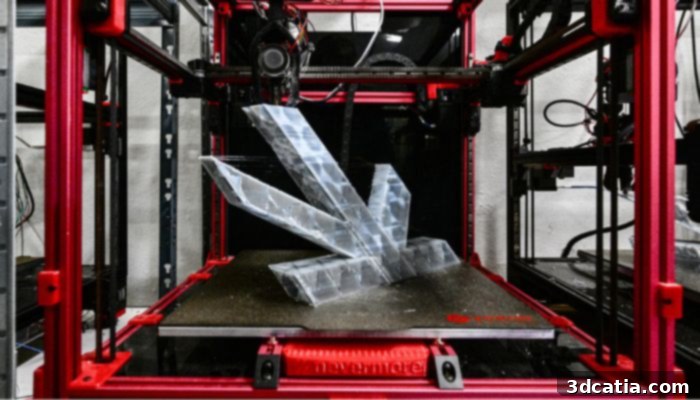
3DDen created a special printer for the marine waste, seen here making one of the parts for the 3D printed Eiffel Tower (photo credits: 3DDen)
The journey of 3D printing such a massive structure from recycled marine plastic was not without its significant technical hurdles. One of the primary challenges stemmed from the inherent nature of the recycled material itself: it is considerably softer than virgin plastics typically used in additive manufacturing, making it inherently more difficult to process and maintain structural integrity during extrusion. Furthermore, attempting to use this unique material in a conventional 3D printer often led to its rapid crystallization, which could immediately destroy the intricate components of the printing machinery. This forced 3DDen to innovate profoundly, not only in material preparation but also in the design of their specialized printing equipment to mitigate these risks. Despite these complex challenges, the use of recycled marine plastic offers compelling advantages. Beyond its crucial role in environmental conservation by diverting waste from oceans, this material also proves to be less expensive than many conventional plastics, presenting a cost-effective and eco-friendly solution for large-scale additive manufacturing projects. This dual benefit—environmental stewardship combined with economic viability—highlights the transformative potential of such sustainable approaches.
Assembly and Impact: A Symbol of Global Olympic Spirit and Sustainability
The construction of the 3D printed Eiffel Tower was an intricate logistical and engineering marvel. To manage its impressive 12.5-meter height, the tower was manufactured in 1,500 individual pieces, each meticulously crafted from the specialized marine waste filament. These components were then transported and expertly assembled directly on site at Lake Most. The sheer scale of the project is evident in its dimensions: the base alone measures a substantial 5.1 meters across, providing a stable foundation for the towering structure, while the uppermost section weighs over 100 kilograms, a testament to the density and strength of the recycled material. This modular approach allowed for efficient production and precise assembly, culminating in a seamless replica that belies its fragmented origins. The 3D printed Eiffel Tower will remain a prominent fixture at the Olympic Festival throughout the entire duration of the Paris Summer Games, from their opening on July 26th until their conclusion on August 11th. Its presence serves as a constant reminder of the Czech Republic’s innovative spirit, commitment to sustainability, and enthusiastic participation in the global celebration of sports.
This pioneering project by 3DDen and the Czech Olympic team extends far beyond mere national pride; it embodies a powerful global message about innovation meeting environmental responsibility. By transforming tons of harmful marine waste into a universally recognized symbol of hope and unity, they have demonstrated the tangible potential of additive manufacturing in tackling some of the world’s most pressing ecological issues. The success of this 3D printed Eiffel Tower offers a compelling blueprint for future large-scale projects, suggesting that iconic structures and functional designs can be realized through sustainable means. It inspires other nations and industries to reconsider their material sourcing and manufacturing processes, advocating for a shift towards circular economies where waste is not merely discarded but reinvented as a valuable resource. Furthermore, this initiative serves as an educational beacon, raising public awareness about ocean pollution and highlighting the incredible possibilities that emerge when technology, creativity, and ecological consciousness converge. It cements the Czech Republic’s position as a forward-thinking nation committed to both athletic excellence and environmental stewardship, leaving a lasting legacy that hopefully inspires sustainable practices across the globe.
What are your thoughts on this remarkable 3D printed Eiffel Tower and its profound message of sustainability? Have you encountered other innovative projects that creatively celebrate the Olympic spirit while championing environmental causes? We encourage you to share your insights and opinions in a comment below, or engage with us on our vibrant social media platforms, including LinkedIn, Facebook, and Twitter pages! Don’t miss out on the latest advancements and breaking news in the world of 3D printing; make sure to sign up for our free weekly newsletter here, delivered directly to your inbox. For a visual exploration of innovative 3D printing applications, you can also explore all our videos on our dedicated YouTube channel.
*Cover Photo Credits: 3DDen