
Revolutionizing Gastronomy: Cocuus Leads the Future of Food 3D Printing and Sustainable Bioprinting
Today, additive manufacturing has transcended its initial application of creating prototypes with thermoplastics. Remarkable advancements in material science have paved the way for this transformative technology to be widely adopted across diverse sectors, including the dynamic gastronomy sector. A growing number of innovative companies are now dedicated to pioneering solutions for 3D printing food, aiming to simplify culinary processes, introduce novel textures, or even produce food without relying on animal products. Among these trailblazers is the Spanish company Cocuus, which has developed its proprietary additive and subtractive manufacturing solutions specifically tailored for food applications. To gain deeper insights into Cocuus’s groundbreaking work and their implementation of these cutting-edge technologies, we had the privilege of speaking with one of their visionary founding partners, Patxi Larumbe.
3DN: Can you briefly introduce yourself and elaborate on your relationship with 3D printing?
At Cocuus, our journey with 3D printing spans two decades. While the general public has only become familiar with 3D printers in the last six or seven years, our team has been deeply immersed in this field for a much longer period. This means we’ve been integral to the genesis and evolution of 3D printing technology right from its inception. Personally, I am Patxi Larumbe, the Strategic Director of Cocuus and one of its co-founders, alongside my esteemed partner Daniel Rico. My engineering background is quite comprehensive, focusing on advanced systems such as CAD CAM CAR, robotics, and sophisticated industrial laser cutting systems. This extensive experience has provided us with a unique perspective and deep understanding of the core principles driving both traditional and advanced manufacturing techniques.
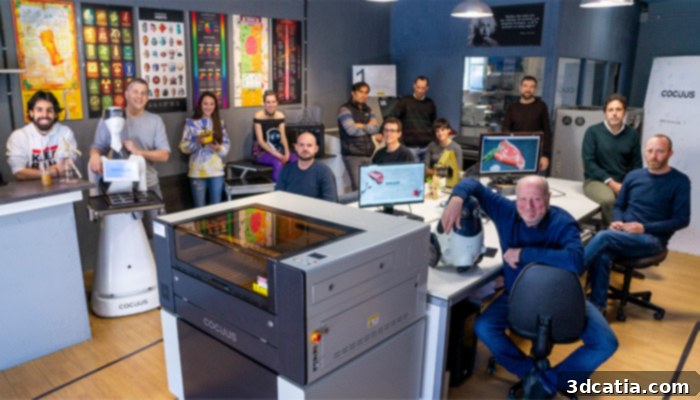
The team behind Cocuus
My passion for laser technology led me to establish a dedicated laboratory in Cizur Menor. This facility was created specifically for the extensive research and application of lasers across various industries, education, and crucially, gastronomy. My expertise encompasses nearly all processes involving lasers, including CO2, fiber, ruby, diode, and UV diodes. I am proficient in the intricate calculation of optics for process optimization, precise beam and optical alignments, and the sophisticated use of DSP cards. Furthermore, my knowledge extends to robotics, covering stepper motors, servo motors, drivers, and various axis systems like Cartesian, delta, and galvo-based systems. Beyond industrial applications, I also possess a deep understanding of show laser illumination, including programming systems with ILDA standard, and developing firmware for Arduinos, Marlin, and GBRL, alongside a working knowledge of stereolithography systems. This broad spectrum of technical expertise has been fundamental in developing Cocuus’s innovative approaches to food manufacturing.
3DN: How did the innovative idea of creating Cocuus come about, focusing specifically on food?
The genesis of Cocuus was truly a pivotal moment in our careers. When the foundational patents for 3D printing finally expired after two decades, it opened up a world of possibilities. However, we made a conscious decision not to follow the conventional path of developing 3D printers for plastic, as many others were doing. Instead, we recognized a nascent but incredibly promising market: food 3D printing. At the time, and our foresight proved correct, this was a field with significantly less competition globally, presenting a unique opportunity to carve out a niche and make a substantial impact.
Like many of the best ventures, Cocuus began informally through a series of “maker” meetings. These were lively, collaborative sessions, typically held around tables cluttered with Arduino boards, electronic components, and, of course, a few beer cans. These gatherings fostered not only a deep friendship but also a powerful alliance among us. This shared vision and camaraderie eventually inspired us to take the monumental leap of leaving our established jobs and fully committing to entrepreneurship. This path, while inherently challenging, was driven by an unwavering initiative and a profound belief in the transformative potential of what we were creating. It’s this persistent drive and conviction that has propelled us to where we are today, even as we acknowledge the exciting, long journey that still lies ahead in the realm of food innovation.
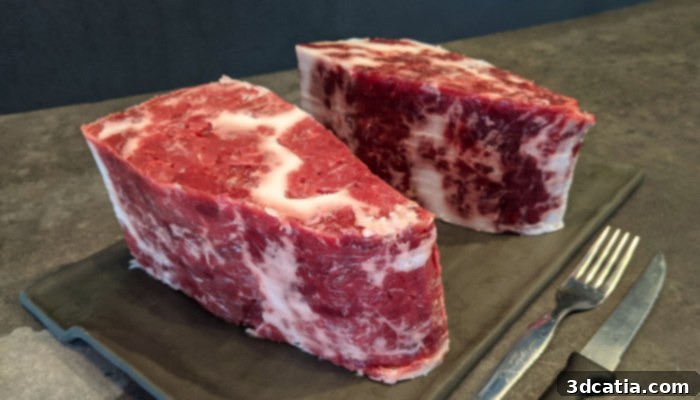
Photo Credits: Cocuus
Our very first laser machine, a true testament to our pioneering spirit, wasn’t initially used for commercial purposes but rather to prepare extraordinary dinners for our friends. We experimented with creating various dishes, pushing the boundaries of culinary artistry. These early experiments consistently surprised everyone, both with the novelty of the creations and the undeniable potential that such advanced technology held for the professional restaurant and catering market. It was from these initial, enthusiastic responses that our core mission solidified: to empower chefs and culinary professionals with innovative new working tools. These tools would not only facilitate precision cutting of base products but also enable the creation of intricate molds, allow for revolutionary changes in food textures, and even permit detailed engravings and personalized drawings directly onto food items, thereby elevating the entire dining experience.
3DN: Could you elaborate on the unique 3D food printing technologies developed by Cocuus?
At Cocuus, we employ 3D technology in a multifaceted way, approaching food innovation from several distinct angles. One of our most disruptive advancements is our unique application of **subtractive printing** in the food sector, a stark contrast to the more commonly known additive manufacturing processes found globally. Instead of building up food layer by layer, we utilize specialized laser machines, roughly the size of a conventional oven, to sculpt and shape food items through precise cut-outs. This method not only allows for intricate designs but also ensures that the leftover food material is recoverable, minimizing waste. Through extensive experimentation, we have also gained invaluable insights into how various foods react to such an intense laser beam, allowing us to optimize our processes for a wide array of ingredients. This subtractive approach is generating significant interest among caterers, executive chefs, and event companies, particularly for its capabilities in marking or engraving on food items, adding a personalized and artistic touch to culinary presentations.
A memorable project involved working with school children, where lunchroom staff noted a general disinterest in fruit. We leveraged our machines to carve charming apple turtles, and by the end of the event, not a single apple was left – a clear demonstration of how innovative presentation can transform perception and encourage healthier eating habits. Expanding beyond monochromatic designs, we recognized the importance of vibrant aesthetics. This led us to integrate **food inkjet printing** into our repertoire. Essentially, we adapted the concept of a standard paper printer to use edible inks, allowing us to print directly onto various food surfaces. This technology enables us to apply intricate designs and a full spectrum of colors onto items like donuts, cakes, or even the delicate foam of coffee and beer, turning them into edible canvases.
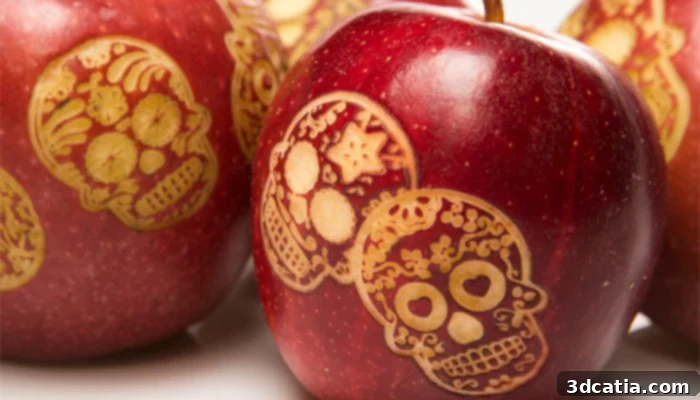
Drawing made with a laser engraver on an apple (photo credits: Cocuus)
The global pandemic, however, necessitated a strategic pivot. With events largely halted and the hospitality sector severely impacted, our initial services became less viable. This challenging period spurred us to develop **geriatric and hospital 3D printing solutions**. Our focus shifted to producing food that, while being an easier-to-consume replica, maintains an external appearance strikingly similar to real food dishes. This innovation directly addresses the critical needs of individuals who struggle with chewing, swallowing, or suffer from dysphagia, significantly improving their quality of life and dignity at mealtimes. This application underscores the humanitarian potential of our technology, providing nutritious and appealing meals for vulnerable populations.
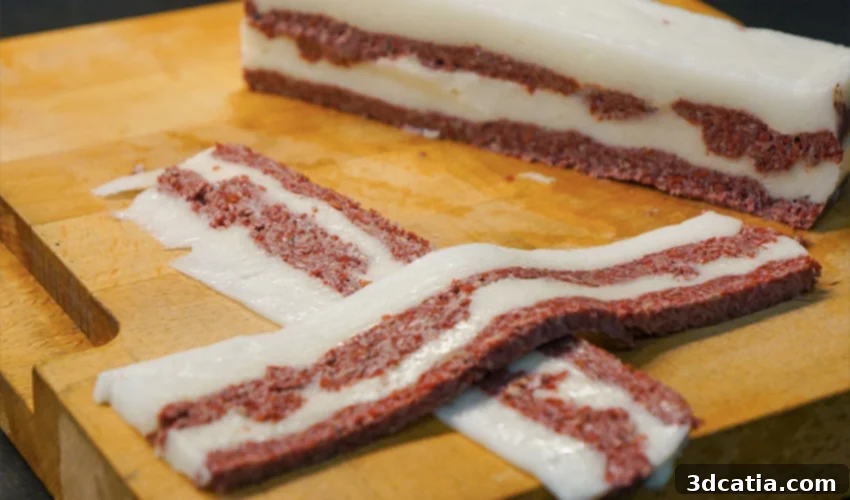
Currently, we are fully immersed in the groundbreaking field of **bioprinting**. This cutting-edge technology involves printing mimetic products that replicate the appearance, texture, and even sensory experience of traditional meat and fish products. The raw materials for these innovations are either advanced vegetable protein products or cells meticulously grown in bioreactors. This represents a significant step towards sustainable and ethical food production, offering alternatives to conventional animal agriculture.
3DN: What are the primary advantages of Cocuus’s production methods, and what significant limitations or challenges do you foresee?
A core principle that distinguishes Cocuus in the market is our commitment to industrial scalability and projection for every project we undertake. We deliberately avoid endeavors that cannot be rapidly industrialized and scaled for high-volume production. This strategic focus ensures that, unlike many of our competitors who might prioritize artisanal or small-batch output, we design and build machines capable of producing food products at a remarkably fast pace. Furthermore, we are continuously developing adaptable machinery that can process diverse ingredients. With only minor modifications, these versatile machines can be utilized to produce both cell-based and plant-based products, offering unprecedented flexibility and efficiency in food manufacturing. This ability to rapidly scale and adapt is a significant advantage in meeting the growing global demand for sustainable food solutions.
While our technologies open up vast possibilities, we acknowledge that certain types of food may not be perfectly replicable with current methods. However, what we consider the most substantial limitation or obstacle isn’t technological, but rather the challenge of effectively communicating the profound, planetary-scale benefits of our approach to a broad audience. These benefits are critical for the future of food security and environmental sustainability:
- The current mode of food production, especially for protein, is unsustainable for a rapidly growing global population. Our methods offer a viable path to address impending protein scarcity.
- Our production processes inherently result in significantly lower CO2 emissions compared to traditional agriculture, thereby reducing the overall climate impact. This contributes directly to global environmental sustainability goals.
- A fundamental ethical advantage is that our methods eliminate animal mistreatment and death from the food supply chain, appealing to a growing segment of environmentally and ethically conscious consumers.
- We have the unparalleled capability to develop food products with enhanced and precisely tailored nutritional levels, addressing specific dietary needs and promoting better public health outcomes.
Photo Credits: Cocuus
3DN: Where do you envision the future of 3D food printing in the coming years, particularly with Cocuus’s innovations?
When we consider the future of 3D printing in gastronomy, it’s essential to define what we mean by “3D printing.” If we conceptualize 3D printing as the transformative process of taking raw food ingredients and shaping them into complex, edible objects, then it becomes clear that the vast majority of its future lies firmly in the realm of global industrial production. At Cocuus, our strong conviction is that we are on the precipice of a revolution where factories will produce delectable “chops” and other meat-like products without a single cow ever entering the facility. This vision extends beyond mere replication; it encompasses a complete paradigm shift in how we source, process, and consume food, driven by sustainability, ethics, and nutritional optimization.
This future will see 3D food printing move beyond novelty to become a cornerstone of both everyday dining and specialized nutritional solutions. We foresee a world where personalized nutrition is easily achievable, where food waste is drastically reduced through on-demand production, and where culinary creativity is unbounded by traditional limitations. Cocuus is actively working to accelerate this future, investing heavily in research and development to refine our technologies and expand their applications. The journey will involve continuous innovation in materials science, printing techniques, and automation to make these advanced food production methods accessible and ubiquitous. For more comprehensive information about our vision and groundbreaking work, please visit our official website HERE.
What are your thoughts on Cocuus’s advancements in food 3D printing and the future of sustainable gastronomy? We invite you to share your insights in a comment below or join the conversation on our Facebook and Twitter pages. Don’t miss out on the latest developments and innovations in 3D printing – remember to sign up for our free weekly newsletter, delivering all the essential news directly to your inbox!