

Revolutionizing Manufacturing: The Coin-Sized 3D Printer from MIT and UT Austin
In a monumental stride forward for additive manufacturing, researchers from MIT and the University of Texas at Austin recently unveiled a groundbreaking innovation: the world’s first chip-based 3D printer. This miniature device, remarkably no larger than a common coin, signifies a profound leap in the accessibility, speed, and customization capabilities of object creation. This development heralds a new era for portable, rapid prototyping and on-demand manufacturing, pushing the boundaries of what was previously thought possible in the realm of three-dimensional fabrication.
At the heart of this prototype device lies a sophisticated millimeter-scale photonic chip. This engineering marvel is ingeniously designed to project reconfigurable beams of light with unprecedented precision into a well containing a specially formulated resin. The interaction is instantaneous and efficient: upon exposure to these directed light beams, the resin quickly solidifies, allowing for the rapid and accurate formation of intricate shapes and complex structures. A key innovation is the chip’s reliance on an array of microscopic optical antennas. These antennas are responsible for steering the light with exceptional accuracy, a mechanism that entirely eliminates the need for the bulky, energy-consuming moving parts typically found in conventional 3D printers. This fundamental shift in design contributes significantly to the device’s diminutive size and enhanced portability, offering a completely new paradigm for how 3D printing operates.
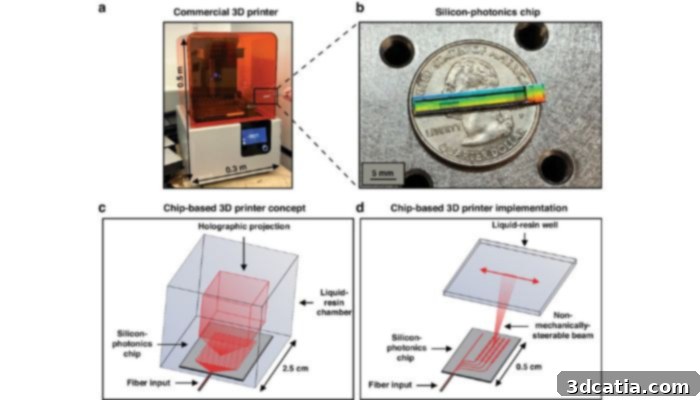
(a) commercial 3D printer for scale, (b) fabricated photonic chip, (c) (c) proposed system with chip-formed hologram in resin, (d) stereolithography-inspired prototype (not to scale).
The significance of this monumental achievement was eloquently articulated by Jelena Notaros, the senior author of the paper and the esteemed Robert J. Shillman Career Development Professor in Electrical Engineering and Computer Science at MIT. She emphasized, “This system is completely rethinking what a 3D printer is. It is no longer a big box sitting on a bench in a lab creating objects, but something that is handheld and portable. It is exciting to think about the new applications that could come out of this and how the field of 3D printing could change.” Her remarks underscore the transformative potential of this technology, envisioning a future where 3D printing transcends the confines of industrial labs and enters the realm of everyday utility, much like smartphones revolutionized personal communication. This shift from stationary, large-scale machines to compact, portable devices represents a paradigm shift that could democratize access to customized manufacturing and rapid fabrication.
This pioneering research is the culmination of years of advanced development in two distinct yet synergistic fields: silicon photonics and photochemistry. Notaros’ team at MIT, renowned for their innovative work on precise light-steering systems, strategically repurposed their existing technology. Their expertise allowed them to adapt these systems to efficiently emit and control visible light, a crucial capability that proved ideally suited for interacting with the specialized resin concocted by UT Austin’s Page Group. The collaboration between these two distinguished institutions, blending expertise in light manipulation with cutting-edge material science, was fundamental to the successful construction of this groundbreaking chip-based 3D printer. This interdisciplinary approach not only solved a complex engineering challenge but also opened new avenues for future research and development in both fields.
Sabrina Corsetti, the lead author and an EECS graduate student, highlighted the intrinsic elegance and profound impact of this innovation. She stated, “Here, we are meeting in the middle between standard photochemistry and silicon photonics by using visible-light-curable resins and visible-light-emitting chips to create this chip-based 3D printer. You have this merging of two technologies into a completely new idea.” This insightful observation perfectly encapsulates the essence of the project: it’s not merely an incremental improvement but a fusion of established scientific disciplines to forge a revolutionary new concept. By meticulously optimizing both the light source (the photonic chip) and the photoreactive material (the resin), the team managed to create a cohesive and highly efficient additive manufacturing system that stands apart from conventional methods. This convergence unlocks unprecedented possibilities for device miniaturization and functionality.
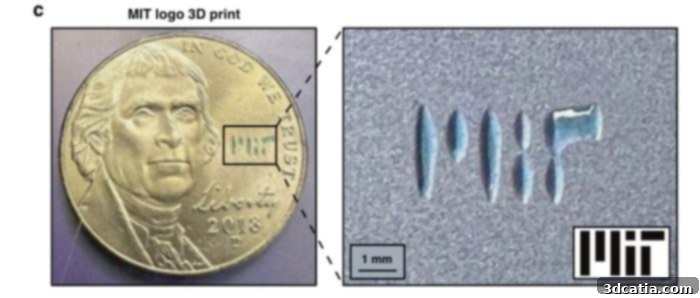
MIT logo printed on a nickel using the chip-based 3D printer.
The research team projects that the potential applications of this novel technology are incredibly far-reaching and diverse, promising to disrupt various sectors. The inherent portability of this 3D printer means it could enable on-the-go creation of customized, low-cost items, offering immediate solutions in diverse scenarios. Imagine field engineers quickly printing a specific fastener for an urgent bicycle repair, or medical professionals fabricating specialized components for critical procedures directly at the point of care, perhaps even custom-fit splints or dental aligners in remote locations. This ability to produce essential items precisely when and where they are needed could revolutionize fields from disaster relief to personalized medicine, significantly reducing logistical complexities and lead times. Furthermore, the printer stands to substantially enhance the rapid prototyping process, particularly for small, intricate parts. Its speed and precision for miniature components make it an ideal tool for iterative design, allowing engineers and designers to quickly test and refine small-scale models without the overhead of larger, more complex printing systems. This accelerates innovation cycles and reduces development costs, fostering greater agility in product development.
Beyond immediate applications, the team’s long-term vision is truly transformative. They envision future systems where the photonic chip could generate a fully three-dimensional hologram of light. This holographic approach would allow for the simultaneous curing of an entire object in a single step, rather than building it layer by layer. Such a development would drastically amplify the efficiency and potential of 3D printing, moving beyond current limitations of speed and build size. This “volumetric” printing capability could unlock entirely new possibilities for creating objects with incredibly complex internal geometries, multi-material compositions, and enhanced structural integrity at speeds currently unimaginable. It would accelerate mass customization, allowing for on-demand production of highly personalized items with industrial efficiency. The ramifications of such a breakthrough would extend to aerospace, consumer electronics, and biomedical engineering, where highly detailed and functional parts could be fabricated in mere seconds. To delve deeper into the specifics of this remarkable achievement, further details can be accessed by clicking here.
This innovation represents more than just a new piece of hardware; it signifies a pivotal moment in the evolution of manufacturing. By miniaturizing the core technology and enhancing its capabilities, MIT and UT Austin are paving the way for a future where personal fabrication is not just a niche hobby but a widespread and essential tool. The potential to create custom objects on-demand, anywhere, will empower individuals and industries alike, fostering unparalleled creativity and problem-solving capacity. This chip-based 3D printer, with its blend of advanced photonics and material science, truly embodies the spirit of innovation and collaborative research, promising to redefine our understanding of production and design in the coming years.
What do you think of this first-ever chip-based 3D printer developed by MIT and UT Austin? We invite you to share your thoughts and predictions in a comment below or join the conversation on our LinkedIn, Facebook, and Twitter pages! Don’t forget to sign up for our free weekly newsletter here to receive the latest 3D printing news directly in your inbox! You can also find all our engaging videos on our dedicated YouTube channel.
*All Photo Credits: Massachusetts Institute of Technology