
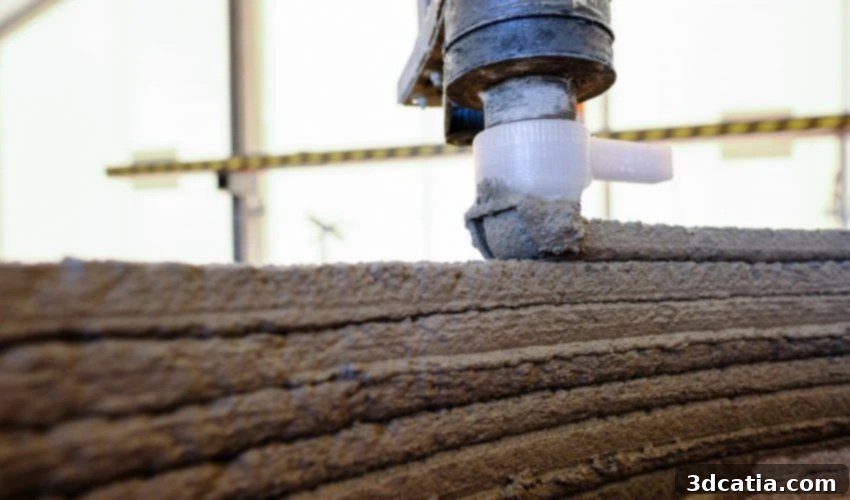
Revolutionizing Sustainable Construction: How Carbon Capture and 3D Printing Are Transforming Building Materials
The global construction industry, a vital pillar of economic development, unfortunately carries a heavy environmental burden, accounting for a staggering 13% of worldwide CO₂ emissions. Addressing this critical challenge requires groundbreaking innovation, and a promising new initiative is emerging from the collaborative efforts of Oregon State University and Sandia National Laboratory. These institutions have secured a substantial three-year, $540,000 grant from the U.S. Department of Energy to pioneer a novel approach: capturing carbon dioxide from industrial emissions and then permanently trapping its mineralized form within advanced 3D printed construction materials. This ambitious research project aims to significantly green one of the economy’s highest-polluting sectors, paving the way for a more sustainable future in building and infrastructure development.
The interdisciplinary team spearheading this endeavor is led by Pavan Akula, an assistant professor of civil engineering at the OSU College of Engineering. His expertise in materials science and sustainable engineering is complemented by researchers from Sandia National Laboratory, the Indian Institute of Science, and the Indian Institute of Technology Roorkee, bringing a global perspective and diverse scientific knowledge to the project. Crucially, the team also includes two industrial partners, Graymont and Verdant Building Alternatives, ensuring that the research is not only academically rigorous but also practically applicable and scalable within the construction sector. This comprehensive collaboration underscores the complexity and multi-faceted nature of the environmental challenges they aim to tackle.
In recent years, the escalating urgency of climate change and the imperative to drastically reduce greenhouse gas emissions have brought environmental sustainability to the forefront of global discourse. While 3D printing technology has gained considerable traction in construction, often lauded for its potential to reduce waste and optimize material use, Professor Akula points out a fundamental flaw in its current application. “In recent years, 3D-printing technology for concrete has been gaining popularity in building construction as it is a more sustainable alternative – it reduces both waste and transport costs. However, most 3D printing of concrete still relies only on traditional materials that are really carbon intensive,” commented Professor Pavan Akula. This highlights the critical need to not just rethink construction methods but, more importantly, to revolutionize the very materials we build with, moving beyond superficial greenwashing to truly carbon-negative solutions.
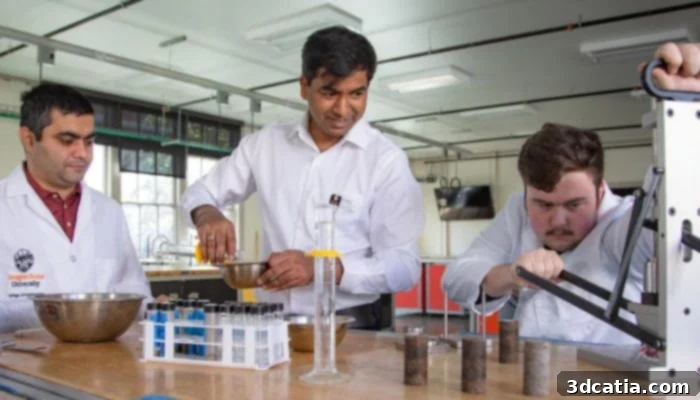
Photo Credits: Oregon State University
The core of this “carbon-intensive” problem lies, more specifically, in Portland cement. Developed in England in the early 1800s, Portland cement remains the most common type of binder used in concrete worldwide. Its widespread adoption is due to its excellent binding properties and versatility, but its production process is notoriously carbon-heavy. Typically, it involves mining, grinding, and then heating clay and limestone in massive industrial kilns to extremely high temperatures, often exceeding 2,820 degrees Fahrenheit (1,550 degrees Celsius). This intense heat triggers a chemical transformation, altering the raw materials into “clinker,” the primary component of cement. However, this calcination process, along with the energy consumed for heating, releases enormous quantities of carbon dioxide into the atmosphere, making cement production one of the largest industrial sources of CO₂ emissions. This deeply embedded issue in conventional construction is precisely what the researchers aim to disrupt and sustainably address.
New 3D Printing Materials for Carbon Sequestration Could Lead to More Sustainable Construction
So, how can 3D printing technology truly become a part of the solution rather than just a more efficient way to use problematic materials? The project’s innovative strategy revolves around two key phases. First, it targets the direct capture of CO₂ emitted by high-polluting industries such as lime and cement manufacturing, preventing these greenhouse gases from ever entering the atmosphere. Second, and crucially, the captured CO₂ will not merely be stored but actively utilized. The team will develop advanced, sustainable binders that have the unique ability to store and permanently mineralize the captured carbon dioxide. This mineralized carbon will then be integrated into 3D printed building components, transforming a harmful emission into a structural part of our future infrastructure. This represents a paradigm shift, effectively turning waste into a valuable, carbon-sequestering resource.
“Our project aims to develop technologies and materials that can significantly reduce the carbon footprint of materials used in 3D printing,” Akula emphasized. This goes beyond simply reducing emissions; it seeks to create materials that actively remove carbon from the atmosphere, offering a truly carbon-negative or carbon-neutral alternative for construction. The potential applications extend beyond simple walls, encompassing a range of structural and non-structural components like beams, columns, and insulation panels. By embedding carbon directly into the building fabric, this research could foster a new generation of green building materials that are not only durable and cost-effective but also fundamentally environmentally responsible, contributing to a truly circular economy in the construction sector.
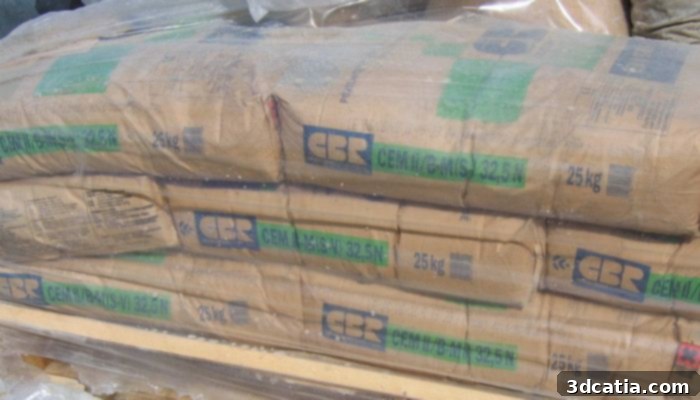
Portland cement is widely used in construction despite its release of carbon dioxide (photo credits: KVDP, Public domain, via Wikimedia Commons)
The significance of this research is underscored by the relentless global demand for concrete, which is projected to continue its upward trajectory, paralleling the accelerating trend of urbanization worldwide. As cities expand and infrastructure needs grow, the environmental impact of conventional construction materials will only intensify unless transformative solutions are adopted. Therefore, the implementation of new technologies and the development of innovative materials are not merely beneficial but absolutely essential to navigate the complex challenges of the present and adapt to an ever-changing future. This project, alongside similar forward-thinking initiatives, offers a tangible pathway toward achieving the ambitious global climate goals outlined in the Paris Agreement.
Signed in 2015, the international treaty, which came into force between the member states of the United Nations Framework Convention on Climate Change, sets a critical mandate: to contain the increase in the global average temperature below the threshold of 2 °C above pre-industrial levels, and to pursue efforts to limit this increase to an even more ambitious 1.5 °C. Achieving this lower target is considered crucial, as it would substantially reduce the risks and devastating effects of climate change, from extreme weather events to rising sea levels. The ability to transform industrial CO₂ emissions into stable, functional building materials directly supports these global commitments, offering a concrete step (pun intended) towards a carbon-neutral built environment.
Beyond the innovative material science, the role of 3D printing technology itself is pivotal in maximizing the sustainability impact. Additive manufacturing offers unparalleled precision, allowing for optimized designs that use only the necessary amount of material, significantly reducing waste compared to traditional construction methods. Furthermore, 3D printing enables the creation of complex geometries and internal structures that can enhance material properties, such as thermal insulation or structural strength, while minimizing overall material volume. This ‘design for efficiency’ capability, combined with the potential for localized, on-demand production, drastically cuts down on transportation costs and associated emissions, contributing to a leaner, greener construction supply chain. Integrating carbon-mineralized binders into this efficient production framework amplifies the environmental benefits exponentially.
This ground-breaking project by Oregon State University and Sandia National Laboratory is not an isolated effort but rather a leading example within a broader movement towards sustainability in additive manufacturing. We have consistently covered the evolving landscape of environmentally conscious 3D technologies, highlighting innovative projects that leverage 3D printing to protect our planet. In the construction sector, for instance, we’ve seen promising developments with the use of natural materials like clay or various biological origin materials to create more sustainable housing solutions. Moreover, recent initiatives such as the European project ConstructAdd are actively studying the benefits of adopting metal as a 3D printing material in demanding sectors like construction and automotive, showcasing the versatility of additive manufacturing in green innovation. These diverse efforts collectively illustrate a growing global commitment to harnessing advanced manufacturing for ecological responsibility. For those interested in delving deeper into Professor Akula’s visionary work, further details can be found in the official press release HERE.
What are your thoughts on the revolutionary potential of new 3D printing materials for sustainable construction? Do you believe carbon capture and mineralization will become standard practice in the industry? We invite you to share your insights and engage in the conversation by leaving a comment below, or by connecting with us on our LinkedIn, Facebook, and Twitter pages! Don’t miss out on the latest advancements in additive manufacturing – remember to sign up for our free weekly Newsletter here, delivering the most current 3D printing news directly to your inbox! You can also find all our compelling videos and interviews on our YouTube channel for a visual journey into the world of 3D printing innovation.
*Cover Photo Credits: COBOD