

3D Printing Safety Regulations in Canada: Protecting Workers and Consumers
3D printing has rapidly transformed from a niche hobby into a powerful tool used in industrial production, education, and various other sectors across Canada. This technological evolution has fundamentally altered how Canadians design, prototype, and manufacture products. However, the increased accessibility of 3D printing technology has also raised awareness of its potential health and safety hazards. While 3D printing is often lauded for its ability to reduce waste, enable on-demand production, and facilitate customization, the process can expose users to fine particles, volatile organic compounds (VOCs), and reactive materials. Federal regulators in Canada are proactively addressing these concerns to ensure that technological advancements do not compromise public health or worker safety. Health Canada (HC) and Employment and Social Development Canada (ESDC) are at the forefront of establishing and enforcing safe additive manufacturing practices throughout the provinces and territories. This article delves into the regulatory landscape of 3D printing in Canada, examining the roles of Health Canada and ESDC in safeguarding the well-being of both consumers and workers.
Addressing Emerging Industrial Risks in 3D Printing
Canada’s regulatory interest in 3D printing health and safety stems from the technology’s increasing prevalence in workplaces, classrooms, and homes. Early research indicated that certain types of 3D printers, such as Fused Deposition Modeling (FDM) and powder-based systems, have the potential to emit hazardous dust and vapors. Consequently, government scientists and policy advisors recognized the potential risks posed by these emissions to both workers and consumers. Understanding these risks is the first step in creating effective and comprehensive regulations.
Health Canada primarily relies on the Canada Consumer Product Safety Act (CCPSA) to regulate consumer products, including 3D printers. The CCPSA places the responsibility on suppliers of 3D printers to ensure that their products do not pose undue health risks. According to a Health Canada spokesperson, “It is the responsibility of the supplier, manufacturer, importer, or retailer to ensure that the consumer products they supply to the Canadian market comply with the CCPSA and its regulations.” This proactive approach ensures that unsafe products are not introduced into the Canadian market.

Under Canada’s Liberal Party-controlled government, the ESDC first created a hazard alert for 3D printers in 2022. You can view the alert HERE.
Health Canada does not pre-approve or certify 3D printers before they are sold to consumers. Instead, the department focuses on taking corrective action if a product is found to be unsafe after it has entered the market. The Health Canada spokesperson further clarified, “The Act and its regulations apply to consumer products available to individuals for non-commercial purposes. If Health Canada identifies that a consumer product poses a danger to human health or safety, it can take appropriate compliance and enforcement action.” This post-market surveillance is essential for identifying and addressing potential hazards that may not have been apparent during the initial product development phase.
To date, Health Canada has not received any credible reports of consumer injuries directly related to 3D printing. However, the department continues to monitor developments in the field closely. Health Canada is also actively conducting research on ultrafine particles (UFPs) and volatile organic compound (VOC) emissions, which remain relevant as new printing materials and methods continue to emerge in the market. This ongoing research is crucial for understanding the potential long-term health effects of 3D printing and for developing appropriate safety guidelines.
From Consumer Safety to Comprehensive Workplace Protection
As 3D printing technology transitioned from hobbyist use to large-scale industrial applications in Canada, the focus of regulation broadened to include workplace safety. Employment and Social Development Canada (ESDC), the federal department responsible for enforcing the Canadian Labour Code, plays a significant role in setting expectations for employers who use 3D printers. ESDC emphasizes that the technology “can lead to health problems such as asthma, lung inflammation, headaches, coughing, circulatory system problems, and skin illnesses.” These health issues can arise from exposure to fine dust, VOCs, and reactive powders, depending on the specific type of printer and materials used. Individuals with pre-existing conditions, such as asthma or those who are immunocompromised, may be particularly vulnerable to these adverse effects.
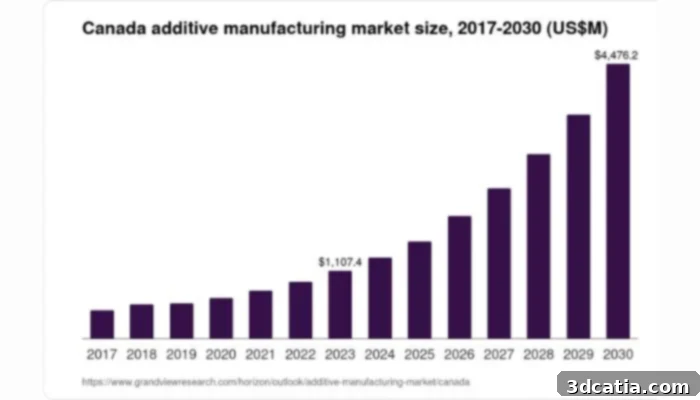
Concerns regarding AM have grown recently, given its increasing presence within the Canadian economy. (Photo Credit: Grand View Research)
ESDC mandates that employers conduct a comprehensive hazard analysis before using any 3D printer. According to the department, “Before using a 3D printer, the employer must conduct a hazard analysis and take action to control the hazard.” This hazard analysis must identify potential risks associated with the specific 3D printing process, materials, and equipment being used. Once these risks are identified, employers are required to ensure that “workers are made aware of the potential hazards, basic first aid, and prevention strategies.” This includes providing adequate training, information, and resources to enable workers to operate 3D printers safely.
ESDC’s guidelines treat 3D printers as industrial tools rather than simple desktop devices. The department emphasizes that “3D printers are more hazardous than paper printers and must be treated with a similar level of care used for other industrial equipment.” This approach includes ensuring proper ventilation, limiting exposure times, and maintaining equipment to prevent leaks or emissions. By recognizing the potential hazards associated with 3D printing, ESDC aims to protect workers from potential health risks and promote a safe working environment.
Canada’s Layered Approach to 3D Printing Safety
The regulatory framework governing 3D printing in Canadian workplaces is largely based on the Canadian Occupational Health and Safety Regulations (COHSR). The COHSR establishes rules for hazard identification (Part X), the use of personal protective equipment (PPE) (Part XII), and the development of comprehensive hazard prevention programs (Part XIX). These regulations provide a structured and systematic approach to managing the risks associated with 3D printing in the workplace.
In practical terms, a company using additive manufacturing in Canada must adhere to the following guidelines:
- Identify and assess hazards from dust, fumes, or chemicals.
- Install proper ventilation, ideally with HEPA filtration systems.
- Train workers in safe printer use, cleaning, and maintenance.
- Comply with the Workplace Hazardous Materials Information System (WHMIS) for labeling and managing hazardous materials.
- Provide protective equipment such as gloves or respirators when other controls are insufficient.
ESDC recommends that “the employer should choose 3D printers already equipped with exposure-limiting features such as covers, ventilation systems, and low-emission features.” The department also emphasizes the importance of using gloves and respirators when other control measures are not sufficient to mitigate the hazard. These measures are not optional but rather reflect the broader duty under the Canada Labour Code for employers to “ensure that the health and safety at work of every employee is protected.” ESDC’s approach demonstrates that while additive manufacturing may be relatively new, the responsibility to manage its risks falls squarely within existing workplace safety laws.
Health Canada’s Focus: Exposure Assessment and Emerging Risks
While ESDC focuses on workplace safety, Health Canada monitors health risks to the general public. The department is actively studying how emissions from 3D printers may affect indoor air quality and human health. According to Health Canada, “Health Canada is conducting research to better understand the health effects of exposure to ultrafine particles (UFPs) and volatile organic compounds (VOCs), including those that may be released from consumer products like 3D printers.” This research is essential for understanding the potential long-term health consequences of exposure to 3D printing emissions.
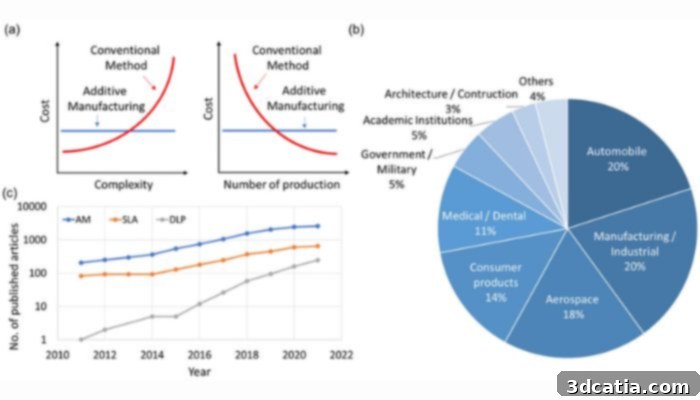
Currently, SLA and DLP lead the charge in growth within Canada’s industrial sectors. (Graph Credit: Progress in Additive Manufacturing Journal (2022))
Health Canada’s research contributes to a broader effort to assess air pollutants and develop exposure guidelines. “Although there are currently no specific exposure limits for UFPs in Canada, Health Canada’s research contributes to the growing international understanding of these particles,” a spokesperson for the department stated. This collaborative approach ensures that Canada remains aligned with international best practices in the field of air quality management.
Health Canada also provides information to consumers on how to minimize exposure when using 3D printers at home. The department recommends using printers in well-ventilated areas, following manufacturer instructions, and selecting materials that produce fewer emissions. In addition, Health Canada advises consumers to “follow the safety data sheet of the plastic or other printing media used in 3D printing and always refer to the manufacturer’s instructions.” By providing clear and actionable recommendations, Health Canada empowers consumers to make informed decisions and protect their health.
Protecting Canada’s Makers and Manufacturers Through Regulations
The risks associated with 3D printing are not always immediately apparent. Unseen hazards such as airborne dust, toxic resins, and reactive powders can have serious long-term health effects. Regulations such as those in the COHSR help ensure that both industrial employers and casual users take appropriate precautions when using 3D printing technology. These protective measures help Canada take a leading role in ensuring that additive manufacturing remains a safe and sustainable industry.
ESDC emphasizes the importance of preventive measures, such as enclosed printers and air filtration systems, noting that “Factors that can lead to an accident, death, or illness from using a 3D printer include airborne microscopic dust from all types of 3D printers, emission of VOCs from plastic 3D printing, and toxicity, flammability and explosiveness of fine metal powder.” The department also highlights the importance of training, stating that “Workers must be made aware of the potential hazards, basic first aid, and prevention strategies.”
In some facilities, medical monitoring may be required to protect workers’ health. “If a qualified person recommends a medical exam for workers at risk of exposure to hazardous substances, then a health monitoring program may be required to screen and update workers’ files regarding changes to their health,” ESDC states. This approach is designed to prevent accidents before they occur and to track potential long-term health effects. By proactively addressing these risks, Canada’s safety framework aims to protect both immediate well-being and future health outcomes.
Shared Responsibility: From Policy to Practical Application
Both Health Canada and ESDC emphasize that safety in additive manufacturing is a shared responsibility. While the government provides the regulatory framework, it is ultimately up to manufacturers, employers, and individuals to implement it effectively. ESDC emphasizes that “Workplace parties are best positioned to identify hazards and implement appropriate preventative measures.” The department points to resources such as hazard alerts and the Canadian Centre for Occupational Health and Safety (CCOHS), which provides detailed guidance on 3D printing materials, ventilation, and worker protection. By providing these resources, ESDC empowers stakeholders to take ownership of safety and implement best practices.

Canada’s Liberal government has largely overseen the development of federal frameworks that address the growing health and safety risks associated with 3D printing. (Credit: Atlantic Council)
Health Canada encourages consumers to report safety incidents through its Consumer Product Incident Report Form, which helps the department track potential problems and refine its guidance over time. In addition to supporting research in additive manufacturing, Health Canada also monitors international developments in 3D printing safety, contributing to global understanding of the technology’s impacts. This continuous improvement approach ensures that Canada’s regulatory framework remains effective and responsive to emerging challenges.
Regulating the Future of Additive Manufacturing
As 3D printing expands into new domains, from bioprinting and construction to aerospace applications, Canadian regulators are preparing for more complex questions about exposure, sustainability, and long-term health effects. The challenge lies in balancing innovation with safety in a rapidly evolving industry. ESDC emphasizes that “The applicable occupational exposure limits of the ingredients must be followed, and the employer is required to train workers in the usage, cleaning, and maintenance of 3D printers, as applicable.”
Canada’s approach to regulating 3D printing emphasizes education, monitoring, and preventive action. This ensures that even as additive manufacturing grows more advanced, the fundamentals of worker protection remain unchanged. Health Canada underscores this point by stating, “3D printers are more hazardous than paper printers and must be treated with a similar level of care used for other industrial equipment.” The department’s research and outreach efforts are helping ensure that everyone, from engineers to educators, understands how to manage that responsibility safely.
Building a Culture of Safe Innovation in 3D Printing
3D printing represents a new era of creativity and manufacturing in Canada, empowering individuals and industries to innovate faster and more efficiently than ever before. However, it is essential to manage this technology with care. Through the coordinated efforts of Health Canada and ESDC, Canada has developed a robust framework for the safe use of additive manufacturing. From workplace ventilation standards to consumer education, the country’s approach prioritizes prevention and accountability. As the technology continues to evolve, so will the regulations, ensuring that Canada’s 3D printing revolution remains sustainable, responsible, and safe for everyone.