
3D Printing Transforms UK Water Industry: Unveiling ‘Printfrastructure’ for a Sustainable Future
The British water supply sector is witnessing a groundbreaking transformation thanks to a pioneering collaboration between United Utilities, a leading water company, and ChangeMaker 3D, a specialist in additive manufacturing services. This partnership has successfully demonstrated the profound benefits and practical applications of 3D printed components within the UK’s vital water infrastructure. After a rigorous twelve-month joint effort, their innovative work revealed substantial reductions in carbon emissions, project costs, and required labor when compared to traditional construction methods. By validating these critical advantages, the project illuminates the immense, untapped potential of 3D printing in civil engineering and construction, an impact that is poised to extend far beyond the water sector to benefit numerous other industries. This initiative represents a significant leap forward, showcasing how advanced manufacturing technologies can address the pressing demands for efficiency and sustainability in infrastructure development.
When the topic of additive manufacturing arises in the context of construction, the immediate association for many often defaults to the large-scale 3D printing of entire houses. Indeed, the past few years have seen a surge in ambitious 3D-printed residential projects globally, and as technological advancements continue at a rapid pace, it’s reasonable to expect even more innovative housing solutions in the future. However, limiting the perception of concrete 3D printing to just residential buildings overlooks a vast array of other impactful applications. This technology offers incredible versatility, enabling the creation of complex, custom, and highly optimized structures and components that can revolutionize various facets of the built environment, from intricate architectural elements to critical infrastructure parts, as the United Utilities and ChangeMaker 3D project compellingly demonstrates.
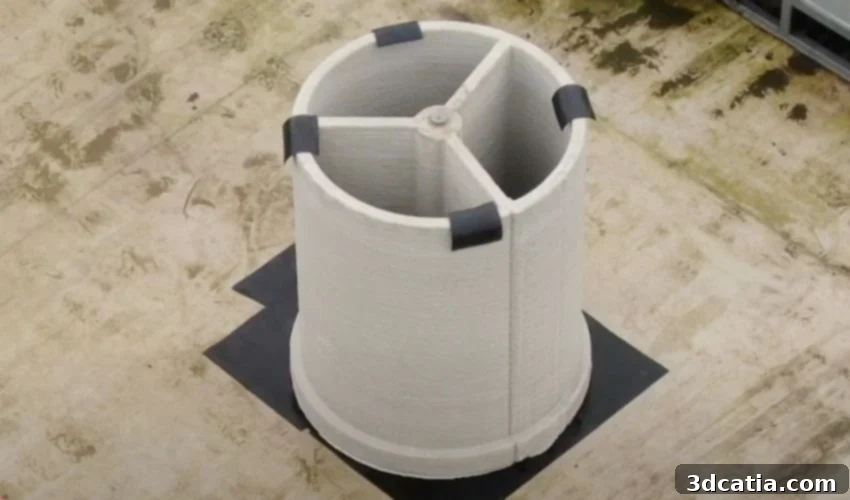
The ambitious collaboration between United Utilities and ChangeMaker 3D commenced in early 2021 with a clear and focused objective: to leverage the power of concrete 3D printing to develop an environmentally sustainable and economically advantageous water chamber. The primary goal was to drastically reduce the carbon footprint associated with such infrastructure. The project kicked off with an intensive 12-week design phase, during which the two companies meticulously deliberated on the most suitable component for this pioneering demonstration. Their rigorous analysis led them to select a wastewater distribution chamber – a choice that was both strategic and challenging. Traditionally, these chambers are technically complex to construct and are significant contributors to carbon emissions due to the extensive use of concrete, formwork, and labor-intensive processes. This decision underscored their commitment to tackling a truly impactful and demanding application of 3D printing.
Creating The 3D Printed Water Chamber: ‘Printfrastructure’ Emerges
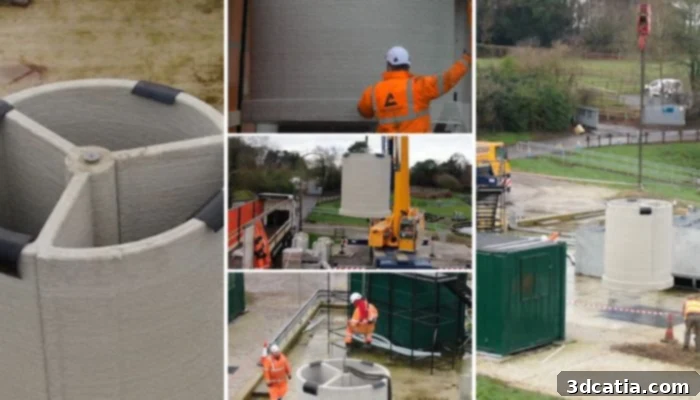
Following the crucial design phase, the collaborative team meticulously crafted a detailed digital model of the cylindrical water chamber. This advanced digital blueprint was then transmitted to their specialized technology partners, CyBe Construction, located in the Netherlands. At CyBe’s state-of-the-art factory, the chamber was brought to life through precise 3D printing, leveraging their expertise in concrete additive manufacturing. Upon its successful creation, the newly printed component was carefully transported and installed at a dedicated test facility situated in Cheshire, a key town north of Manchester. This entire endeavor, from initial concept to physical installation and testing, spanned a comprehensive year of dedicated work and inter-company cooperation. The project culminated in the christening of this innovative component with the fitting name ‘Printfrastructure’, signifying its role as a foundation for future infrastructure built with additive manufacturing.
After undergoing an extensive battery of diverse tests, the team was able to unequivocally demonstrate the superior performance of ‘Printfrastructure’. The results were remarkable: a significant 25% reduction in embodied carbon, a substantial 20% cost saving, and an impressive 55% reduction in labor requirements when benchmarked against conventionally constructed wastewater distribution chambers. These figures highlight not just marginal improvements, but a transformative shift in efficiency and environmental impact. Beyond these quantitative benefits, the team emphasized the unprecedented speed of the construction process; the actual 3D printing time for the entire chamber was remarkably under four hours. This rapid fabrication capability promises to drastically shorten project timelines and minimize disruption to services. Furthermore, ‘Printfrastructure’ offers considerable advancements in on-site safety. The automated nature of concrete 3D printing significantly reduces the necessity for manual laborers to work at height or in confined, potentially hazardous spaces, thereby mitigating risks and creating a safer construction environment for all involved.
Natalie Wadley, Co-Founder and CEO of ChangeMaker 3D, expressed immense pride in this pioneering achievement. She remarked, “After months of hard work, we are thrilled to see the water chamber in situ, with proven environmental and cost benefits. It’s the result of a brilliant collaboration with United Utilities and our team of delivery partners, including CyBe Construction, Costain, Constructure, Ainscough and AutoMutatio. Thanks to them, we have achieved several UK ‘firsts’ – including the design, print and installation of a 3D concrete printed component for this sector, and the UK’s first crane lift of a 3D printed structure. Our mission is to support industry to leave a lighter footprint, and transforming the UK’s infrastructure is critical if the UK is to reach ‘Net Zero’.” Her statement underscores not only the technical success but also the broader implications for national sustainability goals. This project is a testament to the power of cross-industry collaboration and innovation in addressing some of the most pressing challenges facing modern infrastructure. To delve deeper into ChangeMaker 3D’s groundbreaking work and ongoing projects, you can explore their company website HERE.
The successful deployment of ‘Printfrastructure’ by United Utilities and ChangeMaker 3D serves as a powerful proof of concept for the widespread adoption of 3D printing in critical infrastructure. The documented benefits – reduced carbon, cost, and labor – are not merely incremental but represent a paradigm shift in how essential components can be designed, produced, and implemented. This success story is poised to inspire other sectors facing similar challenges in aging infrastructure and sustainability mandates. From energy and telecommunications to transportation and urban development, the principles demonstrated here could unlock unprecedented efficiencies and environmental gains. As nations worldwide strive to achieve ambitious ‘Net Zero’ targets, innovative approaches like additive manufacturing become indispensable tools, offering pathways to build smarter, faster, and greener. While challenges such as standardization, regulatory frameworks, and workforce upskilling remain, this project firmly establishes the UK water industry as a leader in embracing digital construction and sustainable practices, paving the way for a more resilient and eco-conscious future for global infrastructure.
What are your thoughts on this revolutionary 3D-printed wastewater chamber and its potential to reshape the construction landscape? We’d love to hear your opinions! Share your insights in the comments section below or connect with us on our LinkedIn, Facebook, and Twitter pages. Don’t forget to sign up for our free weekly Newsletter here to receive the latest 3D printing news directly in your inbox! You can also find all our compelling videos and interviews on our YouTube channel.
All Photo Credits: ChangeMaker 3D