
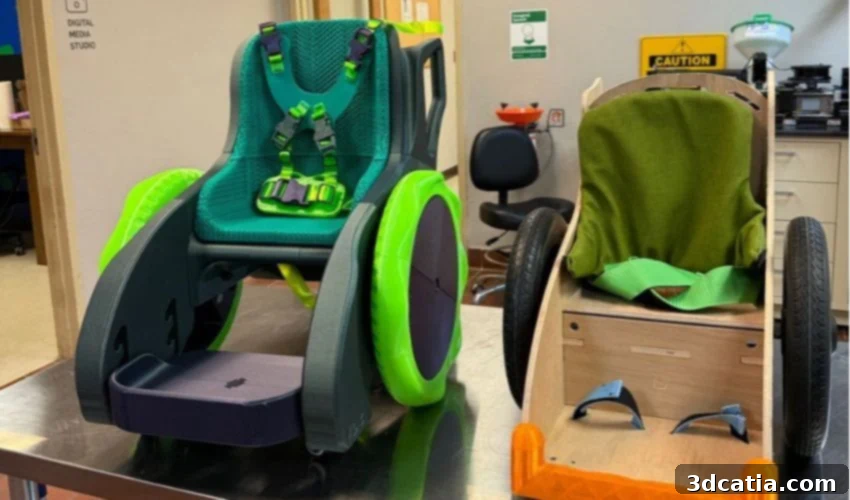
MakeGood’s Breakthrough: The First Fully 3D Printed Wheelchair for Children, Designed for Independence and Accessibility
Imagine a world where children facing mobility challenges can achieve independence from an exceptionally young age, confidently navigating their surroundings and engaging with their environment. Now, envision that crucial mobility device being crafted with a simple 3D printer, requiring absolutely no tools, screws, or glue for its assembly. This inspiring vision has been transformed into a tangible reality by MakeGood, a pioneering New Orleans-based organization wholeheartedly dedicated to the design and development of innovative assistive technologies. They have successfully conceived, engineered, and recently unveiled the first-ever fully 3D printed wheelchair specifically tailored for children. While currently a functional prototype, this revolutionary design holds immense promise to empower countless young lives, fostering independent movement, facilitating early exploration, and setting an unprecedented standard for accessible, customizable, and user-friendly assistive devices globally.
This meticulously engineered wheelchair is specifically aimed at children aged 2 to 8 years old, a pivotal developmental stage where independent mobility is crucial for cognitive and social growth. What truly distinguishes this project is its profound commitment to widespread accessibility: remarkably, anyone with access to a standard consumer 3D printer can build one. Every single part required for the wheelchair’s construction was efficiently printed using a Bambu Lab A1, a popular and relatively accessible 3D printer, showcasing the potential for decentralized manufacturing. The assembly process itself is ingeniously intuitive, completely eliminating the need for specialized tools, cumbersome screws, or messy adhesives. Instead, the various components are designed to precisely interlock, much like a sophisticated and robust jigsaw puzzle, allowing for straightforward and rapid construction. The entire development journey of this groundbreaking chair, from its initial conceptualization to the unveiling of this first working version, has been transparently documented and shared by the project members across various social networks, actively inviting community feedback and collaborative input. This is not a static design; rather, it is a dynamic and evolving project, with a steadfast goal to continuously optimize and refine the solution. The ultimate aim is to offer children with motor disabilities an adaptive, highly effective, and easily reproducible mobility solution that genuinely enhances their quality of life, broadens their horizons, and grants them greater autonomy in their daily lives.
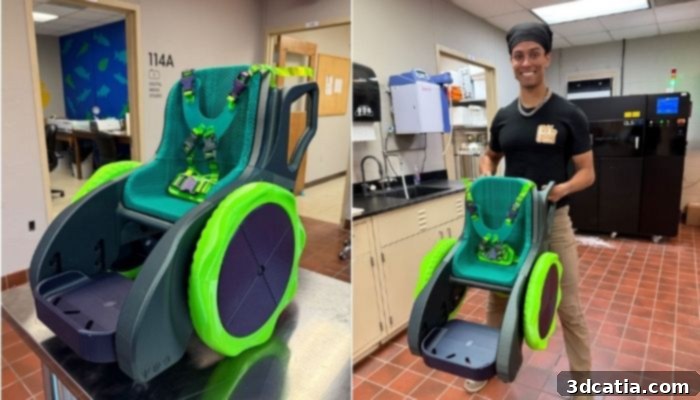
The innovative 3D-printed children’s wheelchair will empower young users to move around independently, opening new avenues for play and exploration.
The choice of material for this pioneering wheelchair underscores a primary focus on durability, safety, and practicality. The entire structure was designed in and printed from PETG, a high-performance thermoplastic celebrated for its exceptional impact resistance, flexibility, and suitability for applications requiring resilience. This material selection ensures that the wheelchair can robustly withstand the typical wear and tear associated with active children, providing both lasting structural integrity and peace of mind for parents and caregivers. Every single component, without exception, has been meticulously 3D printed – from the foundational frame that provides crucial structural support to the functional wheels, robust tires, the ergonomically designed seat, and even the essential safety straps. This comprehensive approach to additive manufacturing highlights the incredible versatility of PETG and the design team’s commitment to a fully integrated, all-3D-printed solution. A standout feature is the seat, which captivates with its intricate lattice pattern. This unique design is far more than just aesthetically pleasing; it serves a vital functional purpose, providing an optimal balance of comfort, breathability, and essential postural support, perfectly contoured to the specific anatomical requirements of growing children. Furthermore, the footrest has been thoughtfully engineered to be easily adjustable, intelligently accommodating the child’s growth over time and ensuring a comfortable and ergonomic fit as they develop. Practicality is also seamlessly integrated into the design; at the rear of the chair, a discreet yet capacious compartment has been integrated. This valuable feature allows children or caregivers to conveniently store personal items, favorite toys, or even crucial medical equipment, such as a portable ventilator, transforming the wheelchair into a truly comprehensive and adaptable mobility solution. The wheels themselves present another innovative design element; they are notably oblong, meaning they are longer than they are wide. This unconventional shape is a deliberate and brilliant choice, specifically engineered to be remarkably easier for young users to grip and propel, significantly enhancing maneuverability, control, and ultimately fostering greater independence. Lastly, a core tenet of the wheelchair’s ingenious design is its inherent modularity. This intelligent system implies that should any individual part experience breakage or significant wear and tear, only that specific damaged component needs to be reprinted and replaced, rather than the entire unit. This modularity not only drastically simplifies maintenance and repair procedures but also substantially reduces long-term costs and minimizes material waste, positioning the wheelchair as an exceptionally sustainable, economically viable, and practical choice for families worldwide.
The Visionaries Behind This Groundbreaking 3D Printed Wheelchair for Children
The genesis of this groundbreaking 3D printed wheelchair stands as a powerful testament to the transformative power of collaborative innovation, born from the synergy of a multidisciplinary team of talented designers and architects. This particular project marks not their first venture into the realm of advanced assistive technology; for a considerable period, MakeGood has been actively engaged in a highly productive partnership with Tikkun Olam Makers (TOM), an organization dedicated to creating solutions for neglected challenges. Their previous collaborative efforts centered around the development of the Toddler Mobility Trainer (TMT), an ingenious mobility training device specifically conceptualized for young children, which was initially constructed primarily from wood. Recognizing the immense, untapped potential of additive manufacturing to overcome the inherent limitations and complexities of traditional fabrication methods, MakeGood sought to dramatically elevate the TMT concept. To take this ambitious vision a crucial step further and to make this essential device widely accessible through the capabilities of 3D printing, they strategically joined forces with LINK PBC, a highly specialized company renowned for its profound expertise in industrial design and its proficiency in optimizing products specifically for additive manufacturing. This pivotal collaboration proved to be an absolute game-changer. Thanks to the combined insights, innovative thinking, and specialized skills of all parties, the Toddler Mobility Trainer was entirely re-envisioned and meticulously redesigned from its very foundations to be fully 3D printable. This transformative process effectively eliminated the numerous and often restrictive constraints associated with traditional manufacturing methods, which frequently demand specialized tools, intricate molds, and complex, expensive production lines. By embracing 3D printing, they paved the way for a more streamlined, significantly more cost-effective, and globally scalable solution that promises to democratize access to vital mobility aids.
While the fully 3D printed wheelchair represents a monumental leap forward in assistive technology, it is important to clearly understand that it is not yet a finalized, mass-produced consumer product. Instead, it serves as an exceptionally robust and highly promising prototype, providing an incredibly solid foundation for continuous innovation, iterative design improvements, and future refinements. Noam Platt, the visionary founder and driving force behind MakeGood, has openly emphasized that the development process is very much ongoing, dynamic, and iterative. The dedicated MakeGood team is committed to meticulously optimizing every conceivable aspect of the design, striving to ensure that the final product is as refined, functional, and user-friendly as humanly possible. This crucial optimization process is heavily informed by invaluable feedback gathered directly from initial users, rigorous field tests conducted in real-world environments, and creative ideas generously contributed by the wider community of makers, designers, and caregivers. This commitment to an open, responsive, and community-driven development cycle guarantees that the wheelchair will genuinely meet and exceed the evolving needs of its young users. The ultimate aspiration behind this ambitious and transformative project is to deliver a perfected, thoroughly tested, and finished version that transcends geographical and socioeconomic barriers. The long-term goal is that anyone, anywhere in the world, with access to a standard consumer 3D printer, will be able to effortlessly download the open-source design files, print the individual components in their preferred color, and easily assemble a fully functional, custom-fit wheelchair for a child in need, almost immediately. This grand vision embodies a future where personalized assistive technology is not a luxury afforded to a few, but an accessible and widespread reality, fundamentally transforming the lives of children with motor disabilities by granting them unprecedented levels of autonomy and independence from a very early age, fostering a new generation of active, engaged, and empowered individuals.
The implications of MakeGood’s remarkable innovation extend far beyond mere individual mobility; this project serves as a powerful testament to how additive manufacturing can profoundly democratize access to essential medical and assistive devices. This is particularly critical in regions where traditional manufacturing infrastructure and established supply chains face significant challenges, often leaving vulnerable populations underserved. By offering a design that is open-source in spirit and inherently easily reproducible, MakeGood is not merely creating a product; they are actively fostering a global community of makers, innovators, and compassionate caregivers capable of providing localized, personalized solutions. This empowers local communities to effectively address their specific needs without being overly reliant on complex international logistics or prohibitively expensive imports. The potential for extensive customization – whether adapting the chair’s dimensions to perfectly fit a child, choosing vibrant colors for personalization, or even incorporating specific features to accommodate unique medical requirements – is immense. This ensures that each child receives a device that is perfectly suited to their individual body and needs, a level of personalization that is often either prohibitively expensive or simply unavailable through conventional manufacturing means. Moreover, the modular design of the wheelchair not only drastically simplifies maintenance and repair but also actively promotes principles of circularity and environmental sustainability. Instead of discarding an entire device due to a single broken or worn part, users can simply print a replacement component, significantly extending the product’s lifespan and drastically reducing material waste. This thoughtful approach aligns seamlessly with modern ecological principles and economic efficiency, offering a truly holistic solution.
What are your thoughts on this groundbreaking first 3D printed wheelchair for children and its potential to revolutionize assistive technology? We warmly invite you to share your valuable insights and comments below or join the vibrant conversation on our LinkedIn, Facebook, and Twitter pages! Don’t miss out on the very latest advancements and exciting developments in additive manufacturing – be sure to sign up for our free weekly Newsletter here, delivering the most relevant 3D printing news straight to your inbox every week! For an immersive visual experience and in-depth demonstrations, you can also find all our compelling videos on our dedicated YouTube channel. If your professional or personal interest lies specifically in more 3D printing news within the dynamic medical and dental sector, we encourage you to click HERE to explore further articles and insights.
*All Photo Credits: Noam Platt, LinkedIn