

Advancing Space Manufacturing: Boeing and Titomic Pioneer Sustainable Titanium 3D Printing
The aerospace industry is undergoing a transformative shift, with additive manufacturing, commonly known as 3D printing, emerging as a cornerstone technology. This revolutionary approach offers unparalleled benefits, including unprecedented design freedom, significant reductions in manufacturing time, and substantial cost savings. These advantages have attracted a diverse range of innovative players across the sector. From pioneering companies like Fleet Space, which is at the forefront of developing fully 3D printed satellites, to ambitious ventures such as Luyten, which harbors plans to print structures directly on the lunar surface, the adoption of additive manufacturing is rapidly expanding. Its integration into critical aerospace applications continues to accelerate, driven by the constant demand for lighter, stronger, and more efficiently produced components. In a significant move highlighting this trend, aerospace giant Boeing, already a seasoned advocate of additive manufacturing, has forged a strategic partnership with Australian 3D printer manufacturer Titomic. This collaboration is set to push the boundaries of 3D printing within the demanding space sector, particularly focusing on sustainable material advancements.
This pivotal collaboration between Boeing and Titomic has been significantly bolstered by a substantial $2.325 million grant from the Australian government. The core objective of this initiative is to rigorously investigate and validate the use of sustainable titanium powders in advanced 3D printing processes. These innovative materials are destined for the production of critical components for next-generation space vehicles and satellites, promising to enhance their performance and environmental footprint. Paul Watson, Boeing Defence Australia’s Director of Aerospace Engineering and Production, articulated the profound value of this partnership, stating, “Demonstrating that additive manufacturing technology, or large-scale 3D printing, using green titanium produces highly resilient, lightweight components will have broad-ranging application across the space sector.” This statement underscores the strategic importance of developing robust, lightweight materials for space exploration and satellite deployment. Moreover, this partnership serves to highlight a burgeoning trend within Australia’s advanced manufacturing landscape, where 3D printing is increasingly being leveraged for aerospace applications. A notable example of this innovative spirit is SPEE3D’s groundbreaking work in printing metal rocket engines, further solidifying Australia’s position as a hub for cutting-edge space technology development.
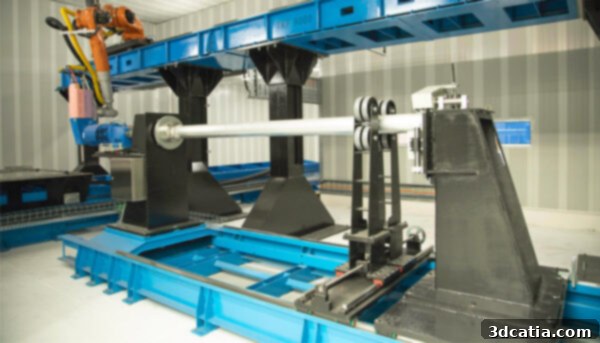
Photo Credits: Titomic
The Unrivaled Advantages of Titanium for Space Applications
Titanium has long been a material of choice within the aerospace industry, and for excellent reasons. Its inherent properties make it exceptionally attractive for demanding applications, particularly in space. Foremost among these is its extraordinary strength-to-weight ratio, which allows for the creation of components that are both incredibly robust and remarkably light. This characteristic is paramount in aerospace, where every gram of weight saved translates into significant fuel efficiency and payload capacity benefits. Beyond its strength, titanium boasts excellent corrosion resistance, a vital attribute for parts exposed to the harsh and extreme conditions of space, including intense radiation and extreme temperature fluctuations. Furthermore, its relative sustainable properties, particularly when processed through advanced additive manufacturing techniques, contribute to a reduced environmental footprint, aligning with global efforts towards greener manufacturing. The synergy between titanium’s superior material properties and the precision of 3D printing unlocks new possibilities for aerospace design and performance.
Titomic Kinetic Fusion: A Revolution in Metal Additive Manufacturing
To harness the full spectrum of benefits offered by titanium, Titomic is deploying its proprietary machines, which are based on the innovative Titomic Kinetic Fusion (TKF) process, for this collaboration with Boeing. This cutting-edge technology operates on the principle of cold spraying, an advanced additive manufacturing method that differs significantly from traditional fusion-based techniques. Unlike processes that rely on melting metal powders with lasers or electron beams, TKF projects titanium particles onto a print substrate at exceptionally high speeds. This high-velocity impact causes the particles to plastically deform and metallurgically bond with the substrate and with each other, forming a dense and robust final part without melting. The cold spray process offers several distinct advantages, particularly for aerospace applications. It minimizes thermal distortion and residual stresses, preserving the inherent material properties of titanium. It also allows for the creation of larger, more complex parts with superior material integrity. With this groundbreaking process and the optimal material choice of titanium, Boeing and Titomic aspire to design and produce aerospace components that not only meet the highest quality standards but are also supremely durable – a characteristic that, as one can imagine, is absolutely critical for the safety and reliability required in the unforgiving environment of the space industry. The precision and integrity offered by TKF ensure that these components can withstand the rigorous demands of launch and orbital operations.
Sustainability at the Core: The “Green Titanium” Initiative
The concept of “green titanium” is central to this pioneering partnership, reflecting a broader industry commitment to environmental stewardship. Traditional titanium manufacturing can be energy-intensive and produce significant waste. By focusing on sustainable titanium powders, Boeing and Titomic are addressing these concerns head-on. Additive manufacturing, by its nature, is a more efficient production method than subtractive manufacturing (machining), as it builds parts layer by layer, generating significantly less material waste. Furthermore, the use of recycled titanium powders or those sourced through environmentally responsible processes can further reduce the overall carbon footprint. This initiative is not merely about creating lightweight components; it’s about establishing a more sustainable lifecycle for aerospace manufacturing, from material sourcing to final product. The long-term vision includes reducing energy consumption, minimizing waste, and exploring closed-loop recycling systems for these high-value materials, setting a new standard for responsible manufacturing in space exploration.
Boeing’s Enduring Commitment to Additive Manufacturing
Boeing’s engagement with Titomic is a testament to its long-standing and strategic commitment to additive manufacturing. The aerospace giant has been integrating 3D printed parts into its aircraft and spacecraft for years, recognizing the technology’s potential for innovation and efficiency. From simple brackets to complex engine components, Boeing has leveraged additive manufacturing to reduce part count, improve performance, and streamline supply chains. This collaboration with Titomic extends Boeing’s capabilities into the realm of large-scale, high-performance metallic components specifically for space, an area where the stakes are incredibly high. The partnership leverages Boeing’s extensive design and engineering expertise, which is critical for defining the requirements and validating the performance of space-grade parts. Paul Watson elaborated on this synergy, stating, “Under the agreement, Boeing will provide the designs and engineering expertise to enable Titomic to demonstrate its cutting-edge kinetic fusion additive manufacturing technology on the production of space parts, initially for JP9102.” This specifically refers to Australia’s JP9102 project, a crucial satellite communications program, indicating that the collaboration aims to deliver tangible, operational benefits to Australia’s defense and space capabilities.
Australia’s Soaring Ambitions in the Space Industry
The Australian government’s substantial grant underscores a national commitment to fostering a vibrant and innovative space industry. Australia is rapidly emerging as a significant player in the global space economy, driven by strategic investments, strong research capabilities, and a collaborative ecosystem. Initiatives like the Boeing-Titomic partnership are vital for nurturing local talent, developing advanced manufacturing capabilities, and positioning Australia at the forefront of space technology. The focus on sustainable materials and advanced manufacturing techniques aligns perfectly with Australia’s broader goals for technological innovation and environmental responsibility. The growth of companies like SPEE3D, with their metal rocket printing endeavors, alongside the developments from Fleet Space and Luyten, paints a picture of a dynamic and forward-thinking space sector. This collaborative spirit, bolstered by government support, is creating a fertile ground for breakthroughs that could have far-reaching implications for international space exploration and satellite services.
Future Outlook and Broader Implications
The partnership between Boeing and Titomic, centered on sustainable titanium 3D printing, represents more than just a technological advancement; it signifies a pivotal step towards the future of space manufacturing. The ability to produce lightweight, resilient, and environmentally conscious components on demand will accelerate innovation in satellite constellations, deep-space probes, and crewed missions. As the demand for space services escalates, the efficiency and cost-effectiveness offered by additive manufacturing, particularly with advanced materials like green titanium, will become indispensable. However, challenges remain, including the need for industry-wide standardization, rigorous qualification processes for additively manufactured parts, and continued efforts to scale up production while reducing costs. Nevertheless, the trajectory is clear: 3D printing, combined with advanced material science, is set to revolutionize how we design, build, and deploy assets in space. It will certainly be interesting to observe how 3D printing and the use of sustainable titanium powders continue to expand and mature within the Australian Space Industry and globally in the coming months and years. For more comprehensive details on this exciting collaboration, interested readers can access Boeing’s official press release HERE.
What are your thoughts on this significant collaboration between Boeing and Titomic and its potential impact on space manufacturing? Let us know in a comment below or connect with us on our Linkedin, Facebook, and Twitter pages! And don’t forget to sign up for our free weekly Newsletter here, to get the latest 3D printing news delivered straight to your inbox! You can also find all our videos and interviews on our YouTube channel.