
Blackstone Resources: Revolutionizing Battery Technology with Advanced 3D Printing for High-Density, Sustainable Solutions
In a world increasingly reliant on efficient and sustainable energy storage, innovation in battery technology is paramount. Swiss company Blackstone Resources, established in 1995, stands at the forefront of this revolution. They specialize in cutting-edge battery production, leveraging additive manufacturing techniques to engineer lithium-ion battery cells that boast an impressive 20% higher energy density than conventional counterparts. Through their patented Thick Layer Technology process, Blackstone Resources is not just developing batteries; they are creating a new standard for environmentally friendly, highly durable, and extraordinarily powerful energy solutions. The company has proudly announced its readiness for mass production, a monumental step poised to significantly reshape the global battery market and accelerate the transition towards a more sustainable energy future.
The integration of additive manufacturing, commonly known as 3D printing, into the production of advanced batteries, particularly solid-state variants, offers transformative advantages. This innovative approach is especially compelling for several reasons: it dramatically increases energy density, allows for a substantial reduction in the overall size and weight of battery packs, and simultaneously enhances performance across the board. These benefits are critical for a wide array of applications, from electric vehicles to portable electronics and grid storage. The underlying principle is the ability of 3D printing to create intricate internal structures and precise material deposition, optimizing every cubic millimeter of the battery cell. This level of design freedom and manufacturing precision is simply not achievable with traditional battery production methods.
The Dawn of 3D Printed Batteries: Enhancing Energy Density and Performance
The potential of 3D printing in battery manufacturing isn’t merely theoretical; it’s rapidly becoming a commercial reality. For instance, the challenge of creating highly efficient, customizable battery solutions was notably addressed by Sakuu in May, when the company unveiled plans for a platform enabling electric car owners to 3D print their vehicle’s battery. While this concept might have sounded futuristic just a few years ago, the pace of technological advancement confirms its imminent feasibility. Blackstone Resources further solidifies this trend with the strategic opening of a dedicated production line for small series of 3D printed batteries in Döbeln, Germany. This facility is a testament to the company’s commitment to industrializing this advanced manufacturing process, moving beyond prototyping to actual production and demonstrating the scalability of their pioneering technology. The ability to produce bespoke battery solutions quickly and efficiently marks a significant leap forward for the entire industry, offering tailored power sources for specific applications rather than relying on generic, one-size-fits-all designs.

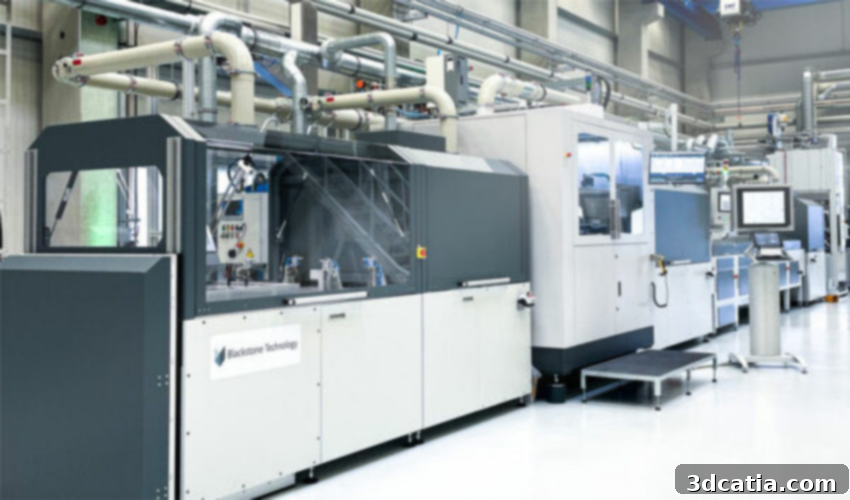
Blackstone Resources uses 3D printing to create more efficient batteries. (Photo Credit: Blackstone Resources)
Blackstone’s Patented Thick Layer Technology: Unlocking Unprecedented Efficiency
At the heart of Blackstone Resources’ groundbreaking innovation is its proprietary 3D printing process, specifically designed to engineer Lithium Iron Phosphate (LFP) battery cells. This sophisticated method utilizes a high-performance cathode material expertly developed by IBU-Tec, a partnership that yields exceptional results. The synergy between Blackstone’s additive manufacturing expertise and IBU-Tec’s material science allows for a breakthrough output of 220 Watt-hours per kilogram (Wh/kg). This figure is remarkably impressive in today’s landscape, especially when compared to the industry’s most advanced conventional solutions, which typically achieve figures closer to 166 Wh/kg. This significant difference represents a tangible increase in energy density, translating directly into longer operating times for devices, extended ranges for electric vehicles, and more compact battery packs across various applications.
Blackstone Resources is not content with current achievements, as articulated in their official press release: “We are currently starting with LFP and NMC cells, but the technology will be applicable to all cell chemistries. In the future, we also want to print solid-state batteries – with solid-state technology, the energy density can be increased by 70%, which is remarkable.” This statement underscores the versatility and future-proof nature of their 3D printing platform. While LFP and Nickel Manganese Cobalt (NMC) chemistries are crucial for today’s market, the ultimate goal is to pioneer the mass production of solid-state batteries. Solid-state technology is considered the holy grail of battery development due to its inherent safety, longer lifespan, and significantly higher energy density potential. A 70% increase in energy density with solid-state technology would be a game-changer, pushing the boundaries of what is currently possible and unlocking entirely new possibilities for electric aviation, long-range EVs, and next-generation portable devices.
Tailored Power: Custom Battery Solutions for Diverse Industries
One of the most compelling aspects of the production line established by Blackstone Resources is its unparalleled capability to manufacture made-to-measure battery cells. This means that the size, shape, and even internal architecture of the battery can be precisely adapted to meet specific customer requirements, moving away from the limitations of standardized battery formats. This flexibility opens up a world of possibilities for industries where space optimization and unique form factors are critical. Blackstone Resources provides the concrete example of the automotive sector, where the battery pack’s placement can vary significantly depending on the vehicle model and design. This often leads to different volumetric and geometric constraints, which traditional battery manufacturing struggles to accommodate efficiently. With 3D printing, complex, non-standard shapes can be produced with ease, perfectly fitting into available spaces and optimizing vehicle design.
Beyond the automotive industry, this customization capability holds immense value for sectors like aerospace, where every gram and cubic centimeter counts, or for medical devices requiring highly specialized power sources. The company asserts that its 3D printed batteries offer substantial benefits in terms of spatial efficiency and material savings. Specifically, they claim their batteries can save up to 15% space within a device or vehicle, allowing for more compact designs or the integration of additional features. Furthermore, the material optimization achieved through their additive manufacturing process translates into significant cost reductions, saving up to 20 euros per kilowatt-hour (kWh) in material expenses. These savings, combined with improved performance and adaptability, present a formidable value proposition for manufacturers seeking advanced, cost-effective, and tailor-made energy storage solutions.
A Commitment to Sustainability: Greener Batteries for a Brighter Future
Ulrich Ernst, Founder and CEO of Blackstone Resources, passionately articulates the company’s dual commitment to technological advancement and environmental stewardship. He emphasizes the profound impact of their innovations: “Our 3D-printed batteries allow us to increase the energy density of our charge carriers by 20% while significantly reducing the effects on the environment. The patented process is based on an ecological, purely water-based process and reduces waste by 50%. In this way, we are making an important and lasting contribution to the transport revolution and to the fight against climate change.” This statement highlights a core principle driving Blackstone Resources: sustainability is not an afterthought but an integral part of their manufacturing philosophy.
The use of a purely water-based process for battery production is a significant environmental advantage, drastically reducing the reliance on harsh, toxic solvents often used in traditional battery manufacturing. This not only minimizes the ecological footprint of the production process but also enhances worker safety. Furthermore, the ability to reduce waste by an impressive 50% speaks volumes about the efficiency and resourcefulness of their additive manufacturing approach. By minimizing material waste and incorporating eco-friendly processes, Blackstone Resources is directly contributing to a circular economy model for battery production. This commitment positions them as a key player in the global effort to combat climate change, offering a cleaner, more sustainable pathway to meet the burgeoning demand for high-performance batteries required by the accelerating transport revolution and the broader energy transition.
Scaling Up: Mass Production and the Global Impact of Blackstone Batteries
Blackstone Resources has strategically opened its advanced fleet of machines, enabling the serial production of battery cells on an industrial scale. The company harbors ambitious plans, aiming to manufacture a battery cell every second once fully operational, illustrating a commitment to high-volume output necessary to meet global demand. This rapid production capability is crucial for making a tangible impact on the market. The versatility of their 3D printing platform means that various shapes of cells can be developed, allowing for optimal integration into diverse product designs. This flexibility extends to the use of different electrode and electrolyte materials, paving the way for continuous innovation and adaptation to emerging battery chemistries and performance requirements.
The operational site in Döbeln, Germany, currently employs 14 dedicated individuals, a number projected to grow significantly to 38 by next year. This expansion in workforce underscores the increasing scale of operations and the positive economic impact of Blackstone’s endeavors. The mass production of these highly efficient, customizable, and environmentally friendly batteries holds the potential to profoundly influence multiple sectors. From accelerating the adoption of electric vehicles by providing better, cheaper, and more adaptable power sources, to enabling longer-lasting consumer electronics and revolutionizing industrial energy storage, the implications are vast. This development represents not just an incremental improvement but a fundamental shift in how batteries are designed, manufactured, and utilized. It’s a journey we will undoubtedly be following with great interest, anticipating the transformative changes Blackstone Resources will bring to the energy landscape. For more detailed information and updates, interested parties can find additional resources HERE.
What are your thoughts on this pioneering project from Blackstone Resources? We invite you to share your insights and comments below, or engage with us on our social media channels: LinkedIn, Facebook, and Twitter! Don’t miss out on the latest advancements in additive manufacturing; sign up for our free weekly Newsletter here to get the freshest 3D printing news delivered straight to your inbox. You can also discover all our compelling videos and expert analyses on our YouTube channel.
Cover Photo Credit: Blackstone Resources