
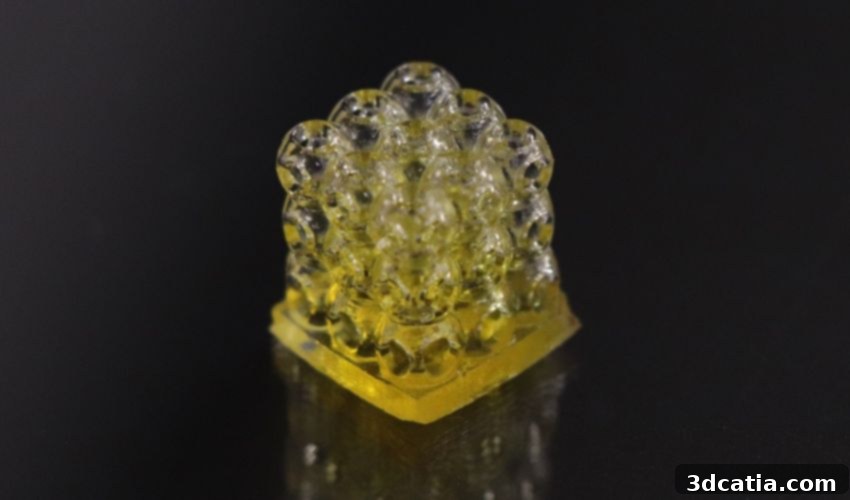
BIORES INX: Revolutionizing Bioprinting with a Game-Changing Gelatin-Based Bioink for DLP 3D Printing
The landscape of advanced manufacturing and regenerative medicine has just been significantly transformed by the launch of BIORES INX. This groundbreaking gelatin-based bioink resin, developed by the innovative Belgian startup BIO INX, is specifically designed for Digital Light Processing (DLP) 3D printing. For years, the immense potential of bioprinting with DLP technology has been hampered by a crucial bottleneck: the limited availability of truly biocompatible and biodegradable materials that can effectively function within this high-resolution printing paradigm. BIORES INX directly addresses this challenge, opening up unprecedented avenues for sophisticated tissue regeneration applications, including critical work on cartilage, bone, and even intricate cardiac tissues. This introduction is not merely an evolutionary step; it represents a fundamental shift in what is achievable in 3D bioprinting, providing researchers and clinicians with a material that offers both exceptional performance and streamlined integration into existing scientific workflows.
What truly sets BIORES INX apart from other bioinks available in the market is its meticulously engineered composition and distinct operational advantages. At its core, the bioink is formulated using gelatin methacrylamide (GelMA), a derivative of natural collagen. This choice of material is highly strategic, as GelMA closely mimics the natural extracellular matrix (ECM) of biological tissues. The ECM is the intricate network of molecules that provides structural and biochemical support to surrounding cells, playing a vital role in cell adhesion, proliferation, and differentiation. The ability of BIORES INX to replicate this natural cellular environment is paramount for successful tissue engineering, as it furnishes the essential cues for cells to behave organically within a printed construct. According to BIO INX, GelMA is widely considered the “gold standard” in the fields of tissue engineering and biofabrication, primarily due to its outstanding biocompatibility and its mechanically tunable properties. Once printed using advanced DLP technology, BIORES INX rapidly cross-links to form a robust, biocompatible, and biodegradable hydrogel network. This hydrogel structure is ideally suited for a broad spectrum of biomedical applications, ranging from the regeneration of soft tissues like muscles and blood vessels to addressing the more complex requirements of hard tissue repair, such as in bone and cartilage regeneration.
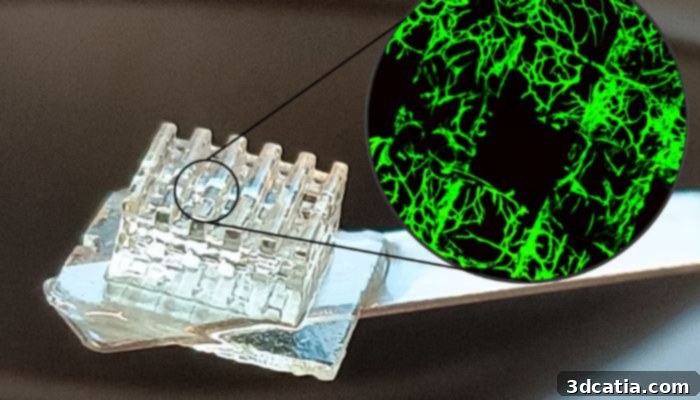
Microscopic view of a scaffold printed with BIORES INX, highlighting its structural integrity and potential for tissue integration.
Beyond its sophisticated material science, BIORES INX delivers substantial practical benefits for bioprinting laboratories and manufacturing settings. A key attribute that stands out is its “ready-to-print” functionality: it remains in a liquid state and is stable at room temperature. This might appear to be a minor detail, but it represents a significant operational leap compared to many traditional gelatin-based resins. Historically, a major impediment for such materials is their tendency to solidify at room temperature, necessitating the use of specialized heated containers or chambers to maintain fluidity throughout the printing process. This requirement introduces several layers of complexity: it adds to equipment costs, increases setup time, and crucially, heating can lead to undesirable effects such as water evaporation. Evaporation can alter the bioink’s concentration, viscosity, and ultimately compromise the consistency and quality of the printed construct. By offering a gelatin-based resin that is readily available and liquid at ambient temperatures, BIO INX dramatically simplifies the bioprinting workflow, mitigates potential errors, and makes the overall process more efficient and accessible for users. Furthermore, BIORES INX is delivered sterile and is ISO 10993-3 certified. This international standard is paramount for medical devices and biomaterials, specifically affirming that the resin exhibits excellent biocompatibility and is rigorously tested for the absence of cytotoxicity, genotoxicity, and other adverse biological reactions. This pre-certification significantly streamlines research and development timelines, allowing scientists and engineers to concentrate their efforts on pioneering applications rather than exhaustive material validation.
The strategic impetus behind the development of BIORES INX was eloquently articulated by Dr. Aysu Arslan, Chief Scientific Officer at BIO INX. She underscored the company’s profound conviction in the transformative power of light-based bioprinting technologies. “We believe that light-based bioprinting is the future of bioprinting thanks to elevated levels of reproducibility, higher resolution, and faster printing speeds,” Dr. Arslan affirmed. This vision highlights the intrinsic advantages of DLP and other light-based methods, which enable the creation of extraordinarily intricate and high-fidelity biological structures with unparalleled precision – a non-negotiable requirement for crafting complex, functional biological constructs. The capability to achieve consistent and repeatable outcomes is crucial for robust research validation and, ultimately, for successful clinical translation. Moreover, the inherent speed of light-based printing considerably reduces fabrication times, facilitating quicker prototyping cycles and increased throughput in research and manufacturing environments. Dr. Arslan further expounded on the synergistic relationship between this advanced printing technology and their chosen material: “The combination of light-based printing technologies with the extreme biocompatibility of gelatin is ideal for biofabrication applications.” This statement encapsulates a core tenet of BIO INX’s philosophy: to meticulously blend cutting-edge printing methodologies with biologically relevant materials to maximize efficacy in creating viable and functional tissues and organs, thereby propelling the field of biofabrication forward.
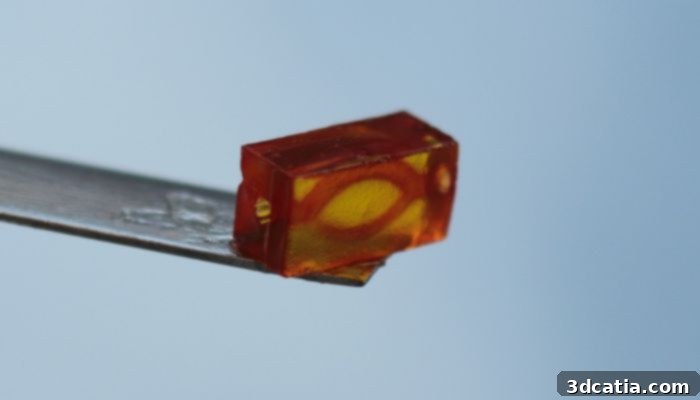
Intricate printed blood vessel structure using BIORES INX, showcasing its capability for complex vascularized constructs.
BIO INX has rapidly solidified its position as a prominent market leader in the supply of bioinks for high-resolution bioprinting. Their extensive expertise spans not only light-based 3D printing but also encompasses materials specifically developed for extrusion 3D printing, underscoring their comprehensive understanding of diverse bioprinting methodologies. The introduction of BIORES INX represents a logical and strategic progression within their robust product development roadmap. As Dr. Arslan elaborated, “After introducing our HydroBIO INX portfolio for high-resolution printing and ReadyGel INX for volumetric printing, developing a gelatin-based DLP resin was the logical next step.” This systematic expansion ensures that BIO INX continues to proactively meet the evolving and diverse demands of the global bioprinting community across a multitude of applications. She further highlighted a specific technical challenge that their team ingeniously overcame with this latest innovation: “However, unlike volumetric and MPL printing, where gelatin’s gelation behavior at room temperature is advantageous, it posed a challenge for DLP printing—one we are thrilled to have overcome with this latest innovation.” This candid insight demonstrates the profound technical prowess and problem-solving capabilities of BIO INX’s research and development team, who successfully engineered a gelatin-based material that not only retains its highly desirable biological properties but also surmounts the specific physical constraints typically associated with light-based DLP processes. The launch of BIORES INX emphatically reinforces BIO INX’s unwavering commitment to pushing the boundaries of biofabrication by consistently providing cutting-edge, practical, and highly effective solutions for creating complex and functional biological structures.
The far-reaching implications of BIORES INX extend significantly beyond the confines of the laboratory bench, promising to reshape the future of regenerative medicine. This advanced bioink offers unprecedented precision and versatility, opening new frontiers for creating patient-specific implants, developing sophisticated drug testing models, and ultimately, engineering fully functional organs. Envision a future where damaged cardiac tissue can be meticulously repaired with a custom-printed patch tailored to an individual’s unique anatomy, or where bone grafts can be fabricated with exact dimensions and optimal cellular compatibility, leading to accelerated healing and a substantial reduction in post-operative complications. BIORES INX’s remarkable ability to support complex biological structures, combined with its operational ease-of-use and high-resolution capabilities, positions it as an exceptionally powerful tool for developing next-generation medical solutions. Researchers can now confidently explore the creation of more intricate vascular networks, develop more physiologically realistic “organ-on-a-chip” models for drug discovery and toxicology screening, and significantly accelerate the development of personalized therapies. This innovation not only pushes the very boundaries of what is conceivable in biotechnology but also brings us substantially closer to a future where the engineering of living tissues becomes a standard medical practice, profoundly improving countless lives globally.
We invite you to engage with us and share your thoughts on BIO INX’s revolutionary new bioink resin. What potential applications do you envision for BIORES INX in your field or in the future of medicine? Let us know in a comment below, or join the vibrant conversation on our LinkedIn, Facebook, and Twitter pages! Don’t forget to sign up for our free weekly Newsletter here to receive the very latest 3D printing news and insights straight to your inbox! You can also find all our compelling videos on our YouTube channel.
*All Photo Credits: BIO INX