
BCN3D and Henkel Drive Innovation with VLM: Advancing Viscous Lithography 3D Printing and High-Performance Resins
The landscape of additive manufacturing is continuously evolving, with strategic partnerships often serving as catalysts for groundbreaking innovation. A prime example of such a collaboration began in 2020, when the Spanish 3D printing pioneer BCN3D and the German industrial conglomerate Henkel Group forged a long-term alliance. This partnership, initially focused on general advancements in additive manufacturing, has recently intensified its efforts, shifting its strategic focus towards the development of advanced material formulations for BCN3D’s innovative Viscous Lithography Manufacturing (VLM) 3D printing technology. Henkel, renowned for its expertise in providing comprehensive end-to-end engineering solutions within the additive manufacturing ecosystem, is playing a pivotal role in creating new, high-performance materials tailored for VLM. This strategic alignment is crucial for BCN3D as it strives to achieve its ambitious goal of accelerated manufacturing autonomy and push the boundaries of industrial 3D printing.
The overarching vision of this collaborative endeavor between these two industry leaders is to establish full control over every intricate stage of the production process within additive manufacturing. To transform this vision into a tangible reality, the unique properties and inherent advantages of VLM technology will be leveraged to engineer novel and highly innovative solutions, particularly in the realm of high-performance resins. This integrated approach promises to unlock new possibilities for industrial applications, where material quality, performance consistency, and production efficiency are paramount.
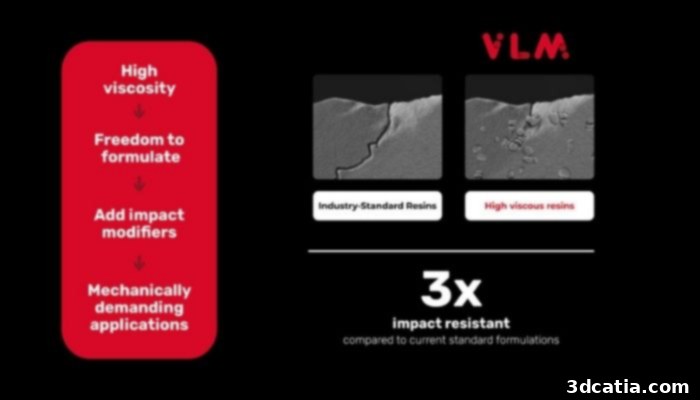
Viscous Lithography Manufacturing (VLM) technology offers numerous advantages in additive manufacturing, enhancing material versatility and performance (photo: BCN3D/Henkel).
Unveiling Viscous Lithography Manufacturing (VLM): A Game-Changing 3D Printing Technology
At its core, Viscous Lithography Manufacturing (VLM) represents a groundbreaking evolution in lithography-based 3D printing processes. Unlike conventional resin 3D printing methods, VLM employs a sophisticated mechanism where ultra-thin layers of highly viscous resins are precisely laminated onto a transparent transfer film. This innovative approach facilitates the rapid and cost-effective production of high-performance components, setting a new benchmark for efficiency and material capabilities in additive manufacturing. The fundamental distinction that sets VLM apart from existing resin technologies in additive manufacturing lies in its unparalleled ability to process resins that are up to 50 times more viscous than the industrial standard resins utilized today. This remarkable capability is a direct result of recent technological advancements and modifications that have overcome traditional constraints in resin handling.
The enhanced viscosity handling of VLM is not merely a technical achievement; it opens up a vast new spectrum of material possibilities. Previously, the high viscosity of certain additives and specialized ingredients made them impractical or impossible to incorporate into 3D printable resins. With VLM, these limitations are largely removed. New ingredients, once deemed unsuitable for additive manufacturing due to viscosity issues, can now be seamlessly integrated into resin formulations. This allows for unprecedented control over the final material properties, enabling engineers to precisely tailor the thermal, mechanical, and chemical characteristics of 3D printed parts. For instance, the addition of specific reinforcing agents or functional fillers, which naturally increase resin viscosity, can now be used to significantly enhance a component’s strength, heat resistance, or electrical conductivity, directly addressing the evolving demands of various industrial applications.
Henkel’s Indispensable Role in Material Innovation for VLM
The success and widespread adoption of a revolutionary 3D printing technology like VLM are intrinsically linked to the availability of advanced, high-performance materials. This is precisely where Henkel’s profound expertise comes into play. As a global leader in adhesives, sealants, and functional coatings, Henkel boasts an extensive history of innovation in material science and a deep understanding of the requirements for industrial applications. Their additive manufacturing division is well-known for developing robust and application-specific engineering solutions, making them the ideal partner to drive the material development for VLM.
Sam Bail, Director of 3D Printing & Partnerships at Henkel, conveyed his enthusiasm and visible satisfaction regarding the joint achievements in advancing additive manufacturing: “BCN3D has unveiled a groundbreaking technology that enables printing high viscosity resins. Thermal & mechanical properties are enhanced by additives that typically increase the viscosity of the resins, which in other cases makes them more difficult to print. The BCN3D team has developed a novel technology that removes the limitations of viscosity and allows the printing of a wide range of new materials which we have witnessed firsthand over the last few years of collaboration. We look forward to seeing the tremendous impact VLM technology brings to the additive market together with new Henkel Industrial resins.”
Bail’s statement underscores the core breakthrough of VLM: its ability to process resins with significantly higher viscosity. This is critical because many desirable performance characteristics – such as increased tensile strength, improved impact resistance, or enhanced heat deflection temperature – often require the incorporation of fillers and additives that inherently raise a resin’s viscosity. In traditional resin 3D printing, such highly viscous materials are difficult to handle, prone to curing inconsistencies, and often lead to printer clogging or reduced part quality. VLM ingeniously circumvents these challenges, allowing Henkel’s material scientists to formulate resins with previously unattainable properties. These industrial-grade resins, developed by Henkel for VLM, will be instrumental in pushing the boundaries of what 3D printed parts can achieve in terms of functionality and durability across various sectors.
BCN3D’s Vision and the VLM Technology Adoption Program
BCN3D is not just developing a new technology; it is cultivating a holistic ecosystem designed to accelerate its adoption and unlock its full potential. The specialized resins formulated by Henkel for 3D printing are slated for deployment at BCN3D’s cutting-edge new application center. This facility will serve as a hub for innovation and testing, but more importantly, it will host the pioneering VLM Technology Adoption Program. This program is envisioned as a collaborative platform where external companies and industrial partners can gain early access to VLM technology, experiment with its capabilities, and integrate it into their specific workflows. By engaging a diverse range of users, the program aims to reveal the comprehensive potential of VLM technology and demonstrate its transformative impact on manufacturing processes as 3D printed parts are created and validated in real-world scenarios.
Xavier Martínez Faneca, CEO of BCN3D, articulated the strategic importance of this collaboration and program in a recent press release: “BCN3D is very excited to announce this collaboration with Henkel, and it represents a significant milestone in the history of VLM. The VLM Technology Adoption Program is showing us the potential of VLM technology and how it can help companies to overcome their current limitations. There is no doubt that this technology combined with new customer-targeted formulations will fulfill the needs of the AM sector.”
Faneca’s remarks highlight the reciprocal benefits of the partnership. While Henkel provides invaluable material science expertise, BCN3D offers the revolutionary VLM platform. The Technology Adoption Program is central to this synergy, acting as a proving ground for both the hardware and the specialized resins. It allows BCN3D to collect critical feedback from potential end-users, ensuring that the technology evolves in a way that directly addresses the real-world challenges and demands of the additive manufacturing sector. The ability to offer “customer-targeted formulations” is particularly significant, indicating a commitment to developing bespoke material solutions that meet the precise performance requirements of various industries, from automotive and aerospace to medical and consumer goods.
Synergy of the Partnership: A Future of Advanced Additive Manufacturing
The combined efforts of BCN3D and Henkel are poised to redefine the capabilities of industrial 3D printing. The long-term objective of achieving “full control over every stage of the production process” is not merely an aspiration but a strategic imperative that addresses some of the most persistent challenges in additive manufacturing, such as material variability, process inconsistencies, and scalability issues. By integrating advanced hardware with bespoke material science, the partnership aims to deliver a level of reliability and performance that can truly compete with, and in many cases surpass, traditional manufacturing methods for complex and high-value components.
The innovative solutions emerging from this collaboration, particularly the focus on high-performance resins, will have a profound impact across various industries. Sectors demanding robust, lightweight, and custom-designed parts stand to benefit immensely. For instance, in the automotive industry, VLM could enable the rapid prototyping and production of parts with enhanced thermal resistance or structural integrity. In aerospace, where every gram matters, the ability to tailor material properties could lead to lighter, more efficient components. The medical field could see advancements in biocompatible parts with specific mechanical responses, while consumer electronics might benefit from durable, intricately designed enclosures.
Furthermore, the inherent multi-material capabilities of VLM – an aspect of the technology that hints at its future potential – suggest a pathway towards even greater complexity and functionality in 3D printed objects. Imagine components that integrate different materials for specific functions, such as a rigid structural core with a flexible outer layer, or parts that combine electrical conductivity with thermal insulation. Such advancements could unlock an entirely new generation of products and applications that are currently beyond the reach of existing additive manufacturing technologies. The BCN3D-Henkel partnership is not just about refining an existing process; it’s about pioneering a future where manufacturing autonomy is accelerated, material limitations are overcome, and the full potential of additive manufacturing is realized.
What do you think of BCN3D and Henkel’s VLM technology and this strategic partnership? Share your thoughts in a comment below or connect with us on our LinkedIn, Facebook, and Twitter pages! Don’t forget to sign up for our free weekly Newsletter here, to receive the latest 3D printing news straight to your inbox! You can also find all our engaging videos on our YouTube channel.
*Cover Photo Credits: BCN3D/Henkel