
Transforming Pandemic Waste: How Recycled PPE is Revolutionizing 3D Printing Filament Production
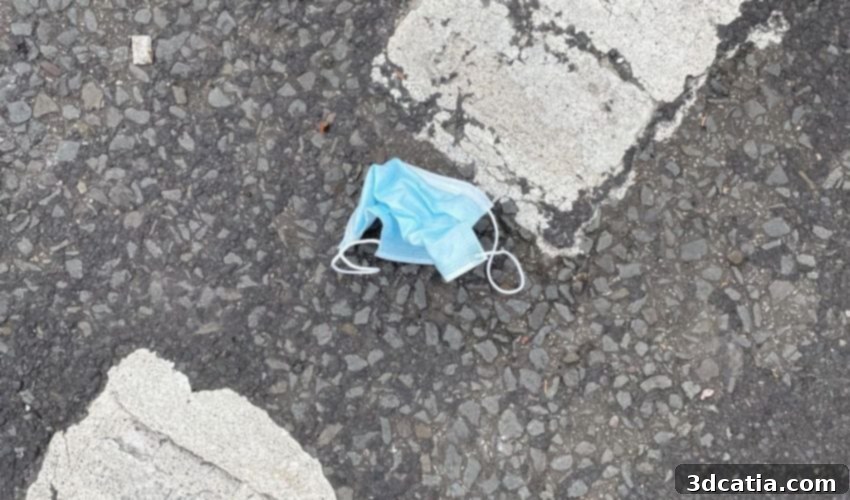
The global COVID-19 pandemic irrevocably changed our world, leaving behind not only profound social and medical impacts but also an unforeseen environmental challenge: an unprecedented surge in Personal Protective Equipment (PPE) waste. This includes billions of single-use masks, gloves, and aprons, essential for frontline defense but devastating for our planet. Conservative estimates suggest that the pandemic generated up to 1.6 million tonnes of plastic waste daily, with approximately 3.4 billion face masks discarded every single day. The sheer scale of this plastic pollution crisis is immense, prompting urgent calls for innovative and sustainable solutions. But what if this mountain of medical waste could be transformed into a valuable resource, particularly for the burgeoning world of 3D printing, by recycling it into high-quality filament?
This visionary idea is now becoming a reality, thanks to a pioneering collaboration in Australia. The innovative Australian company 3rd Axis has joined forces with the esteemed Australian Nuclear Science and Technology Organisation (ANSTO) to tackle this very issue, spearheading an ambitious project to convert waste PPE into FDM (Fused Deposition Modeling) feedstock. This initiative represents a significant step towards a more circular economy, turning a global problem into a sustainable opportunity for additive manufacturing.
A Powerful Partnership: 3rd Axis and ANSTO Leading the Charge for Sustainability
At the heart of this groundbreaking project is the synergistic partnership between 3rd Axis and ANSTO. Established in 1987, ANSTO stands as Australia’s national nuclear research and development organization, renowned for integrating cutting-edge science, ingenuity, and a deep commitment to sustainability. Their expertise spans a wide range of scientific disciplines, from nuclear medicine to advanced materials, making them an ideal partner for tackling complex material science and environmental challenges. 3rd Axis, an agile and forward-thinking company focused on advanced manufacturing and material solutions, is a vital member of nandin, ANSTO’s Innovation Centre. Nandin serves as a dynamic hub where various science and technology groups converge, fostering collaboration, accelerating the sharing of ideas, and ultimately driving improvements within Australia’s manufacturing sector.
This collaboration leverages ANSTO’s deep scientific understanding of materials and decontamination processes, combined with 3rd Axis’s expertise in additive manufacturing and product development. Together, they are not just recycling waste; they are developing a robust, scalable process that could redefine how medical plastics are managed globally. Their shared vision extends beyond simply producing filament; it aims to establish a viable and sustainable supply chain for recycled materials within the 3D printing industry, addressing both pressing environmental concerns and future resource scarcity. This alliance exemplifies how cross-sector innovation can lead to impactful solutions for global sustainability issues.
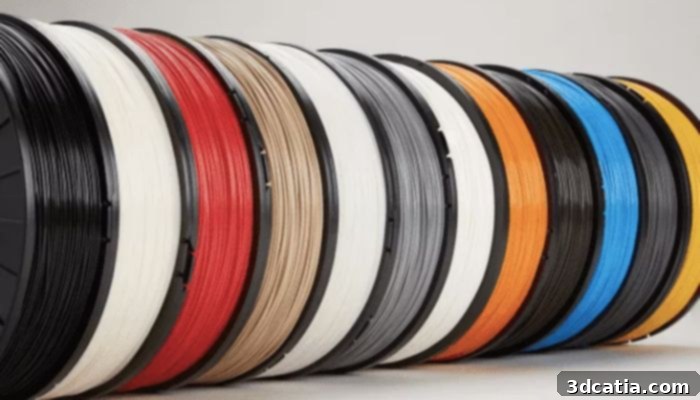
Filaments come in many different colours for FDM printing (Photo credit: ThinkFab)
The Innovative Process: From Contaminated Waste to High-Quality 3D Printing Filament
Transforming used medical PPE into safe and functional 3D printing filament is a complex undertaking, far from a simple melt-and-mold process. The primary challenge lies in the nature of medical waste itself – it’s often contaminated with biological agents, viruses, and other chemical residues, posing significant health risks if not handled correctly. Therefore, the waste undergoes a rigorous, multistage decontamination process designed to ensure it is completely safe for handling and subsequent processing. This crucial step typically involves advanced sterilization techniques, thorough cleaning, and potentially chemical treatments to neutralize any pathogens or harmful substances. ANSTO’s sophisticated scientific capabilities are particularly valuable here, ensuring the highest standards of safety, purity, and material integrity before the plastic can be repurposed.
Once meticulously decontaminated, the cleaned PPE waste is then sorted by plastic type (e.g., polypropylene from masks, nitriles from gloves), shredded into smaller pieces, and carefully prepared before being fed into specialized extrusion machinery. Here, the material is melted down at precise temperatures and extruded through a die to form a continuous, consistent strand of polymer filament. This entire process requires precise control over temperature, pressure, and cooling rates to produce filament that meets the stringent dimensional and material property requirements for reliable 3D printing. Any inconsistencies in diameter or material composition can lead to print failures, highlighting the technical challenges involved in producing recycled filament comparable to virgin materials, especially for applications demanding high precision.
Streamlining Collection and Expanding the Impact of Recycled Materials
A critical component of this project’s long-term success involves optimizing the upstream supply chain. 3rd Axis is committed to working closely with medical suppliers, hospitals, and healthcare centers to significantly improve the collection and selection processes for waste PPE. This means establishing efficient sorting systems at the point of discard to segregate appropriate plastic types and minimize cross-contamination, making the downstream recycling process more effective, safer, and ultimately more scalable. The goal is to maximize the amount of usable waste collected, ensuring a steady and reliable supply stream for filament production, thereby closing the loop on a significant portion of medical plastic waste.
The vision articulated by 3rd Axis CEO Andrew Cooper extends far beyond merely reducing landfill waste. He envisions a future where the plastic from a mask worn today could be repurposed into a wide array of functional products tomorrow. “Eventually what it will mean is the mask you’re wearing today could tomorrow become part of a water tank, fence posts, parts for machines – even parts on an airplane,” Cooper explained. This highlights the immense potential for recycled PPE filament to contribute to diverse industries, fostering a truly circular economy where materials are continually reused and repurposed rather than discarded after a single use. The applications could range from consumer goods and infrastructure components to high-performance industrial and aerospace parts, demonstrating the versatility and value of these innovative recycled materials.
The Broader Landscape: 3D Printing’s Indispensable Role in Sustainability and the Circular Economy
The initiative by 3rd Axis and ANSTO is part of a growing global movement acknowledging the critical environmental concerns within the 3D printing industry and beyond. The inherent flexibility, customization capabilities, and additive nature of additive manufacturing make it an ideal candidate for incorporating recycled materials. Unlike traditional subtractive manufacturing, which often produces significant waste during prototyping and production, 3D printing generates minimal waste, especially when optimized for material usage. Furthermore, the ability to print on-demand and near the point-of-use reduces transportation costs, associated carbon emissions, and the need for large inventories.
This project is not an isolated effort but rather a prominent example within a burgeoning field. Numerous organizations worldwide are actively exploring innovative ways to repurpose various waste streams into 3D printing feedstock. For instance, the Estonian start-up Filaret has gained recognition for its ingenious method of recycling cigarette butts – a ubiquitous and environmentally harmful form of litter – into FDM filament. Similarly, back in 2021, the University of Bristol also successfully demonstrated the recycling of surgical masks for diverse 3D printing applications, showcasing the versatility of this approach. These examples underscore a collective commitment within the additive manufacturing community to drive sustainable practices and contribute significantly to a more circular economy where waste is seen as a resource.
The collaboration between 3rd Axis and ANSTO distinguishes itself through the profound involvement of a major national scientific organization with extensive research capabilities. This ensures a rigorous scientific approach to material characterization, decontamination, and quality control, which is absolutely essential for developing reliable, safe, and high-performance recycled materials for widespread industrial adoption. This project stands as a powerful testament to how advanced scientific research, industrial innovation, and unwavering environmental stewardship can converge to create impactful, scalable solutions for some of the world’s most pressing global challenges.
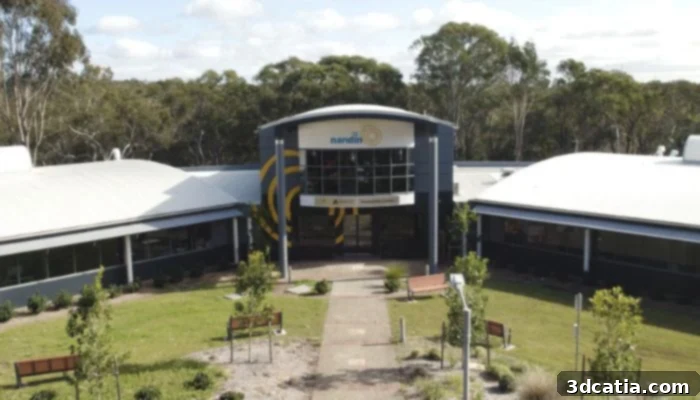
ANSTO’s state-of-the-art facility in Australia, a hub for scientific innovation (Photo credit: ANSTO)
Challenges and the Future Outlook for Recycled PPE Filaments
While the promise of recycling PPE into 3D printer filament is immense, the journey is not without its challenges. Ensuring consistent material quality and properties from diverse and potentially mixed waste streams is paramount for reliable industrial applications. The rigorous decontamination process, while essential, adds layers of cost and complexity to the overall workflow. Scaling up collection and processing facilities to meet industrial demand requires significant logistical planning, substantial investment, and robust partnerships across healthcare and manufacturing sectors. Moreover, educating users and industries about the viability, performance, and environmental benefits of recycled filaments is crucial for widespread market acceptance and demand generation.
Despite these hurdles, the future for initiatives like the 3rd Axis and ANSTO collaboration looks incredibly bright. As technology advances, so too will the efficiency and cost-effectiveness of recycling processes. The growing global emphasis on sustainability, coupled with corporate social responsibility and the imperative of a circular economy, will further drive demand for such innovative materials. Projects like these pave the way for a fundamental paradigm shift in waste management, transforming what was once considered disposable pollution into a valuable resource for advanced manufacturing. It demonstrates how local innovation, supported by strong scientific backing, can contribute significantly to global environmental solutions and foster a more resilient, resource-efficient, and sustainable industrial landscape for generations to come.
What are your thoughts on this pioneering project to recycle PPE into 3D printing filament? We invite you to share your perspectives and comments below, or join the ongoing conversation on our LinkedIn, Facebook, and Twitter pages! Don’t miss out on the latest advancements in additive manufacturing – remember to sign up for our free weekly Newsletter here to get the freshest 3D printing news delivered straight to your inbox. You can also explore all our insightful videos on our YouTube channel for more in-depth content and interviews.