
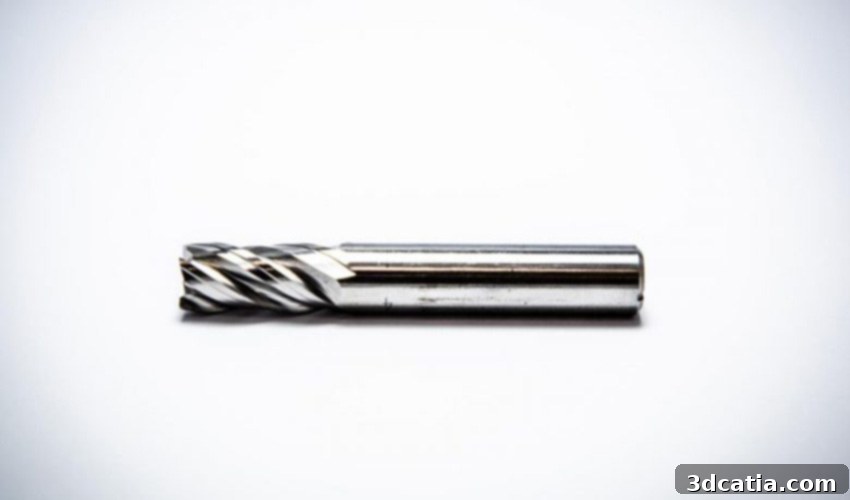
Revolutionizing Manufacturing: RMIT’s 3D Printed Steel Tools Conquer Titanium Alloys
A groundbreaking innovation from RMIT University in Melbourne, Australia, is set to redefine the landscape of industrial tooling. A PhD student, Jimmy Toton, has successfully developed a 3D printed steel tool that demonstrates an extraordinary capability: it can effectively cut through robust titanium alloys. This achievement is particularly remarkable as it also shows promise in surpassing the performance of traditionally manufactured steel tools, paving a transformative path for the wider application of additive manufacturing in the production of high-performance industrial tools.
The development of such a small yet incredibly powerful tool has garnered significant recognition within the defense and manufacturing sectors. In acknowledgment of his pioneering research, PhD candidate Jimmy Toton was awarded the prestigious 2019 Young Defence Innovator Award and a $15,000 prize at the Avalon International Airshow. This critical project was a collaborative effort, undertaken with the invaluable support and expertise of the Defence Materials Technology Centre (DMTC) and leading industry partner Sutton Tools, all conducted within the state-of-the-art facilities of RMIT’s Advanced Manufacturing Precinct.
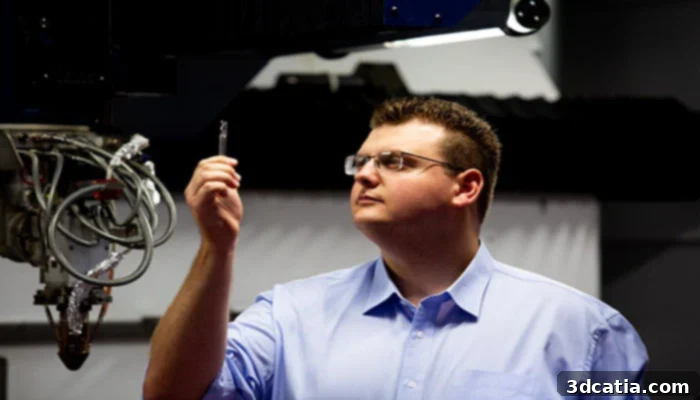
Jimmy Toton inspects 3D printed steel milling cutter; Photo: RMIT University
The Power of Additive Manufacturing: Laser Metal Deposition (LMD)
The advanced steel milling cutters at the heart of Toton’s research were meticulously produced using Laser Metal Deposition (LMD) technology. This cutting-edge additive manufacturing process is also widely recognized as Directed Energy Deposition (DED). Unlike conventional manufacturing methods that involve subtractive processes (removing material to create a shape), LMD/DED builds objects layer by layer, directly from a digital design.
At its core, LMD/DED operates through a sophisticated system where fine metallic powders are precisely delivered through a deposition nozzle. Simultaneously, a high-power laser beam heats these powders as they exit the nozzle, melting them to form a molten metallic bead. This molten material is then fused onto the substrate, or the previously deposited layer, creating a new layer. The process is repeated with extreme precision, layer by layer, until the desired complex three-dimensional object is fully formed. This method offers unparalleled control over material properties and geometric complexity, making it ideal for high-performance applications like industrial tooling.
The choice of LMD/DED technology was crucial for this project’s success. It allows for the creation of tools with optimized geometries that are impossible to achieve with traditional machining. Furthermore, it enables the use of advanced metallic alloys that are notoriously difficult to process otherwise. The ability to control the microstructure of the deposited material contributes directly to the enhanced hardness, wear resistance, and overall durability required for cutting challenging materials like titanium. This precision manufacturing technique not only fabricates new tools but also holds immense potential for repairing and enhancing existing components, thereby extending their lifespan and reducing waste in industrial operations.
Unlocking New Horizons for Industry Applications
The implications of this breakthrough extend far beyond the research lab. Jimmy Toton emphasizes the transformative potential: “Now that we’ve shown what’s possible, the full potential of 3D printing can start being applied to this industry, where it could improve productivity and tool life while reducing cost. Manufacturers need to take full advantage of these new opportunities to become or remain competitive, especially in cases where manufacturing costs are high. There is real opportunity now to be leading with this technology”.
Titanium alloys are notoriously difficult to machine due to their high strength-to-weight ratio, excellent corrosion resistance, and high-temperature performance. These properties make them indispensable in critical sectors such as aerospace, defense, and biomedical implants, but also significantly increase the cost and complexity of manufacturing components from them. Conventional tools often wear out rapidly, requiring frequent replacements and leading to increased downtime and production costs. The ability of Toton’s 3D printed steel tools to cut titanium with superior performance directly addresses these long-standing challenges.
This innovation promises to improve productivity by enabling faster machining speeds and longer tool life, meaning less frequent tool changes and more efficient production cycles. The reduction in manufacturing costs can be attributed to several factors: potentially lower material waste through additive processes, the ability to produce complex tools on demand without expensive molds or extensive machining, and the extension of tool lifespan. For industries facing intense global competition and high operational costs, leveraging such advanced additive manufacturing techniques could provide a crucial competitive edge, allowing them to innovate faster and deliver products more efficiently.
Overcoming Technical Hurdles for Industrial Impact
The journey to this groundbreaking success was not without its challenges. The research team faced significant technical hurdles, particularly in ensuring the integrity of the 3D printed material. One of the primary difficulties, as the team explains, was “getting the layers to print and bond strongly to avoid cracks in the end piece.” In metal additive manufacturing, the rapid heating and cooling cycles inherent in processes like LMD/DED can induce internal stresses, leading to defects such as cracking, warping, or poor interlayer adhesion. These issues can compromise the mechanical properties and reliability of the final component, especially for demanding applications like cutting tools.
The successful demonstration of the 3D printed tool’s titanium cutting performance against more traditional tools is a testament to the team’s ability to overcome these complex metallurgical and process-related challenges. This involved meticulous optimization of printing parameters, potentially incorporating pre-heating or post-processing heat treatments, and careful material selection to manage thermal gradients and ensure robust metallurgical bonding between successive layers. The project’s explicit focus on delivering tangible impact for industrial applications, rather than solely pursuing academic research, underscores its practical relevance and readiness for commercialization. This applied approach ensures that the developed technology is not just theoretically sound but also robust and reliable enough for real-world manufacturing environments.
Strategic Impact on Australian Manufacturing and Defence
Dr. Mark Hodge, CEO at the Defence Materials Technology Centre (DMTC), articulates the broader strategic significance of this project for Australia. He states, “Supply chain innovations and advances like improved tooling capability all add up to meeting performance benchmarks and positioning Australian companies to win work in local and global supply chains. The costs of drills, milling cutters and other tooling over the life of major Defence equipment contracts can run into the tens, if not hundreds, of millions of dollars. This project opens the way to making these high-performing tools cheaper and faster, here in Australia”.
Dr. Hodge’s comments highlight several critical aspects. Firstly, it emphasizes the importance of a resilient and innovative domestic supply chain for national security and economic competitiveness. By developing advanced tooling capabilities locally, Australia can reduce its reliance on foreign suppliers, enhance its manufacturing self-sufficiency, and ensure access to cutting-edge technologies. This aligns perfectly with national strategies aimed at bolstering local industry and securing high-value manufacturing jobs.
Secondly, the immense cost savings identified by Dr. Hodge – “tens, if not hundreds, of millions of dollars” in tooling costs over the life of major defense contracts – underscore the massive economic impact of this innovation. Such savings can free up significant resources that can be reinvested into further research and development, or into other critical defense capabilities. The ability to produce “cheaper and faster” high-performing tools domestically not only strengthens Australia’s defense industrial base but also positions Australian companies as leaders in advanced manufacturing on the global stage, attracting new opportunities and fostering further technological advancements.
The success of Jimmy Toton’s project at RMIT, supported by DMTC and Sutton Tools, is a prime example of how targeted research and development in additive manufacturing can yield transformative results. It not only provides a superior tool for challenging materials like titanium but also lays the groundwork for a more efficient, cost-effective, and domestically robust manufacturing future for Australia and beyond. This is a clear indicator that 3D printing is rapidly moving from niche applications to becoming a mainstream technology capable of significantly impacting heavy industry and high-stakes sectors.
Find out more information HERE.
What do you think of Jimmy Toton’s new research? Let us know in a comment below or on our Facebook and Twitter pages! Don’t forget to sign up for our free weekly Newsletter, with all the latest news in 3D printing!