
Revolutionizing Vision: How 3D-Printed Augmented Reality Contact Lenses are Shaping the Future
The concept of intelligent contact lenses has long captivated the scientific community and the public imagination. Much like their conventional counterparts, these advanced lenses are designed to be comfortably placed on the eye, but with the revolutionary capability to provide wearers with real-time digital information and experiences. While the potential applications are vast, research in this field has predominantly focused on the medical sector, specifically for advanced disease diagnosis and health monitoring. Global tech giants, including Google, have previously explored the development of Augmented Reality (AR) contact lenses, yet significant technical hurdles related to miniaturization, power supply, and display clarity have historically impeded their widespread commercialization.
However, a groundbreaking collaboration has recently brought us closer to realizing this futuristic vision. Researchers at the National Institute of Science and Technology (UNIST) in South Korea have joined forces with the Smart 3D Printing Research Team at the Korea Electrotechnology Research Institute (KERI). Together, they have pioneered a novel approach utilizing cutting-edge 3D printing technology to develop smart contact lenses that seamlessly enable augmented reality, marking a significant leap forward in wearable tech and ocular display solutions. This innovative partnership underscores a critical breakthrough in manufacturing, allowing for the precise creation of intricate components on non-planar surfaces, which is essential for devices worn directly on the human eye.
The Innovative Technology Behind AR Contact Lenses
At the heart of this new AR contact lens technology lies the ingenious method of precisely printing micro-patterns directly onto the lens display. This process is crucial for generating the visual information that forms the augmented reality experience. To achieve such unparalleled precision on a curved surface, the researchers have cleverly harnessed a fundamental physical phenomenon known as the meniscus. The meniscus refers to the curvature of a liquid’s surface, which is primarily caused by surface tension. In this context, the liquid is the specialized printing ink, and its controlled curvature allows for extraordinarily fine and accurate deposition of materials.
The AR contact lenses incorporate electrochromic monitors, which are dynamic displays that change color when a low electrical current is applied. These monitors are meticulously integrated into the lens structure. The researchers opted for a specific material to power these displays: a unique variant of “Pure Prussian Blue” ink. This choice was deliberate, as Pure Prussian Blue offers several distinct advantages critical for ocular applications. It provides exceptionally fast color contrast and rapid color change capabilities, which are vital for a fluid and responsive AR experience. Furthermore, its cost-efficiency makes the manufacturing process more viable for eventual mass production, paving the way for more accessible and affordable smart contact lenses.
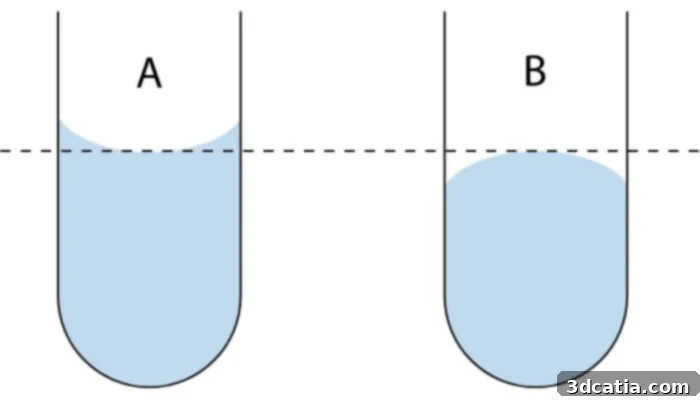
Menisci can be concave (left), as is the case for water-based fluids, or convex (left), as for mercury in glass. The researchers used the meniscus of the ink to print micropatterns (Photo credit: jleedev on Wikimedia Commons)
The ability to manipulate the meniscus of the ink is what grants this 3D printing method its versatility and precision. As illustrated, menisci can exhibit either concave shapes, typical of water-based fluids, or convex shapes, such as mercury in glass. By precisely controlling the properties of the printing ink and the printing conditions, the UNIST and KERI teams can dictate the shape and behavior of the meniscus, enabling them to print incredibly fine and functional micro-patterns onto the curved surface of a contact lens. This level of control is paramount for creating high-resolution displays directly on the eye, distinguishing this technology from previous attempts that struggled with the intricacies of spherical surfaces.
Diverse Applications of AR Contact Lenses
The potential applications for these cutting-edge AR contact lenses are truly transformative, promising to redefine how we interact with information and the world around us. One of the most anticipated and impactful applications is hands-free, real-time navigation. Imagine walking through a bustling city, with directional arrows, street names, and points of interest subtly overlaid directly onto your field of vision, guiding you effortlessly through unfamiliar territories. This immersive navigation experience would eliminate the need to constantly glance at a smartphone, allowing users to remain fully present and aware of their surroundings, enhancing safety and convenience.
Beyond practical navigation, AR contact lenses are poised to revolutionize the entertainment and gaming industries. Envision a future where popular augmented reality games, such as Pokémon Go, are no longer confined to the small screen of a smartphone or tablet. Instead, players could engage directly with the virtual world overlaid onto their real environment, experiencing unparalleled levels of immersion and interaction. The possibilities extend to entirely new genres of games that blend digital elements seamlessly with physical reality, creating truly interactive and dynamic experiences.
Dr. Seol Seung-Kwon of KERI emphasized the significance of their achievement, stating, “Our achievement is to develop a 3D printing technology that can print functional micro-patterns on a non-planar substrate to commercialize advanced smart contact lenses for AR.” He further added, “It will greatly contribute to the miniaturization and versatility of AR devices.” This statement highlights a core advantage: the ability to print on curved surfaces is a critical breakthrough for wearable electronics, especially those designed for the human body. This opens doors not just for AR contact lenses, but for a whole new generation of compact and adaptable AR devices that are less intrusive and more integrated into daily life.
The medical field stands to benefit immensely from this technology as well. While intelligent contact lenses have been researched for disease diagnosis, the integration of AR capabilities takes this further. Future lenses could monitor vital signs, glucose levels for diabetics, detect early signs of ocular diseases, or even administer medication. Surgeons could potentially view patient data or anatomical overlays directly in their field of vision during complex procedures, enhancing precision and safety. Furthermore, professionals in various fields, from architects visualizing blueprints on-site to engineers inspecting intricate machinery, could leverage these lenses for on-demand data access and enhanced situational awareness, creating more efficient and informed workflows.
The Precision of 3D Printing: Chemical Process Explained
Understanding the intricate chemical process behind the 3D printing of these AR contact lenses reveals the depth of innovation achieved by the UNIST and KERI teams. The process begins with the precise control of evaporation occurring between a sophisticated micro-nozzle and a solvent. This controlled evaporation is the catalyst for the crystallization of the Pure Prussian Blue ink, which forms the crucial display elements. The ink itself is composed of iron(III) hydrocyanide, a compound selected for its electrochromic properties and ability to form stable microstructures.
As the iron(III) hydrocyanide ink makes contact with the substrate – the lens material – a meniscus promptly forms on its surface. This meniscus, carefully managed through printing parameters, plays a pivotal role in dictating the final pattern. A critical step involves the evaporation of water from the meniscus. As water molecules leave the surface, precursor ions and residual water molecules begin to migrate towards the surface of the meniscus. This migratory pattern is not random; it is precisely controlled to ensure optimal material deposition.
Subsequently, a concentrated accumulation of these precursor ions occurs specifically in the outer part of the meniscus. This localized concentration is vital, as it leads to what is known as edge-enhanced crystallization of FeFe(CN)6. Edge-enhanced crystallization is a highly desirable outcome because it ensures that the printed patterns are not only uniform but also possess sharply defined edges, which is essential for clear and legible AR displays. This precise control over the crystallization factors of FeFe(CN)6 during the printing step is what allows for the creation of intricate, high-resolution patterns on the lens substrate without blurring or inconsistencies.
A significant advantage of this meniscus-driven 3D printing technique is its remarkable versatility with regard to materials and shapes. Thanks to the precise manipulation of surface tension and fluid dynamics, the manufacturer is not limited to specific types of substrates. This means the technology could potentially be adapted to various lens materials, enhancing biocompatibility and comfort. Moreover, a major breakthrough is that the printing of micropatterns is no longer confined to flat, straight surfaces. The researchers have successfully demonstrated the capability to print these sophisticated patterns on curved shapes, which is a fundamental requirement for the manufacturing of contact lenses that conform perfectly to the human eye. This capability overcomes one of the most significant engineering challenges in developing practical AR contact lenses.
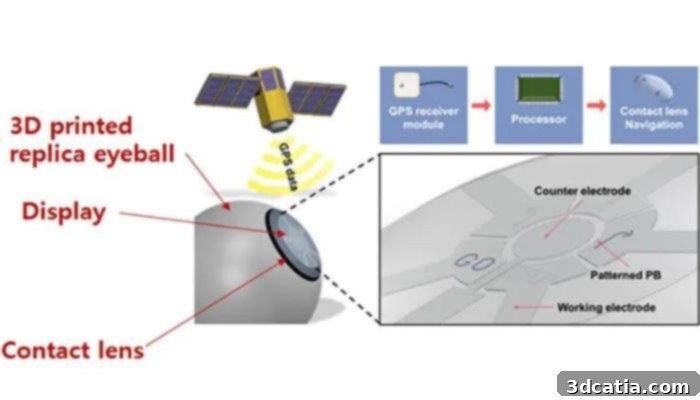
Photo credits: SciTechDaily
Overcoming Challenges and Glimpsing the Future
While the advancements made by UNIST and KERI are monumental, the path to widespread commercialization of AR contact lenses still involves navigating several complex challenges. Key areas of focus include power management – ensuring the lenses can operate for extended periods without frequent recharging, potentially through inductive charging or micro-batteries – and data transmission, which requires robust, high-bandwidth, and secure communication protocols. User comfort and long-term biocompatibility are paramount, requiring extensive testing and regulatory approvals to guarantee safety for continuous wear. Mass production at an affordable cost also presents manufacturing scalability challenges that need to be addressed.
Despite these hurdles, the researchers are optimistic about the far-reaching implications of their new 3D printing technology. They believe its precision and versatility will extend its importance beyond AR contact lenses, finding critical applications in other rapidly evolving fields. For instance, the ability to print complex micro-patterns on diverse substrates could revolutionize the development of next-generation batteries, enabling higher energy densities and more compact designs. Similarly, the technology holds immense promise for creating advanced biosensors, which could offer unprecedented levels of sensitivity and accuracy for health monitoring, environmental detection, and medical diagnostics.
Furthermore, the integration of these smart contact lenses with the artificial intelligence sector is a natural and exciting progression. AR lenses equipped with AI could offer highly personalized experiences, anticipate user needs, process complex visual information in real-time, and even facilitate advanced human-computer interaction through eye-tracking and gesture recognition. This convergence of augmented reality, 3D printing, and artificial intelligence signifies a profound shift towards a future where technology is not just worn, but seamlessly integrated into our perception of reality.
This breakthrough by UNIST and KERI represents a significant stride towards making augmented reality a truly pervasive and personal experience. As research continues, the vision of a world where information and digital interaction are directly overlaid onto our sight becomes increasingly tangible, promising a future of enhanced perception and unprecedented connectivity.
For those eager to delve deeper into this fascinating AR contact lenses project, more detailed information can be found HERE. What are your thoughts on these innovative 3D-printed AR contact lenses and their potential to transform our daily lives? We invite you to share your perspectives and comments below, or engage with us on our LinkedIn, Facebook, and Twitter pages! Don’t forget to sign up for our free weekly Newsletter here to receive the latest 3D printing news straight to your inbox! You can also find all our compelling videos on our YouTube channel for more insights into the world of additive manufacturing.
*Cover photo credit: StartupNoon