

Anisoprint’s Continuous Fiber 3D Printing: Pushing the Boundaries of Advanced Composites in Manufacturing
Anisoprint, a pioneering Russian 3D printer manufacturer, has made significant strides in the realm of additive manufacturing by developing a groundbreaking solution for continuous fiber composites. Their innovative Composer machine operates on the principle of melt deposition, enabling the reinforcement of virtually any 3D printing plastic with high-performance composite fibers directly during the printing process. This patented coextrusion technology holds immense potential across various industries, as composite materials inherently offer superior strength, reduced weight, and enhanced resistance compared to traditional materials. Such properties make them indispensable for demanding sectors like aerospace, automotive, and medical industries, where performance and efficiency are paramount. To delve deeper into this transformative technology, its multifaceted benefits, and current limitations, we had the exclusive opportunity to speak with Fedor Antonov, CEO of Anisoprint.
Unveiling Anisoprint: A Visionary Approach to Composite 3D Printing
Anisoprint was founded by a dedicated team of engineers and scientists united by a profound vision: to revolutionize manufacturing by harnessing the true potential of composite materials when designed and applied correctly. Our journey began with the realization that by precisely managing the unique properties of composites, we could invent a technology capable of surpassing traditional materials like metal, yielding parts that are not only stronger and lighter but also more cost-effective. The perfect conduit for realizing this ambitious vision proved to be 3D printing. As a broad category encompassing a wide array of technologies, 3D printing is rapidly transforming manufacturing through digitalization and automation across numerous industries. Through our patented continuous fiber composite 3D printing technology, we are now empowering companies to significantly reduce manufacturing costs and enhance product performance across a diverse range of applications, from critical aerospace components to advanced healthcare solutions. This innovation promises to redefine what’s possible in product design and production.

Fedor Antonov, CEO of Anisoprint
The Anisoprint Composer: Advanced Continuous Fiber Coextrusion (CFC) Technology
Our 3D printers are built upon our proprietary Composite Fiber Coextrusion (CFC) technology, which represents a core innovation distinguishing our products from other continuous fiber composite 3D printing approaches. Unlike methods such as prepreg, dry fiber coextrusion, or lamination – each with its inherent limitations – CFC technology allows us to directly reinforce plastic with continuous composite fibers during the printing process itself, rather than in a separate, pre-processing stage. This fundamental difference provides unparalleled flexibility and significant advantages. It liberates users to choose virtually any thermoplastic polymer they desire, including common materials like PETG, ABS, PC, PLA, and Nylon. Furthermore, it allows for dynamic adjustment of the composite infill density, providing granular control over the final part’s mechanical properties.
By carefully varying the choice of reinforcing materials, precisely controlling the direction of fibers within the print, and optimizing the density of the printed structure, we can produce highly optimized parts. This enables the creation of intricate shapes, complex lattice structures, and even bionic designs that mimic natural forms, offering superior performance with minimal material usage. Ultimately, this leads to a substantial reduction in manufacturing costs, as our approach ensures that only the exact amount of material necessary to achieve the required part properties is used, minimizing waste and maximizing efficiency.
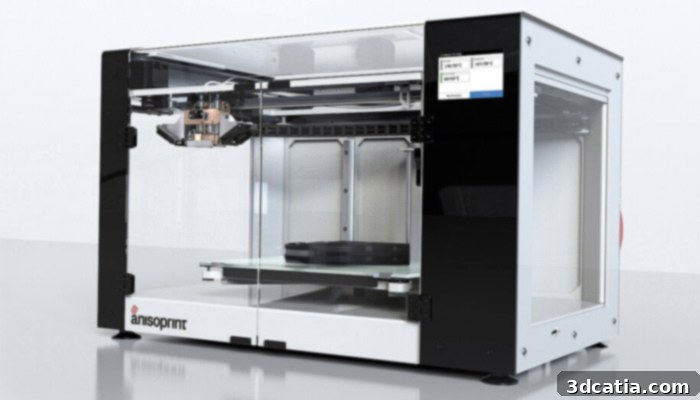
The Composer 3D printer | Credits: Anisoprint
The primary reason composite structures are not yet as ubiquitous as they are in the natural world stems from the limitations imposed by existing manufacturing technologies. Traditional methods often restrict what can truly be achieved with composite materials, forcing designers to contend with flat structures, straight fibers, and a limited selection of suitable materials. Furthermore, many conventional composite manufacturing processes are prohibitively expensive and demand significant manual labor. Our driving motivation at Anisoprint was to engineer a technology that minimizes these limitations while preserving the core unique properties of composites: exceptional strength and remarkable lightweight characteristics. We aimed to democratize access to advanced composite manufacturing, making it more flexible, affordable, and accessible.
Our inaugural product, the Anisoprint Composer, already embodies the majority of these visionary ideas. It is designed as a desktop, user-friendly, and cost-effective machine that empowers users to reinforce virtually any type of thermoplastic polymer with high-strength continuous reinforcing fibers. Much like rebar strengthens concrete, these fibers dramatically enhance the material’s properties, making the resulting part dozens of times stronger than the unreinforced plastic. This capability opens doors for creating high-performance components previously only achievable with more complex and costly manufacturing methods.
To further simplify the management and optimization of material properties, we developed our own dedicated software, Anisoprint Aura. This powerful tool is freely available for download from our website. Anisoprint Aura provides comprehensive control over fiber directions and volume fraction, allowing users to design and produce complex geometric structures with precisely tailored properties. This leads to parts that are lighter, stronger, and more cost-effective than those produced with almost any other conventional material or manufacturing process. The synergistic combination of our hardware and software empowers engineers and designers to unleash the full potential of composite 3D printing.

The process behind the coextrusion technology | Credits: Anisoprint
Navigating the Challenges and Harnessing the Benefits of Composite 3D Printing
The primary challenge inherent in 3D printing with composite materials lies in the very nature of these advanced substances. To effectively create a composite, one must seamlessly merge a reinforcement component, which imparts the desired mechanical properties, with a matrix material, which binds these disparate reinforcing elements together. This integration is far from a simple process. In most cases, the reinforcement takes the form of a fibrous material, comprising incredibly long and thin microfibers, while the matrix is typically a viscous polymer. The crucial task is to merge these two components efficiently, ensuring excellent impregnation of the fibers by the polymer and strong, consistent bonding between them. Achieving this without compromising the integrity or performance of the final composite is a significant engineering hurdle.
At Anisoprint, we address this challenge through a sophisticated two-stage process. First, we impregnate the fibers with a specialized polymer. This polymer exhibits low viscosity in its uncured state, allowing it to easily penetrate and saturate the fiber tow, forming a strong, tight bond. Following this impregnation, the polymer is heated and cures, transforming into a stiff, solid substance. This critical step is performed prior to the actual 3D printing. When we initiate the printing process, these pre-impregnated composite fibers serve as the robust reinforcement. They are pulled through the printer nozzle concurrently with a chosen thermoplastic plastic, which then bonds these fibers together as they are precisely shaped into the final part’s structure. This synchronized extrusion of both materials is precisely why our process is termed coextrusion. This innovative approach offers the flexibility to select a thermoplastic with specific desirable characteristics—be it chemical resistance, particular frictional properties, flame retardancy, or other specialized attributes—and then enhance it manifold with continuous fibers, often achieving strength levels that surpass even those of many metals.
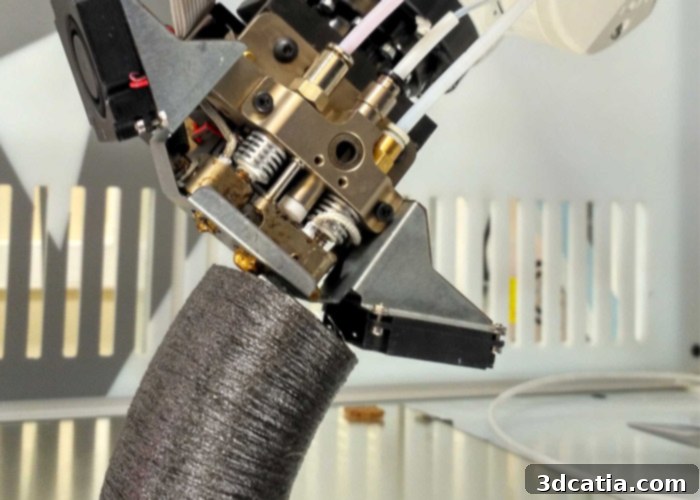
Photo Credits: Anisoprint
Targeting High-Demand Sectors and Overcoming Certification Hurdles
Composite materials are in exceptionally high demand within industries where low weight is not merely an advantage but an absolute necessity. Foremost among these are the aerospace sector, encompassing aircraft, helicopters, drones, and spacecraft, where every gram saved translates into significant fuel efficiency and payload capacity. High-performance mobility, including sport and racing cars, high-end bikes, and bicycles, also benefits immensely from lightweight, strong composites, enhancing speed, agility, and energy efficiency. Furthermore, the healthcare industry finds critical applications in custom prosthetic devices, orthopedic braces, corsets, and insoles, where reduced weight and tailored fit improve patient comfort and mobility. While these sectors have already integrated composite materials into certain products, continuous fiber composite 3D printing has the potential to dramatically increase the prevalence and complexity of such parts. Imagine lighter airplanes consuming less fuel, leading to more affordable flights; electric cars capable of longer ranges on a single charge; bicycles as light as a shopping bag; and individuals with special needs benefiting from custom-fitted, slim, and ultra-light prosthetics that perfectly integrate with their bodies.
Achieving this widespread adoption is, however, a journey with its own set of challenges. A fundamental prerequisite for advanced materials in these critical applications is absolute assurance of reliability, safety, and a predictable lifespan. This necessitates rigorous and complex certification procedures in virtually every industry, especially where product performance directly impacts human lives. Not only the material itself but also the hardware used for manufacturing and the entire production process must undergo stringent certification. This comprehensive certification process currently stands as one of the most significant barriers preventing 3D-printed parts from seamlessly integrating into our everyday lives. Anisoprint is actively engaged in the certification process for our materials and technology, but like many players in the nascent 3D printing market, we are still at the beginning of this extensive endeavor. Consequently, our immediate focus includes applications that do not require such extensive, high-level certification, such as the manufacturing of specialized tools.
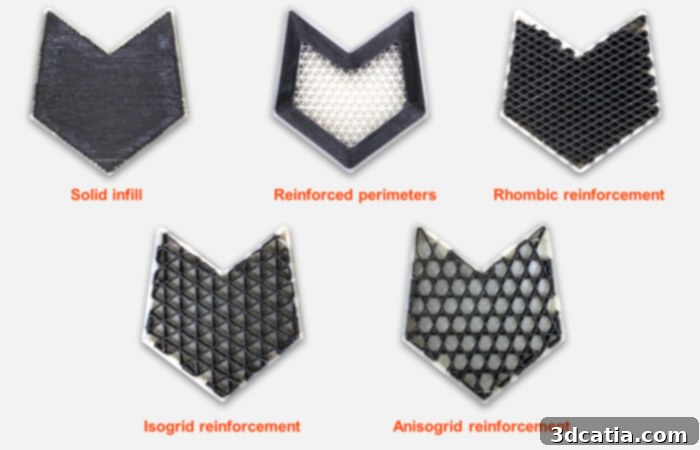
Photo credits: Anisoprint
Many of our customers, particularly those in manufacturing, rely heavily on custom tools such as molds, dies, clamps, fixtures, and jigs. These tools often need to be produced rapidly and on-demand to maintain operational efficiency. They are frequently subjected to significant loads during operation, requiring high stiffness and sturdiness. Moreover, in many instances, these tools are handled by workers, making lightweight design a crucial ergonomic factor. By leveraging Anisoprint’s technology, manufacturers can achieve all these desired properties simultaneously. Our customers using the Composer 3D printer within their production facilities can replace a broken part in a matter of hours, a stark contrast to the months it might take when ordering from external tool companies. This capability allows them to internalize repair and replacement processes, dramatically reducing equipment downtime and maintaining continuous production. Furthermore, printing these parts in-house significantly lowers costs, as 3D printed parts are generally cheaper to produce, boast a longer lifespan due to optimized design, and eliminate expenses associated with external services and logistics. This demonstrates a compelling immediate value proposition for Anisoprint’s technology.
Future Horizons: Expanding Anisoprint’s Impact
Currently, we offer two distinct formats of our desktop Composer printer. While it remains a niche product, its applications are steadily growing. It is predominantly utilized for creating manufacturing tools, jigs, and fixtures, as well as non-primary spare parts for diverse items like bicycles, scooters, and wheelchairs. Beyond industrial applications, the Composer is also a valuable research instrument, actively used by several leading universities across Europe and Russia to explore the frontiers of continuous fiber composite materials and their additive manufacturing potential. As we move forward, our vision includes expanding the capabilities of our machines, exploring new material combinations, and scaling our technology to address an even broader range of industrial and consumer needs, pushing towards larger format printers and fully automated production systems.
The Inevitable Era of 3D Printing
The era of 3D printing is not just a possibility; it is an inevitability. We firmly believe there is no other path forward for modern manufacturing. The inherent benefits it offers over traditional manufacturing methodologies are undeniable and transformative. It’s simply a matter of embracing this evolution. While there will always be diverse applications for various technologies—be it plastic, metal, or composite 3D printing—the fundamental ways in which we design, manufacture, and deliver products will change forever. This shift promises a future that is not only more efficient and customizable but also significantly more sustainable and aligned with natural principles of material optimization. Anisoprint is proud to be at the forefront of this revolution, contributing to a future where advanced materials are accessible and impactful for everyone.
What are your thoughts on Anisoprint and their innovative technology? Share your insights in a comment below or connect with us on our Facebook and Twitter pages! And don’t forget to subscribe to our free weekly Newsletter to receive all the latest news and updates in 3D printing directly in your inbox!