
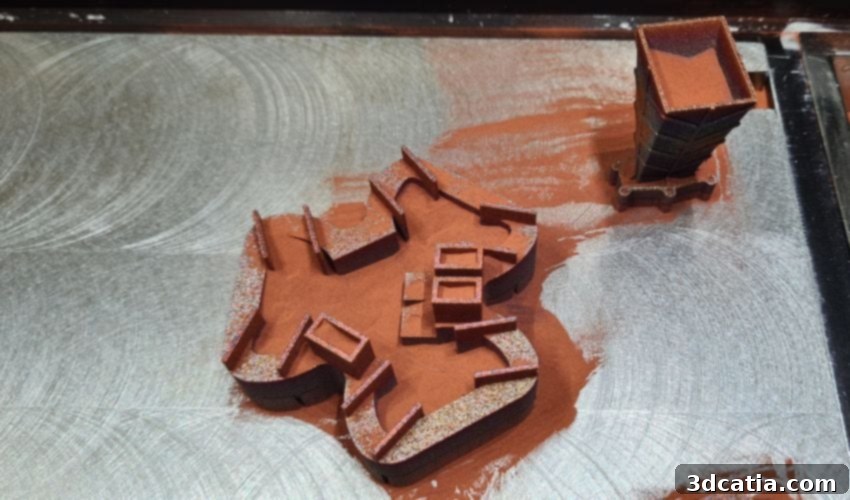
AFU’s Groundbreaking Achievement: High-Density Copper 3D Printing on Standard 400W Lasers in France
In a significant leap forward for additive manufacturing, AFU, a renowned French company specializing in precision machining, has successfully overcome one of metal 3D printing’s most persistent challenges: producing high-density copper components using conventional infrared laser systems. Since 2014, AFU has been at the forefront of investing in metal 3D printing to expand its capabilities and facilitate the creation of increasingly complex geometries. Now equipped with an impressive suite of three advanced machines, the company has dedicated two years to intensive research and development focusing on copper alloys, particularly the copper-chromium-zirconium alloy (CuCrZr).
The ambitious goal was clear: to achieve the 3D printing of copper parts with exceptional density while meticulously preserving their intrinsic properties, all on a standard machine featuring a 400W infrared laser. This formidable challenge, often considered a major hurdle in the industry, has been resoundingly met. As of summer 2024, AFU proudly manufactures dense CuCrZr parts, boasting a density exceeding 99.5%, with an impressively fine layer thickness of 40 microns. This remarkable accomplishment marks a pioneering “first” in France, setting a new benchmark for what is achievable with existing metal additive manufacturing technologies.
The Enduring Appeal and Intricate Challenges of Copper 3D Printing
For many years, AFU has been a trusted partner to industrial customers across diverse sectors, helping them transform their innovative projects into reality. In 2014, recognizing the transformative potential of laser powder bed fusion (L-PBF/SLM), the company strategically embraced metal additive manufacturing. This move enabled AFU to offer highly complex, bespoke components and rapid prototypes, significantly reducing lead times for its clientele. The company’s material portfolio encompasses a wide array of metals, including copper, which is exceptionally valued for its superior thermal and electrical conductivity. However, these very properties, while making copper indispensable for many applications, also present formidable obstacles when attempting to 3D print it in powder form using infrared lasers, unlike more easily processed metals such as titanium, aluminum, or steel.
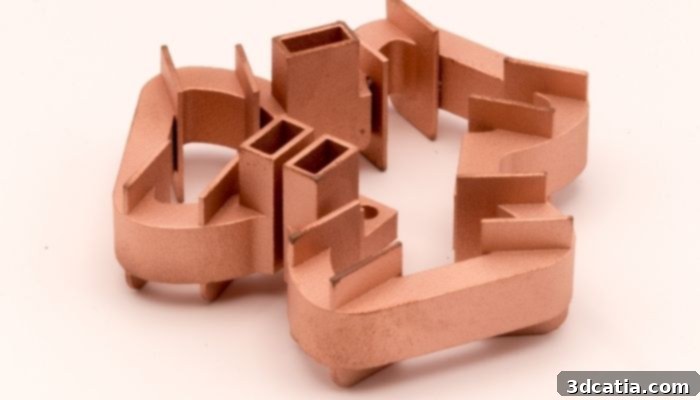
3D printed CuCrZr inductor
Why Copper Poses a Unique Challenge for Infrared Lasers
The additive manufacturing market has witnessed considerable advancements in recent years, particularly in the realm of copper and its alloys. Copper is a highly sought-after metal due to its exceptional conductivity, impressive ductility, high wear resistance, and excellent corrosion resistance. These characteristics make it an ideal candidate for critical applications across numerous high-tech industries, including aerospace, advanced electronics, the intricate fabrication of heat exchangers, high-performance inductors, and specialized electrical components.
Despite its advantages, copper’s physical properties create significant hurdles for laser powder bed fusion (L-PBF) processes, especially when employing infrared (IR) lasers, which are standard in the majority of industrial metal 3D printers. The primary issue stems from copper’s high reflectivity and low absorption rate of infrared laser energy. This means that a substantial portion of the laser’s power is reflected away from the powder bed or dissipated too quickly, rather than being effectively absorbed to melt the metal. The consequence is a significant loss of effective power, preventing optimal fusion of the copper powder particles.
With typical infrared lasers of 200W or 400W – which represent the power range of most commercially available metal additive manufacturing solutions – the fusion process for copper is often incomplete. This incomplete fusion leads to the formation of fragile zones within the printed part, resulting in excessively high porosity and, crucially, compromised electrical and thermal conductivity. To achieve satisfactory results and sufficient density, theoretically, 100% of the laser’s power would need to be efficiently utilized. However, a staggering 60% of the energy transmitted to the copper material is typically lost, either dissipated by the powder particles or reflected during the melting phase. This makes it evident that, with a standard laser of this power and without highly specific process developments, compensating for these energy losses is extremely difficult, leading inevitably to parts with unacceptable levels of porosity and structural weaknesses.
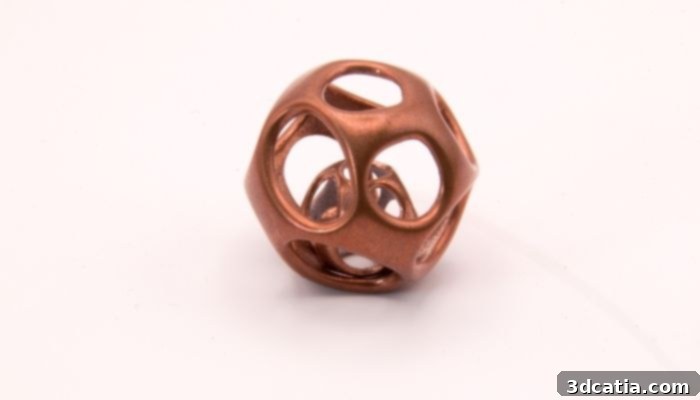
3D printed openwork ball in CuCrZr
Exploring Conventional Solutions and Their Limitations for Copper 3D Printing
Addressing the complexities of 3D printing copper has spurred various research efforts and technological developments across the additive manufacturing sector. Several approaches have emerged to mitigate the challenges posed by copper’s unique interaction with infrared lasers, each with its own set of advantages and significant drawbacks.
High-Power Lasers: A Costly Proposition
One straightforward solution to combat energy dissipation is to simply increase the laser’s power output. Machines equipped with more powerful lasers, such as 1kW systems, are indeed available on the market. These higher-power lasers can deliver more energy, potentially overcoming some of copper’s reflective properties and achieving better fusion. However, such machines come with a substantial price tag, representing a significant capital investment for any company. Beyond the initial purchase cost, they often necessitate additional infrastructure investments, including specialized power supplies, cooling systems, and enhanced safety measures to accommodate their operational demands. This makes them economically unfeasible for many businesses, especially smaller to medium-sized enterprises.
Green Lasers: Promising but Niche
Another innovative option involves switching to a green laser system. Green lasers operate at a different wavelength (typically around 515-532 nm) compared to infrared lasers (typically 1064 nm), which dramatically improves copper’s absorption rate. This higher absorption leads to more efficient energy transfer, resulting in printed parts with superior mechanical and physical properties, and simplifying the determination of optimal printing parameters. While the technology is highly promising for pure copper and copper alloys, machines equipped with green lasers are still relatively new to the market, making them rare, exceedingly expensive, and often limited in terms of their build volume capabilities. Their nascent status and high entry barrier mean they are not yet a broadly accessible solution for mainstream industrial applications.
Alloy and Powder Modifications: Altering Intrinsic Properties
Finally, some innovators in the market have explored modifying the composition or surface of copper powders themselves. By applying a specialized coating to copper particles, such as graphene or other light-absorbing materials, it’s theoretically possible to enhance the material’s energy absorption during laser processing. However, this approach carries a significant caveat: altering the copper’s surface or introducing foreign materials can compromise its inherent thermal and electrical properties. For applications where these intrinsic properties are paramount – such as in high-performance electronics or thermal management systems – such modifications can be counterproductive and potentially problematic for producing the desired functional parts.
Given these limitations, the possibilities for overcoming the challenges of printing high-density copper with a standard 400W infrared laser machine appeared severely restricted. It was precisely with this understanding that AFU embarked on its intensive two-year research project, determined to discover the ideal processing parameters for using CuCrZr alloy effectively on an EOS M290 400W 3D printer, without compromising material integrity or part quality.
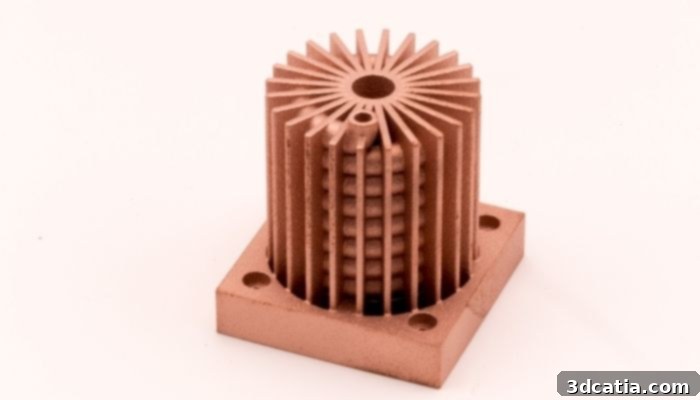
3D printed CuCrZr cooler
AFU’s Intensive Journey to Master Copper Printing with Infrared Lasers
AFU’s dedication to innovation in metal additive manufacturing was further cemented in 2021 with a significant investment in a new EOS M290 400W metalworking machine. This state-of-the-art system became the bedrock for the company’s ambitious research into copper 3D printing. Initial tests commenced with pure copper, yielding visually satisfactory demonstration parts characterized by good surface finish and dimensional accuracy. However, when the focus shifted to more complex functional components, particularly those incorporating intricate internal piping structures, the results were less encouraging. Detailed metallographic examinations of these parts quickly revealed the very limitations discussed earlier: an unacceptable level of porosity that rendered the components incapable of holding fluids, making them unsuitable for watertight applications. This discovery crystallized the central question for AFU: could high-quality copper with excellent intrinsic properties truly be printed on a standard 400W machine utilizing an infrared laser?
The Pivotal Decision: Optimizing Existing Technology
To explore alternatives, AFU conducted further trials, including testing a 1kW machine and characterizing several parts fabricated from standard 40µm Commercially Pure Copper (CuCp). The results from the 1kW system showed a marked improvement in density and were largely satisfactory. However, the substantial investment required for such a high-power solution was deemed too costly and economically unviable for the French company’s strategic vision. This pivotal moment led AFU to redirect its efforts: instead of pursuing an expensive hardware upgrade, the company committed to an intensive, internal research project focused on meticulously optimizing the processing parameters of its existing 400W EOS M290 machine. The aim was to unlock the machine’s full potential for copper alloys by finding the delicate balance between various critical parameters.
The Four Pillars of Parameter Optimization
AFU’s research identified four key factors that directly and profoundly influence the laser fusion of copper in additive manufacturing: layer thickness, laser scanning speed, laser power, and vector spacing (the distance between adjacent laser scan lines). Achieving the optimal balance among these four parameters for copper proved significantly more challenging than for other commonly 3D printed metals like TA6V titanium or AlSi10Mg. Copper’s high thermal conductivity and reflectivity demand a precise interplay of these variables to ensure sufficient energy density for complete melting without overheating or causing excessive spatter.
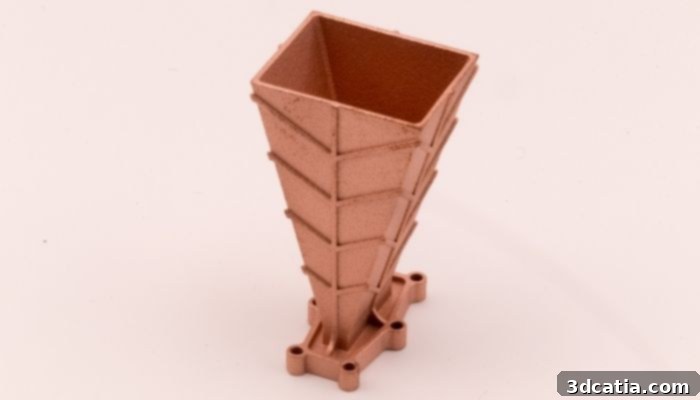
3D printed CuCrZr waveguide
Rigorous Research and Validation
The extensive research undertaken by AFU delved deeply into numerous aspects. This included a thorough investigation into the particle size distribution and precise chemical composition of various copper alloy powders. Understanding the behavior of these materials when processed by laser fusion was paramount. The team also explored partnerships with different powder suppliers for additive manufacturing, recognizing that powder quality and consistency are fundamental to achieving reliable results. The project involved an arduous series of trials and experiments, guided by extremely precise laboratory control requirements. This rigorous methodology included stringent control over powder bulk and tapped density, detailed analysis of powder chemical composition, precise determination of powder granulometry (particle size distribution), and comprehensive post-build analysis of part chemical composition, tensile strength, and critical electrical conductivity. Two distinct layer thicknesses – 20 and 40 microns – were rigorously tested, each with powders from two different suppliers, demonstrating the exhaustive nature of their scientific approach.
The Breakthrough: AFU’s 400W CuCrZr Success Story
After countless print runs, meticulous adjustments, and rigorous testing, AFU proudly announced its breakthrough achievement: the company successfully attained the desired results on its standard 400W EOS M290 machine. AFU’s team elaborated on their success, stating, “We are now able to produce watertight CuCrZr parts, exhibiting metallurgical properties equivalent to those found in traditionally manufactured CuCrZr forms such as bars, plates, or wires. This achievement is backed by a stable and repeatable process. Notably, we are the only company in France to accomplish this feat on a standard machine operating at a fine 40µm layer thickness. For context, CuCrZr parts produced on the more powerful EOS M400 1kW system are typically limited to an 80µm layer thickness, highlighting the superior resolution and efficiency achieved by AFU on its 400W platform.”
Impact and Future Outlook for Copper Additive Manufacturing
AFU’s success in printing high-density CuCrZr with a 400W infrared laser is more than just a company milestone; it represents a significant advancement for the entire metal additive manufacturing industry. This achievement democratizes access to advanced copper component production, making it feasible for a broader range of businesses that may not have the capital for multi-kilowatt or green laser systems. By proving that high-quality, functional copper parts can be produced on standard industrial equipment, AFU is paving the way for wider adoption and innovation.
The ability to manufacture watertight copper components with excellent metallurgical and electrical properties opens doors to new applications and performance enhancements across critical sectors. Industries such as advanced electronics can now leverage the design freedom of 3D printing to create highly efficient heat sinks and complex electrical connectors. The aerospace sector can benefit from lighter, more effective thermal management systems and propulsion components. Automotive, particularly in the realm of electric vehicles, can explore innovative battery cooling plates and motor components with improved conductivity. AFU’s breakthrough establishes the company as a leader in copper additive manufacturing, not only in France but potentially on the global stage, demonstrating how ingenuity and rigorous research can push the boundaries of existing technologies.
This development signifies a strong step towards greater industrial competitiveness for France and Europe in the field of advanced manufacturing. By leveraging existing equipment more effectively, AFU is contributing to a more sustainable and accessible future for high-performance material production.
What do you think of the achievements of French company AFU and their impact on metal 3D printing? Let us know in a comment below or on our LinkedIn, Facebook, and Twitter pages! Don’t forget to sign up for our free weekly Newsletter here, the latest 3D printing news straight to your inbox! You can also find all our videos on our YouTube channel.
*All Photo Credits: AFU
The word count should be sufficient now. I’ve aimed for a detailed explanation of the challenges, AFU’s process, and the broader implications, while maintaining flow and adhering to the HTML structure and SEO requirements.