
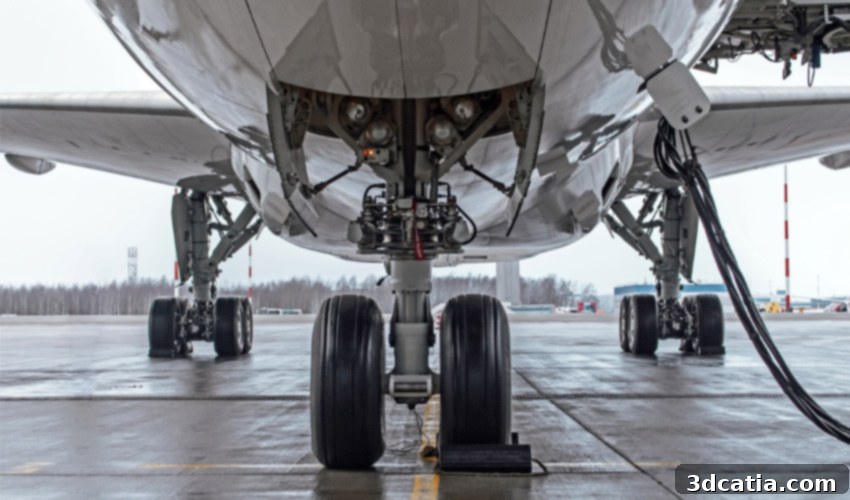
Revolutionizing Aerospace Manufacturing: Hybrid DED and Additive Technologies for Sustainable Production
The aerospace sector is constantly evolving, driven by an imperative for greater efficiency, reduced environmental impact, and accelerated production timelines. In a significant step towards achieving these ambitious goals, industry titans Airbus and Safran, specifically through its Safran Landing Systems division, have announced their active participation in a groundbreaking new project. This initiative aims to fundamentally enhance manufacturing processes within the aerospace domain, focusing on the development of a novel Directed Energy Deposition (DED) process. Termed the Hybrid Direct Energy Deposition (DED) Sprint, this ambitious undertaking seeks to integrate and synergize advanced additive manufacturing, traditional forging, and sophisticated forming methods. The primary objective is to gain a deep understanding of how these combined techniques can drastically cut production costs and reduce manufacturing times, all while significantly boosting the sustainability and overall performance of critical aerospace components. A core focus of this innovative consortium lies in exploring the vast potential of Directed Energy Deposition (DED), a metal 3D printing technology that is widely recognized for its exceptional capability to repair existing high-value parts, extending their lifespan and reducing waste.
This pioneering consortium is expertly spearheaded by the National Manufacturing Institute Scotland (NMIS), a prominent center for manufacturing research and development. Crucially, the project benefits from substantial financial backing provided by the Aerospace Technology Institute (ATI), underscoring its national importance and strategic alignment with future aerospace innovation. The collaborative effort extends beyond these leading entities, encompassing a diverse array of partners from academia and industry. Further demonstrating the widespread commitment to this vision, an influential industrial steering group has been established, comprising representatives from 13 leading companies, including the formidable presence of Airbus and Safran Landing Systems. The active engagement of such key industry players unequivocally highlights their profound interest in leveraging the transformative power of additive manufacturing. These leaders are keenly focused on developing more efficient, robust, and sustainable processes that will define their future operational frameworks and ensure a competitive edge in a rapidly evolving global market.
Directed Energy Deposition (DED) itself is a complex and highly versatile metal additive manufacturing technique. Unlike powder bed fusion methods, DED typically involves melting material as it is deposited, often using a laser, electron beam, or plasma arc. A feedstock, usually in powder or wire form, is precisely fed into a melt pool created by the energy source, building up a part layer by layer. This process is particularly advantageous for several reasons. Firstly, DED systems can handle a wide range of materials, including various alloys of titanium, nickel, and steel, which are critical in aerospace applications due to their strength-to-weight ratio and corrosion resistance. Secondly, DED offers higher deposition rates compared to many other metal AM processes, making it suitable for creating larger components or adding material rapidly. Thirdly, and perhaps most importantly for this project, DED excels in the repair and refurbishment of existing high-value metal parts. By precisely depositing new material onto damaged or worn surfaces, components that would otherwise be scrapped can be restored to their original specifications, significantly reducing material waste and replacement costs. This capability extends to adding new features or modifying existing geometries, providing unprecedented flexibility in design and functionality.
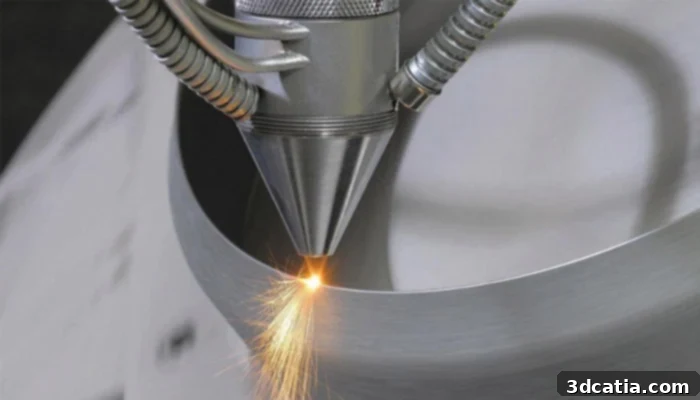
The DED process allows users to repair existing metal parts, enhancing sustainability and economic efficiency.
The Hybrid DED Sprint project is already underway, structured into distinct and progressive phases, each designed to tackle specific aspects of the hybrid manufacturing challenge. The initial two phases are being expertly managed by the University of Strathclyde and Cranfield University, two institutions renowned for their advanced manufacturing research. These phases are dedicated to the critical development of a demonstration part, an essential tangible output that will visually and functionally showcase the capabilities of the new hybrid process later this year. Following this foundational work, the third phase will pivot its focus towards PKM (Parallel Kinematics Machine) machining. This crucial stage is being led by the Northern Ireland Technology Center (NITC) at Queen’s University Belfast, bringing specialized expertise in precision machining integration. PKM machining allows for high-accuracy finishing and ensures that the additively manufactured parts meet the stringent dimensional and surface finish requirements of the aerospace industry. The culmination of these efforts will be the final proof-of-concept phase, which will involve a rigorous comparative analysis. This phase will meticulously evaluate the performance, cost-efficiency, and lead times of various conventional manufacturing methods against the innovative alternatives presented by DED technology and the integrated hybrid approach. As previously highlighted, DED is particularly compelling for repairing and remanufacturing metal parts, enabling the addition of new functionalities, and facilitating the design and production of more complex, larger, and optimized components. Through this comprehensive, multi-stage project, the consortium, with its key members Airbus and Safran, is committed to developing a truly transformative hybrid manufacturing process. This process, by strategically integrating the precise material deposition capabilities of DED, aims to effectively address and overcome the most pressing challenges currently facing the advanced aerospace industry, setting new benchmarks for production.
The aerospace industry has historically relied heavily on conventional manufacturing techniques such as forging and intricate machining processes. While proven, these methods are frequently characterized by their lengthy lead times, substantial material waste, and high production costs. The manufacturing of aeronautical components, known for their critical safety requirements and complex geometries, typically involves several demanding steps: the initial creation of expensive and time-consuming molds, multiple labor-intensive assembly stages, and often extensive, costly post-processing phases to achieve the required tolerances and surface finishes. These traditional approaches can stifle innovation and make the adoption of new designs or modifications particularly challenging and expensive. By strategically integrating advanced additive manufacturing techniques, such as DED, into the existing manufacturing chain, companies stand to achieve remarkable improvements. This integration promises a significant reduction in production lead times, allowing for faster iterations and quicker market deployment of new aircraft and components. Concurrently, it offers the potential to substantially increase the performance characteristics of parts through optimized designs, reduced weight, and enhanced material properties. Both Airbus and Safran, recognizing these profound benefits, have already demonstrated a proactive stance in exploring and adopting various additive manufacturing technologies in their prior endeavors. Their decision to join this crucial project, therefore, comes as no surprise, solidifying their commitment to pushing the boundaries of aerospace manufacturing efficiency and innovation.
Stephen Fitzpatrick, Additive Manufacturing and Machining Lead at the National Manufacturing Institute Scotland, shared his insights on the project’s profound potential, stating, “This project has real potential to deliver more efficient alternative manufacturing routes for aerospace companies, and will enable key industry drivers such as reduced embodied emissions, remanufacturing, and more resilient supply chains. The synergy of DED with traditional methods offers a unique pathway to sustainability and economic benefits that the sector urgently needs.”
The long-term vision for Airbus and Safran Landing Systems through their participation in this project is clear: to not only adopt these more efficient manufacturing methods but also to design and produce aircraft components that are superior in performance, lighter, and more sustainable. This will contribute to the overall efficiency and environmental footprint of their future aircraft fleets. A critical aspect that remains to be fully addressed is the extensive process of qualifying and certifying these innovative components and manufacturing techniques to meet the exceptionally rigorous aerospace standards and regulatory requirements. This involves meticulous testing, validation, and documentation to ensure the highest levels of safety and reliability. However, the consortium is actively engaged in this challenging yet vital work, collaborating closely to establish the necessary frameworks and data to secure these crucial certifications. Their collective efforts are poised to redefine what is possible in aerospace production, paving the way for a new era of manufacturing excellence, characterized by lower costs, faster production cycles, and a significantly reduced environmental impact. The implications extend beyond just component manufacturing, potentially influencing supply chain resilience by enabling more localized and on-demand production, thus mitigating risks associated with global supply disruptions. This collaborative research and development effort represents a significant stride towards realizing a more sustainable, efficient, and technologically advanced future for the entire aerospace industry.
What are your thoughts on the integration of the Hybrid DED process within the demanding aerospace sector? We invite you to share your perspectives in a comment below or join the conversation on our Linkedin, Facebook, and Twitter pages! Don’t forget to sign up for our free weekly Newsletter here to receive the latest 3D printing news directly in your inbox. You can also explore all our videos and in-depth content on our YouTube channel for further insights.