
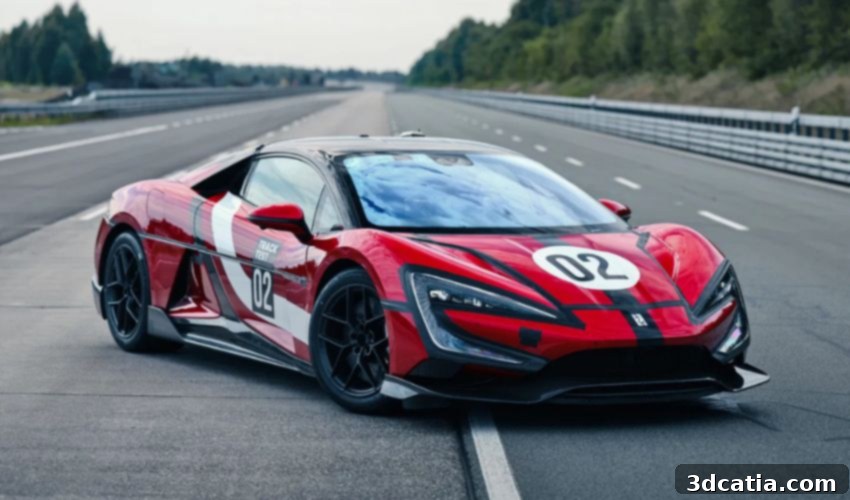
The Future of Hypercars: Yangwang U9X Redefines Performance with Additive Manufacturing and Aerospace Engineering
Additive manufacturing has once again demonstrated its unparalleled ability to push the boundaries of performance and engineering excellence. On a historic day, August 22, 2025, the groundbreaking Yangwang U9 Xtreme (U9X) etched its name into the record books at Germany’s legendary Nürburgring Nordschleife circuit. This wasn’t just another fast lap; the U9X completed the grueling 20.8-kilometer track in an astonishing 6:59.157 minutes. This monumental achievement not only secured the top position in its class for electric super sports cars, outpacing the previous record by a remarkable five seconds, but also made it the first mass-produced electric vehicle (EV) to conquer the formidable seven-minute barrier. This record-breaking run signifies a pivotal moment for both electric vehicle technology and advanced manufacturing, showcasing what is possible when cutting-edge innovation meets relentless ambition.
Yangwang, the premium performance brand under the Chinese automotive giant BYD, attributes this extraordinary accomplishment to far more than sheer horsepower and advanced aerodynamics. The secret weapon, as revealed by Yang Feng, head of the Yangwang Research Institute at BYD Auto Engineering Research Institute, lies deeply embedded within the car’s very structure: its revolutionary 3D printed body. Speaking to CarNewsChina, Feng disclosed that a significant part of his team’s success stemmed from an unconventional yet highly effective approach – drawing direct inspiration from aerospace industry standards for the production of the U9X’s sophisticated frame. This cross-industry pollination of ideas and technologies underscores a growing trend where the most demanding sectors converge to redefine engineering possibilities. The integration of additive manufacturing, particularly metal 3D printing, has been instrumental in realizing designs previously deemed unfeasible for automotive applications, leading to unprecedented levels of structural integrity and performance.
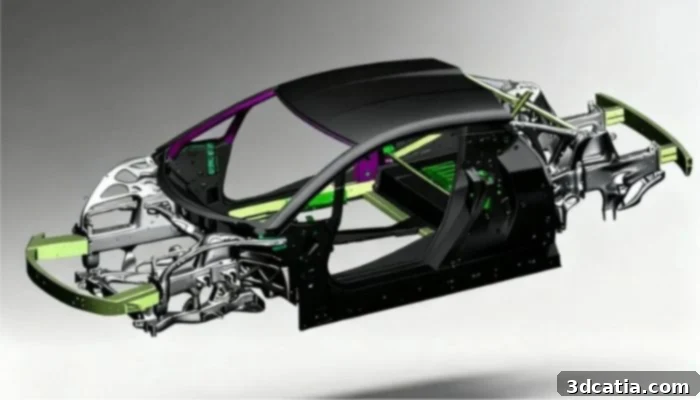
The 3D printed car frame was inspired by aerospace design principles.
Aerospace Design Principles and Advanced Materials Reimagined for Unrivaled Automotive Performance
The development of the Yangwang U9X’s revolutionary frame saw engineers looking beyond conventional automotive wisdom and directly towards the demanding world of the aerospace industry. This deliberate shift in perspective enabled the team to unlock new levels of structural efficiency and performance. Central to their innovative approach was the development of what they term “multidimensional surface parametric modeling.” This advanced computational technique is specifically engineered to ensure seamless and continuous transitions across highly complex curved surfaces, which are typically challenging to achieve with traditional manufacturing methods. Such precision modeling was critical for creating the vehicle’s signature “Printing HyperCell” structure – a sophisticated, honeycomb-like design that cleverly integrates intricate internal cavities and ribs. This bio-inspired architecture is not merely aesthetic; it is meticulously crafted to deliver maximum rigidity while simultaneously achieving remarkable lightness, a crucial factor for any high-performance vehicle. According to CarNewsChina, this marks a pioneering application of such an intricate structure in the automotive sector, setting a new benchmark for vehicle frame design. The tangible benefits are staggering: the new design reportedly boosts torsional stiffness by an incredible 200 percent compared to solid structures of equivalent weight. This dramatic increase in stiffness translates directly into superior handling, enhanced responsiveness, and unparalleled stability, especially at the extreme speeds the U9X is designed to achieve.
The aerospace inspiration extended far beyond just structural design; it profoundly influenced the material science behind the U9X. The vehicle incorporates cutting-edge, aerospace-grade materials specifically formulated for this ambitious project. Drawing extensively on advanced research in aircraft lightweighting – a field obsessed with reducing mass without compromising structural integrity – the Yangwang team meticulously developed a proprietary high-strength aluminum alloy. This innovative alloy boasts an astounding three times the yield strength of conventional cast aluminum, representing a monumental leap in material capability. Achieving such strength is crucial for a hypercar, as it ensures that the vehicle can withstand the immense forces and stresses encountered during high-speed driving and aggressive cornering. Furthermore, the team ensured that while pursuing extreme performance, the alloy maintained an optimal balance of safety characteristics and crashworthiness. This meticulous attention to both design and material science is what truly differentiates the U9X, allowing it to achieve a perfect synergy between lightweight construction, extraordinary strength, and uncompromised safety, setting a new paradigm for performance vehicle engineering.
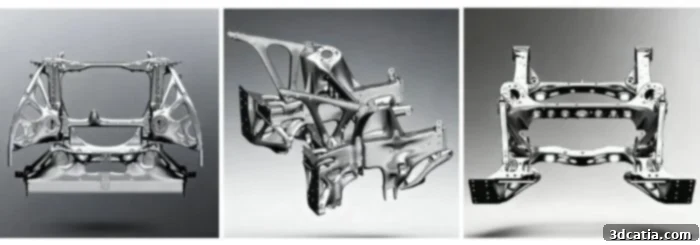
Views of the 3D printed car frame
Additive Manufacturing: The Enabler of Extreme Precision and Performance
The realization of such an intricately designed and structurally superior frame demanded a manufacturing process capable of unprecedented precision and geometric freedom. For this, Yangwang turned to laser selective melting (LSM), a sophisticated metal 3D printing technique. LSM allowed engineers to achieve a remarkable level of accuracy, with component features precisely rendered down to 0.33 mm. This level of detail is typically associated with high-precision aerospace components, such as jet engine parts, rather than large-scale automotive body structures. A significant challenge in metal additive manufacturing, particularly with thin-walled components, is thermal deformation – the distortion caused by the intense heat of the laser. To counteract this, the Yangwang team employed advanced process compensation algorithms. These complex computational models meticulously predict and adjust for thermal expansion and contraction during the printing process, ensuring that critical mounting surfaces maintain an astonishing tolerance accuracy within 0.1 mm. This meticulous control over manufacturing not only guarantees the structural integrity of the HyperCell design but also enables tighter integration between various vehicle subsystems. The resulting precision and the inherent advantages of topology optimization – where material is placed only where functionally needed – contribute significantly to the vehicle’s exceptional stability and responsiveness, even when hurtling towards speeds approaching 400 km/h. This synergy between advanced design, materials, and manufacturing redefines what’s achievable in high-performance automotive engineering, paving the way for lighter, stronger, and more dynamically capable vehicles.
The innovative approach and superior engineering of the U9X’s 3D-printed body did not go unnoticed by the broader automotive industry. Recently, the vehicle earned a prestigious award at the European Car Body Conference, a globally recognized event celebrating excellence in automotive body engineering. This accolade is particularly significant as the U9X’s project was the sole entry from a Chinese brand to receive such high recognition, underscoring its groundbreaking nature on an international stage. Scoring highest among a distinguished jury of experts, this victory powerfully highlights how aerospace-grade innovation, particularly through the adoption of additive manufacturing, is fundamentally redefining the landscape of automotive engineering. It signals a clear shift towards advanced manufacturing techniques as a cornerstone for future vehicle development. If the Yangwang U9X’s record-shattering performance and critical acclaim are any indication, the next generation of high-performance cars will increasingly look to the skies for inspiration, incorporating technologies and methodologies traditionally reserved for aircraft and spacecraft, thereby transcending the conventional boundaries of road-going vehicles.
To delve deeper into the intricate details of the U9X’s engineering marvel, we encourage you to read the comprehensive article from CarNewsChina here. We’d love to hear your thoughts on the incredible Yangwang U9 Xtreme and its game-changing use of additive manufacturing. Share your opinions in the comments section below or join the conversation on our LinkedIn or Facebook pages! Furthermore, ensure you stay ahead of the curve in the rapidly evolving world of 3D printing by signing up for our free weekly Newsletter to receive the latest news directly to your inbox. You can also explore our extensive library of videos on our YouTube channel for more insights. For those keenly interested in the latest advancements and applications of 3D printing within the dynamic automotive and transportation sectors, our dedicated page is an invaluable resource, accessible HERE.
*Photo Credits: Yangwang via CarNewsChina.com