
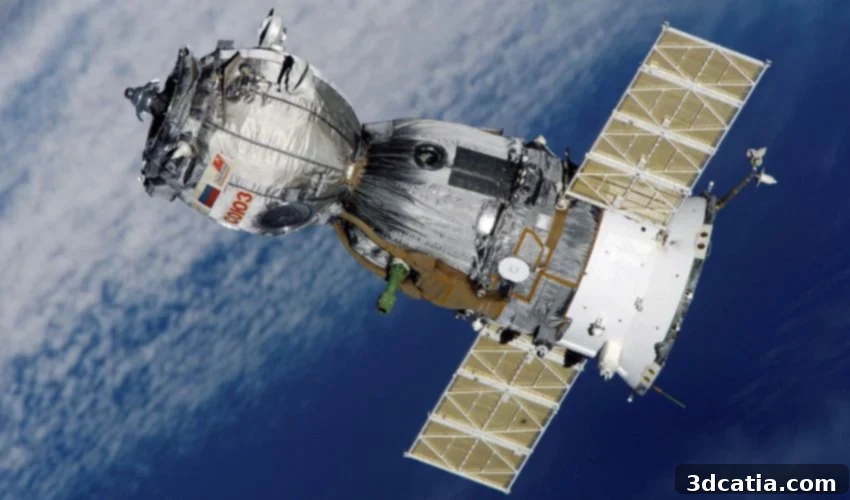
Revolutionizing Satellite Optics: Additive Manufacturing and Freeform Technology in Space with iLAuNCH
Outer space, once a distant frontier, is now a bustling domain critical to modern life on Earth. As of December 2023, an astounding 9,039 satellites orbit our planet, according to Orbiting Now, a testament to humanity’s increasing reliance on orbital infrastructure. These sophisticated machines are indispensable, facilitating everything from accurate weather forecasting and global television broadcasts to seamless internet communications and precise GPS navigation that underpins countless industries and daily activities. The sheer volume and diverse applications of satellites underscore the incessant need for relentless innovation in the sector. Among the most crucial components for these orbital assets are their optical payloads, particularly the high-precision glass optics that enable their diverse functions, whether for Earth observation, deep-space imaging, or inter-satellite communication. Exciting news now emerges from Australia, where a groundbreaking initiative is set to redefine satellite optical manufacturing. Through the ambitious iLAuNCH Trailblazer program, a powerful collaboration between the University of South Australia (UniSA), VPG Innovation, and SMR is pioneering a novel optical manufacturing process: freeform optics, meticulously crafted using advanced additive manufacturing techniques. This synergistic approach promises to unlock unprecedented capabilities for future space missions.
The Critical Role of Satellites and the Drive for Innovation
Our reliance on satellite technology continues to grow exponentially, touching nearly every aspect of modern society. From ensuring agricultural efficiency through remote sensing and managing natural disasters with real-time data to enabling global financial transactions and supporting military intelligence, satellites are the silent workhorses of the 21st century. The constant demand for enhanced performance, reduced size, increased durability, and cost-effectiveness for these instruments, especially given the extreme environment of space, drives relentless innovation. Traditional manufacturing methods, while robust and well-understood, often impose significant constraints on design flexibility, particularly for optical components. These limitations can hinder performance, especially when striving for wider fields of view, higher resolution, or more compact and lightweight designs—factors that are paramount for the next generation of small and nanosatellites, which are rapidly gaining traction in the space industry. The ability to push beyond conventional symmetrical optical designs represents a monumental leap forward, promising to unlock new possibilities for observation, communication, and exploration from orbit, ultimately enhancing our understanding of Earth and the cosmos.
Unveiling Freeform Optics: Breaking Design Barriers for Space Applications
At the heart of this innovation lies the revolutionary concept of freeform optics. Unlike conventional lenses and mirrors, which are typically constrained by rotational or translational symmetry (such as spherical or aspherical shapes), freeform optics are characterized by their complete freedom from such symmetrical limitations in form and shape. This liberation from traditional design rules allows optical engineers to create highly complex, asymmetrical surfaces that can achieve optical functions previously deemed impossible or incredibly difficult with conventional techniques. For satellite applications, this means the potential for significantly larger fields of view from a single optical system, more compact and lighter designs that save crucial space and weight on board (a critical factor for launch costs), and enhanced imaging capabilities with fewer optical elements. Moreover, freeform optics can be specifically engineered to correct aberrations more effectively across a wider range of viewing angles, leading to superior image quality, higher signal-to-noise ratios, and more efficient data acquisition. This adaptability also extends to their resilience, as these bespoke parts can be designed to better withstand the unique and harsh conditions of space, including extreme temperature fluctuations, vacuum, and radiation exposure, thereby improving mission longevity and reliability. The ability to design and produce such intricate components efficiently and precisely, without the prohibitive costs and time associated with traditional bespoke manufacturing, is where additive manufacturing becomes an indispensable tool.
iLAuNCH Trailblazer: Propelling Australian Space Innovation
It is no coincidence that this groundbreaking work is being undertaken as part of the iLAuNCH Trailblazer program. This strategic national initiative was specifically established with the ambitious goal of accelerating Australia’s space innovation capabilities and fostering a robust domestic space industry. By connecting universities, leading research institutions, and dynamic industry partners, iLAuNCH aims to translate cutting-edge scientific research and technological advancements into tangible, real-world space applications. The program serves as a vital bridge between academic discovery and industrial implementation, ensuring that Australia plays a significant and competitive role in the global space economy. The collaborative nature of iLAuNCH brings together diverse expertise and resources, pooling knowledge and capabilities to tackle complex, multi-faceted challenges, such as the development of advanced satellite optics. This concerted effort is crucial for developing sovereign capabilities and positioning Australia at the forefront of the global space race.
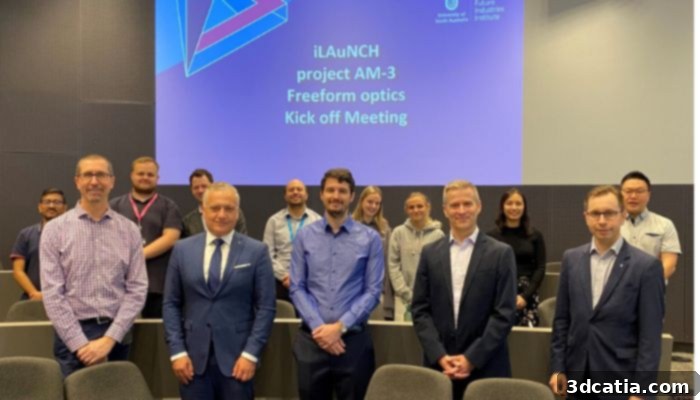
The team involved in the iLAuNCH freeform optics project (photo credits: iLAuNCH)
Darin Lovett, Executive Director of the iLAuNCH Trailblazer, emphasized the program’s core philosophy and its impact: “This project demonstrates what iLAuNCH is all about, taking a 2021 Defence Innovation Partnership (DIP) concept demonstrator that investigated the viability of Freeform Optical Components for small satellites – and moving it into production using Australian technology for real world application.” His statement succinctly highlights the program’s commitment to transitioning promising research concepts and proof-of-concept prototypes into practical, deployable solutions, significantly reducing the often lengthy time from innovation to market. This project not only showcases the advanced manufacturing capabilities emerging within Australia but also strategically positions the nation as a key player in the development and supply chain of next-generation satellite technology, particularly for the burgeoning small satellite and nanosatellite markets. By focusing on practical application, iLAuNCH is directly contributing to Australia’s economic growth and technological sovereignty in the critical space sector.
Additive Manufacturing: The Foundation for Advanced Space Optics
While the project leverages a sophisticated combination of technologies, the central and transformative role of additive manufacturing (AM), commonly known as 3D printing, cannot be overstated. AM offers unprecedented design freedom, allowing for the creation of intricate geometries, highly complex external shapes, and customized internal structures that are impossible or cost-prohibitive to achieve with conventional subtractive or formative manufacturing techniques. For freeform optics, this means the ability to precisely build the non-symmetrical, complex curvature required to deliver superior optical performance and unique functionalities. Beyond sheer design complexity, AM provides several other critical advantages particularly beneficial for demanding space applications. It enables the production of lightweight components, which is paramount for satellites where every gram saved translates directly into lower launch costs and increased overall mission efficiency. Furthermore, AM facilitates rapid prototyping and iterative design improvements, significantly accelerating the development cycle for advanced optical systems, reducing lead times from months to weeks. The technology also allows for on-demand manufacturing and customization, potentially leading to reduced inventory costs, simplified supply chains, and faster deployment of new satellite designs or replacement parts.
Within the context of iLAuNCH’s broader competencies and research focus, there’s a particular emphasis on Directed Energy Deposition (DED) 3D printing. DED, an additive manufacturing process where focused thermal energy (typically a laser or electron beam) is used to melt materials as they are deposited layer by layer, is well-suited for producing robust, high-performance metallic or ceramic components. While the specific AM method used for the freeform optics project isn’t explicitly detailed, DED’s capability to work with diverse materials and produce strong, dense parts suggests its potential applicability for structural elements or even the initial build of the optical substrate where material integrity is paramount. However, achieving the ultra-smooth, precise, and reflective surfaces required for high-fidelity optical mirrors and lenses necessitates a sophisticated hybrid manufacturing approach, combining the strengths of AM with subsequent advanced finishing techniques.
Synergistic Technologies: A Hybrid Approach to Space-Grade Mirrors
The true ingenuity and innovative core of this iLAuNCH project lies in its comprehensive, multi-disciplinary approach, which masterfully combines the transformative power of additive manufacturing with established, ultra-precision techniques. To create freeform mirrors for satellites that not only meet but exceed stringent space-grade requirements, the process extends well beyond just 3D printing. It strategically integrates additive manufacturing for the initial, complex geometric formation of the optical substrate with a series of crucial and highly specialized post-processing steps: traditional precision surface-finishing, highly specialized vacuum coating, and precise molding techniques. This synergy is absolutely essential because while additive manufacturing excels at producing complex shapes with unparalleled design flexibility and material efficiency, the surface finish directly off an AM machine, even with the most advanced processes, is typically not smooth enough for high-fidelity optical applications that demand nanometer-level precision. Therefore, meticulous and often multi-stage surface finishing techniques are employed to achieve the ultra-smoothness required for reflective optics, removing any microscopic irregularities.
Following this intensive surface preparation, a critical step is the application of vacuum coating. This sophisticated process involves depositing thin, often multi-layered, films of various materials onto the optical surface under controlled vacuum conditions. These coatings are meticulously engineered to enhance reflectivity, reduce glare, manage specific wavelengths, and provide crucial protection against the harsh space environment, including atomic oxygen erosion, micrometeoroid impacts, and damaging radiation. Finally, molding techniques might be utilized, either for subsequent replication of the precisely finished freeform optic or to further refine the shape of specific elements, ensuring unparalleled consistency and precision across multiple units if required for a constellation of satellites. This sophisticated combination of advanced additive manufacturing for groundbreaking design freedom and traditional ultra-precision methods ensures that the freeform optical components not only boast revolutionary designs but also possess the structural integrity, thermal stability, and optical performance necessary for reliable and long-duration operation in the unforgiving environment of Earth orbit and beyond. This innovative hybrid manufacturing methodology is what truly sets this iLAuNCH project apart, demonstrating a viable and scalable pathway for producing high-performance, next-generation space hardware for a multitude of critical applications.
Expert Insights on the Transformative Impact
Dr. Stoehr, a key figure instrumental in this collaborative effort, articulated the profound implications of this project, emphasizing its far-reaching impact. He stated: “Our combined efforts will redefine the possibilities in additive manufacturing and freeform optics, promising a transformative impact on the future of space exploration. As we contribute our expertise, we are not just advancing technology but shaping a future where South Australia becomes synonymous with cutting-edge value-added manufacturing.” His vision underscores not only the significant technological leap this project represents but also the substantial economic and industrial development it brings to the region, solidifying South Australia’s reputation as a dynamic hub for advanced manufacturing and burgeoning space innovation. This sentiment regarding Australia’s growing influence in the space sector was echoed by Al Jawhari, Co-Founder and Group CEO of Stärke-AMG, who provided a broader perspective on the nation’s emerging role in the global space landscape and the transformative potential of these technologies.
Al Jawhari elaborated on the strategic importance of Australia’s burgeoning space capabilities, particularly highlighting the nation’s proactive stance in the development of new small satellite platforms and its strong engagement with the increasing global trend towards nanosatellite deployment. He concluded:
“With Australia developing new space capabilities and small satellite platforms, it is at the forefront of those developments, including the rising trend towards nanosatellite platforms. The iLAuNCH Trailblazer, in partnership with UNISQ, UniSA, Stärke-AMG, and SMR Australia, is an innovative journey pushing the boundaries of additive manufacturing to revolutionize emerging freeform optics technology. We firmly believe in the transformative power of additive manufacturing and its potential to positively reshape the manufacturing industry. We are proud to be leading those efforts that will enable innovative satellite optics design and manufacturing for Earth observation and other critical applications. Together, we are enabling a future where freeform optics will redefine the possibilities of space missions.”
These expert perspectives collectively paint a compelling picture of a future where advanced manufacturing techniques, fundamentally driven by additive manufacturing, unlock unprecedented potential for space technology. The project’s dedicated focus on innovative satellite optics design and manufacturing for critical applications such as Earth observation, telecommunications, and scientific research directly addresses current and future needs in global space infrastructure. By enabling the creation of more efficient, lighter, and higher-performing optical systems, freeform optics will undoubtedly redefine the capabilities and ambitions of future space missions, paving the way for enhanced scientific discovery, improved terrestrial services, and sustained exploration.
You can find out more about the pioneering work of iLAuNCH HERE. What do you think of the transformative use of additive manufacturing for freeform optics in space applications? We invite you to share your thoughts and insights in a comment below or join the conversation on our Linkedin, Facebook, and Twitter pages! Don’t forget to sign up for our free weekly Newsletter here, to receive the latest 3D printing news straight to your inbox! You can also find all our engaging videos and interviews on our dedicated YouTube channel, showcasing advancements and applications in the world of additive manufacturing.
*Cover Photo: A satellite in space (photo credits: WikiImages from Pixabay)