

EY Report Unveils Rapid Global Expansion and Maturation of 3D Printing into Serial Production
The landscape of additive manufacturing (AM), commonly known as 3D printing, has undergone a transformative evolution over the past few years, moving from a niche technology primarily used for prototyping to a pivotal force in industrial production. This significant shift is meticulously documented in EY’s second comprehensive analysis, the Global 3D Printing Report 2019. Building upon their initial findings from 2016, this latest report highlights an astounding acceleration in enterprise adoption and a clear strategic reorientation towards functional applications. The data reveals that a substantial 65% of surveyed companies now leverage 3D printing in their operations, a dramatic increase from just 24% three years prior. Furthermore, a remarkable four out of ten businesses have recognized the inherent advantages of this technology by investing in their own in-house additive manufacturing solutions, demonstrating a growing commitment to harnessing its diverse benefits.
Beyond the sheer increase in adoption, the EY report also brings to light a notable recalibration in the global geographic distribution of the 3D printing market. Emerging economic powerhouses, particularly in Asia—with South Korea and China leading the charge—are rapidly expanding their market share. This ascent marks a distinct shift in dominance, challenging the historically strong positions held by countries such as Germany and the United States in the additive manufacturing space. Such a dynamic redistribution underscores the evolving global industrial landscape and the strategic embrace of advanced manufacturing technologies across different regions.
The robust conclusions drawn in the Global 3D Printing Report 2019 are founded on a comprehensive global survey, gathering insights from 900 participants representing 726 diverse companies worldwide. This extensive study encompasses 13 countries, with a strong representation from key regions including the US, Europe, and Asia, and spans across nine distinct industrial sectors. For instance, the United States alone contributed responses from 219 companies, providing a rich dataset for analysis. This broad methodological approach ensures that the report offers a multifaceted and authoritative perspective on the current state and future trajectory of additive manufacturing globally.
A striking revelation from the report is the clear leadership of South Korea and China in the adoption of 3D printing technology, a stark contrast to their positions in 2016. EY’s analysis suggests that this rapid acceleration could be a direct reflection of their robust economic development over recent years, which has demonstrably extended into the additive manufacturing market. Another compelling hypothesis posits that these nations have proactively identified and capitalized on the immense potential of emerging technologies to forge new competitive advantages. By strategically investing in 3D printing, they are moving beyond a traditional reliance on cost leadership, positioning themselves at the forefront of technological innovation and manufacturing excellence. This strategic foresight allows them to build more resilient and agile production capabilities.
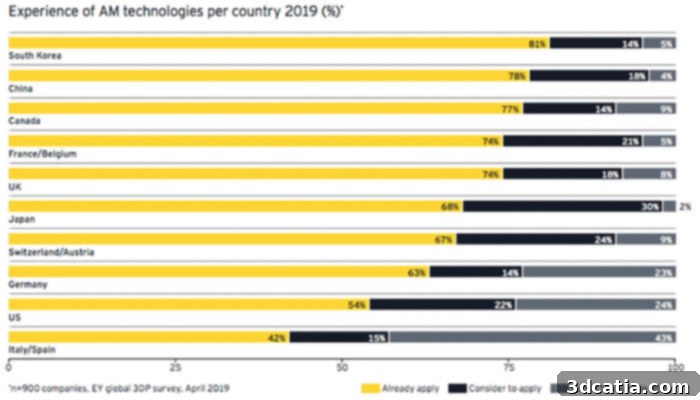
Image via EY
When examining sector-specific adoption, the aerospace industry emerges as the most experienced and dedicated proponent of additive manufacturing technologies. A significant 78% of companies within this sector report actively utilizing 3D printing, reflecting its critical role in producing lightweight, complex, and high-performance components vital for aircraft and spacecraft. This strong adoption is driven by the aerospace industry’s constant pursuit of innovation, material efficiency, and performance optimization, areas where AM excels.
While other sectors may exhibit lower overall adoption rates compared to aerospace, the report underscores a phenomenal surge in their engagement with additive manufacturing since 2016. For instance, the interest and practical experience among logistics and transportation companies have multiplied by six times, indicating a rapid awakening to the benefits of on-demand part production, custom tooling, and spare parts management. This growing enthusiasm across diverse industries signifies a broader understanding of AM’s capabilities beyond initial prototyping, moving towards more integral roles in their operational workflows and supply chains. The potential for creating custom components, improving efficiency, and reducing lead times is increasingly recognized across the board.
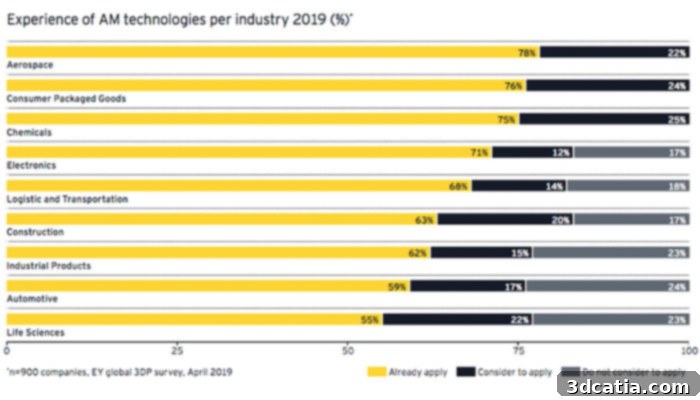
Image via EY
Additive Manufacturing’s Ascent to Serial Production
Recent discourse in the industry has consistently pointed towards a future where additive manufacturing transcends its traditional role in prototyping. The EY report unequivocally confirms this trend, illustrating that 3D printing is increasingly being embraced for the direct creation of functional parts. These critical components span several categories: end-use components and final parts delivered directly to clients; specialized tools and molds essential for conventional manufacturing processes; and on-demand spare parts produced from digital inventories. This pivot towards direct manufacturing signifies a maturation of the technology and its integration into core production strategies.
The data reveals compelling insights into this shift: almost one-third of the companies surveyed by EY in 2019 were actively producing one or more of these three types of functional parts. More precisely, 18% of businesses are leveraging 3D printing to fabricate final components for their products. Furthermore, 15% and 14% of companies are utilizing additive manufacturing directly for the production of tools and spare parts, respectively. These figures underscore a tangible movement away from mere conceptualization and iteration towards tangible, revenue-generating applications. The ability to create complex geometries, customize designs, and produce parts on demand offers unprecedented flexibility and efficiency, challenging traditional manufacturing paradigms.
Looking ahead, the forecasts are even more ambitious. A significant 46% of companies anticipate implementing 3D printing for their serial production by 2022, representing a substantial leap from the current 18%. This projected growth highlights the industry’s confidence in AM’s ability to scale and meet industrial demands. However, this figure is not uniformly distributed across all surveyed countries, with Asia, once again, emerging as the frontrunner. The region’s proactive investment and rapid adoption rates are setting a brisk pace for the rest of the world, indicating a strategic advantage in embracing advanced manufacturing capabilities. The accompanying breakdown below further illustrates these regional disparities and aspirations.
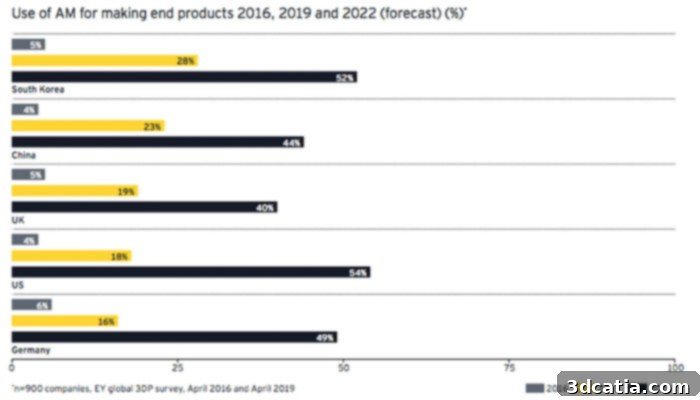
Image via EY
One of the most frequently cited benefits of 3D printing, according to participants, is its unparalleled capability to create tailored solutions that precisely meet individual customer demands. This inherent flexibility offers companies a distinct competitive advantage, allowing for mass customization and personalized products that were previously unattainable or prohibitively expensive. The sheer volume of custom-made 3D printed parts across various sectors today – from medical implants to consumer goods – serves as compelling evidence of this benefit.
Furthermore, the technology proves highly advantageous by significantly reducing lead times and overall manufacturing costs. By streamlining production processes, minimizing waste, and eliminating the need for complex tooling, 3D printing offers a leaner, more agile manufacturing paradigm. This efficiency directly translates into faster market entry and more cost-effective production cycles.
Crucially, additive manufacturing is profoundly impacting the entire supply chain, particularly revolutionizing how parts are stored and delivered. A significant 48% of participants express a strong desire to digitize their physical stocks, thereby transitioning to an on-demand production model. This move away from traditional warehousing towards digital inventories represents a monumental boom for the spare parts market, enabling companies to produce components only when needed, reducing inventory costs and obsolescence. Moreover, 56% of respondents believe that 3D printing actively diminishes logistics and transport efforts. By enabling localized production and reducing the need for extensive shipping networks, AM contributes to more sustainable and efficient supply chains.
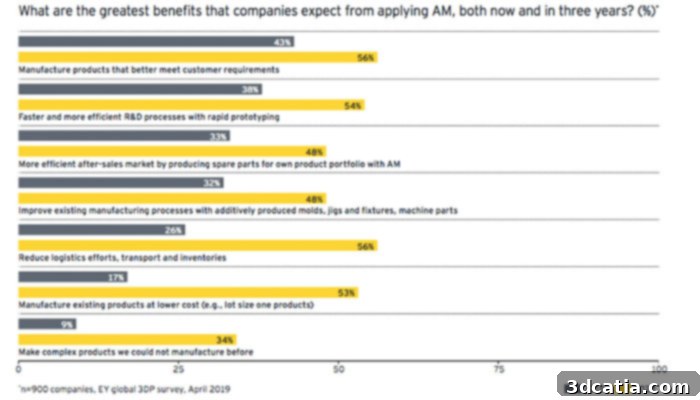
Image via EY
Despite the numerous and undeniable benefits of additive manufacturing, the report acknowledges several persistent limitations that hinder its wider adoption, predominantly revolving around cost. A staggering 90% of participants cite the high price of 3D printing materials as a significant barrier. Similarly, the initial investment required for additive manufacturing systems themselves is considered too high by 87% of respondents. These financial hurdles present a substantial challenge, especially for small to medium-sized enterprises (SMEs) looking to integrate the technology.
Beyond cost, a prevalent lack of specialized knowledge also impedes progress. Whether in the intricate aspects of design for additive manufacturing (DfAM) or the complexities of production, this knowledge gap prevents approximately 50% of the surveyed companies from fully investing in 3D printing solutions. The skills required to optimize designs for AM processes, understand material properties, and manage post-processing are still not widely available. However, a silver lining appears with the emergence of new training opportunities and educational programs. These initiatives are gradually addressing the knowledge deficit, paving the way for a more skilled workforce capable of unlocking AM’s full potential and ultimately removing some of these critical barriers to adoption.
In conclusion, the Global 3D Printing Report 2019 paints a highly optimistic picture for the continued expansion of additive manufacturing. The report confidently forecasts an impressive annual market growth of 25% leading up to 2023, projecting the global market value to reach an estimated $27.4 billion. This significant growth trajectory is excellent news for the entire sector, indicating a vibrant future marked by several key advancements. We can anticipate the introduction of innovative new materials, further technological evolution of 3D printing machines in terms of speed, cost-efficiency, and sophisticated software capabilities. Crucially, the report foresees a continued increase in the production of 3D printed end-use parts, with these functional applications progressively surpassing and ultimately redefining the role of rapid prototyping applications as the primary driver of market growth. This comprehensive analysis from EY underscores additive manufacturing as a dynamic and increasingly indispensable technology on the global stage.
For a deeper dive into these insights and more detailed information, you can access the full report on EY’s official website HERE.
What are your thoughts on these findings from EY’s latest report on the global adoption and strategic use of 3D printing in 2019? We invite you to share your perspectives in the comments section below or engage with us on our Facebook and Twitter pages! Don’t miss out on the latest advancements and news in the world of 3D printing by signing up for our free weekly Newsletter, delivered straight to your inbox.