
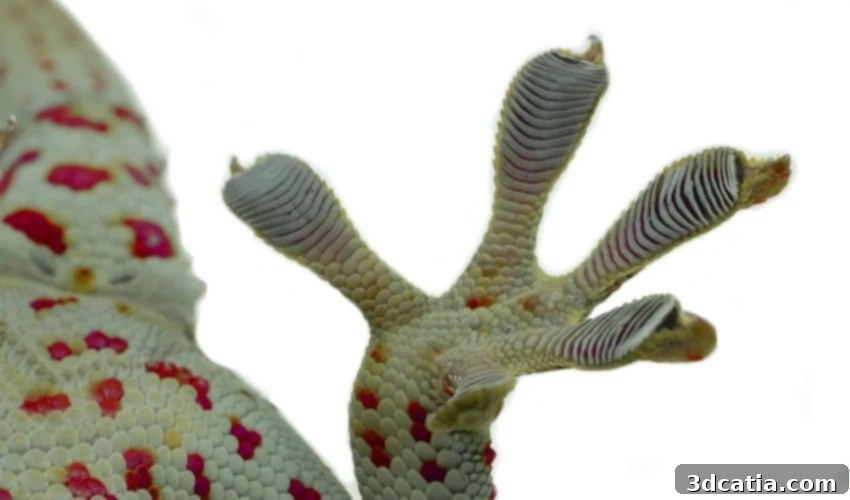
From Flaw to Breakthrough: Hanyang University Harnesses 3D Printing Overcuring for Gecko-Inspired Adhesive Surfaces
Imagine if a common manufacturing defect could be transformed into the cornerstone of groundbreaking new technology. This intriguing premise is precisely what a team of visionary researchers at Hanyang University in South Korea has achieved. By ingeniously re-evaluating and strategically leveraging the phenomenon of ‘overcuring’ in 3D printing, they have successfully developed novel adhesive surfaces that draw profound inspiration from the unparalleled clinging abilities of geckos. Utilizing the Digital Light Processing (DLP) additive manufacturing process, these scientists have managed to precisely replicate anisotropic microstructures that mirror the intricate design found on the legs of these remarkable reptiles, celebrated for their extraordinary capacity to adhere firmly to, and then effortlessly detach from, virtually any surface.
The potential ramifications of this pioneering research are immense and far-reaching. These biomimetic structures hold significant promise for a diverse array of advanced applications. Envision a future where soft robotics can perform delicate tasks with unprecedented precision, biomedical devices can interface seamlessly and non-invasively with biological systems, and sophisticated manipulation systems can handle fragile objects without causing any damage. The initial findings and methodology of this pivotal study were proudly published in the esteemed journal *Microsystems & Nanoengineering*, a testament to the collaborative efforts of several distinguished departments within the innovative Korean university.
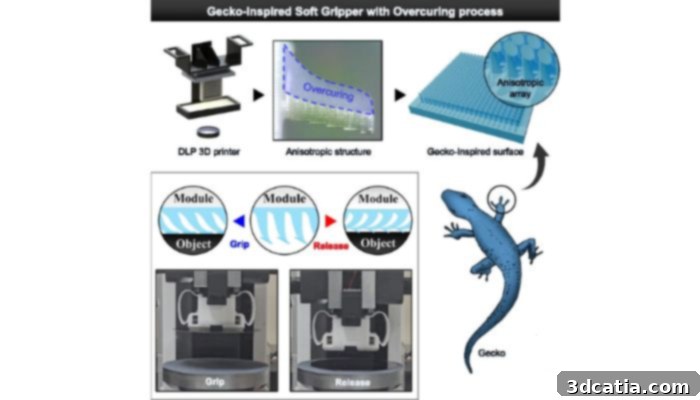
An in-depth explanation illustrating the innovative process for creating and meticulously testing these advanced anisotropic structures (photo credits: Kim, S., Kim, J., Seo, S. et al.).
For those less familiar with the intricacies of modern additive manufacturing, the DLP 3D printing process is a sophisticated technique that operates on the principle of selectively solidifying liquid photopolymer resins using projected light. A digital micromirror device (DMD) precisely controls where light is exposed, curing the resin layer by layer to build a three-dimensional object. While renowned for its speed, resolution, and ability to produce intricate details, one of the perennial and most significant challenges associated with DLP 3D printing is the occurrence of ‘overcuring.’ This phenomenon transpires when the light, intended for a specific area, inadvertently penetrates further or spreads beyond its desired boundaries, causing the resin to harden in unintended regions of the printed part. Traditionally, overcuring has been unequivocally regarded as an undesirable defect, as it fundamentally compromises the dimensional accuracy, structural integrity, and overall precision of the final printed object, leading to potential part failure or deviations from the intended design.
However, the pioneering research conducted at Hanyang University dares to fundamentally challenge and redefine this conventional understanding. Instead of viewing overcuring as a detrimental flaw to be avoided, the researchers made a deliberate and strategic decision to harness its power. Their innovative approach involved intentionally and precisely manipulating overcuring to fabricate perfectly inclined microstructures. These structures are directly inspired by the highly effective adhesive properties observed in the specialized legs of geckos. By meticulously controlling critical printing parameters, specifically the printing direction and the precise duration of light exposure, the team achieved an unprecedented level of control. This mastery allowed them to systematically induce a perfect, calculated tilt within microscopic abutments, starting from surprisingly simple digital models. This breakthrough demonstrates a profound shift in perspective, transforming what was once a source of frustration into a sophisticated design tool for advanced material engineering.
Why Create These Anisotropic Structures Inspired by Geckos? The Science of Superior Adhesion
To truly appreciate the brilliance of this innovation, one must delve into the remarkable biomechanics of gecko adhesion. The unparalleled climbing ability of geckos is attributed to the unique architecture of their feet, which are exquisitely covered with millions of tiny hair-like structures known as setae. Each seta, in turn, branches out into hundreds or thousands of even tinier, flattened structures called spatulae. This highly organized, hierarchical arrangement allows geckos to generate powerful adhesive forces without the need for suction, glues, or surface tension. The secret lies in the extremely close proximity these spatulae achieve with a surface, enabling the creation of weak intermolecular forces known as van der Waals forces. Individually weak, these forces become collectively incredibly strong due to the sheer number of contact points.
Crucially, the effectiveness of this adhesion is inherently anisotropic. The slanted orientation of these microscopic fibers means that when pressure is applied in one specific direction – typically by dragging their foot slightly as they climb – the spatulae engage with the surface, maximizing contact and creating a remarkably firm grip. Conversely, with a subtle twist or lift of the foot, the angle of contact changes dramatically, allowing the gecko to effortlessly detach and move forward. This directional adhesion, where the gripping force depends on the angle and direction of movement, is what the Hanyang University team sought to replicate in their engineered materials. Mimicking this sophisticated biological logic in artificial materials offers a revolutionary approach to creating switchable adhesive systems that are both strong and easily releasable.
Translating this intricate biological phenomenon into an engineering solution, the Hanyang University team meticulously processed the precisely printed microstructures using an advanced double-molding technique. This multi-step process was essential to faithfully transform the initial 3D printed forms into sophisticated surfaces capable of exhibiting switchable, gecko-like adhesion. The newly fabricated surfaces exhibit a remarkable replication of the gecko’s anisotropic adhesive properties, demonstrating strong adhesion under specific directional forces and easy detachment when manipulated differently. This makes them exceptionally well-suited for a wide range of cutting-edge applications, particularly in the development of robotic grippers. These grippers are designed to delicately and securely handle fragile or sensitive objects, such as electronic components, biological tissues, or intricate assemblies, without imparting any damaging pressure or leaving behind residues, thereby significantly expanding the capabilities of automated handling systems.
To comprehensively validate the practical feasibility and superior performance of their innovative methodology, the research team meticulously fabricated and rigorously tested a sophisticated mechanical module that ingeniously incorporated these newly developed anisotropic structures. The performance of their prototype was truly impressive: it demonstrated an exceptional ability to securely attach to a diverse range of different materials, from smooth glass to textured plastics, and then, with precisely controlled movement, release them with remarkable ease. This dynamic adhesion-and-release capability underscores the practicality and versatility of their design. Furthermore, a crucial aspect of their evaluation involved a direct comparative analysis between these novel structures and those produced through more conventional, traditional fabrication methods. The results were compelling: the gecko-inspired structures exhibited significantly enhanced stability, offering more reliable and predictable performance. Critically, this advanced stability was achieved while simultaneously reducing the inherent complexity of the overall fabrication process. This ingenious use of overcuring, re-envisioned as a fundamental design parameter rather than a flaw, effectively eliminated several costly, time-consuming, and resource-intensive intermediate steps that are typically required in traditional microfabrication. This streamlined approach not only makes the entire production process considerably more efficient but also more economically viable. The unexpected revelation that a perceived defect could yield such profound advantages underscores the power of creative scientific inquiry.
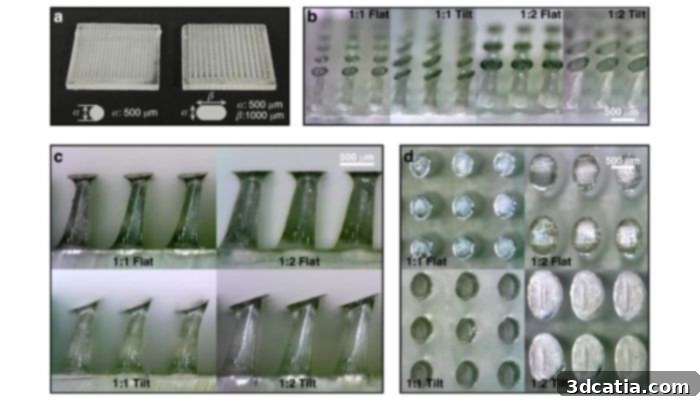
Illustrative photographs showcasing the functional anisotropic structures, highlighting their design and operational capabilities (photo credits: Kim, S., Kim, J., Seo, S. et al.).
This landmark study unequivocally demonstrates the transformative potential inherent in rethinking manufacturing challenges. It illustrates how a seemingly undesirable defect, when approached from an innovative and creative perspective, can not only be mitigated but actively transformed into a profound technological advantage. By artfully reinterpreting ‘overcuring’ – traditionally a limitation in DLP 3D printing – as a powerful and controllable design tool, the dedicated researchers at Hanyang University have brilliantly navigated and ultimately overcome some of the intrinsic technical limitations often associated with the DLP process. This paradigm shift has effectively unlocked an entirely new avenue for the efficient and cost-effective fabrication of advanced, high-performance structures, pushing the boundaries of what is possible in additive manufacturing.
The development of these sophisticated gecko-inspired robotic grippers represents just one compelling example of the immense and multifaceted potential that this revolutionary technique offers. Looking towards the future, the practical applications of this innovative method are poised for significant expansion, extending into a multitude of critical and emerging fields. Consider the burgeoning sector of soft robotics, where the ability to achieve precise, reversible adhesion is paramount for delicate interaction with the environment and human operators. In the realm of precision medical devices, this technology could lead to breakthroughs in micro-surgical tools, targeted drug delivery systems, or advanced prosthetics requiring adaptable surface interactions. Furthermore, in demanding industrial assembly systems, these adhesive structures could revolutionize the handling of minuscule components, enabling faster, more accurate, and damage-free automated manufacturing processes. Beyond these, potential applications could even span sectors like space exploration, allowing grippers to operate efficiently in vacuum conditions, or in advanced consumer products demanding innovative attachment solutions. This research truly opens up a world of possibilities for novel material design and functional device development.
What are your thoughts on the innovative approach of leveraging a perceived defect like overcuring to develop such groundbreaking new technologies? We invite you to share your insights and engage with us in a comment below, or join the discussion on our dynamic LinkedIn, Facebook, and Twitter pages! Don’t forget to sign up for our free weekly Newsletter here to receive the latest 3D printing news and developments delivered directly to your inbox. You can also explore all our engaging videos and in-depth content on our dedicated YouTube channel. For more detailed information about the specific technique and research findings, you can access the full study HERE.