
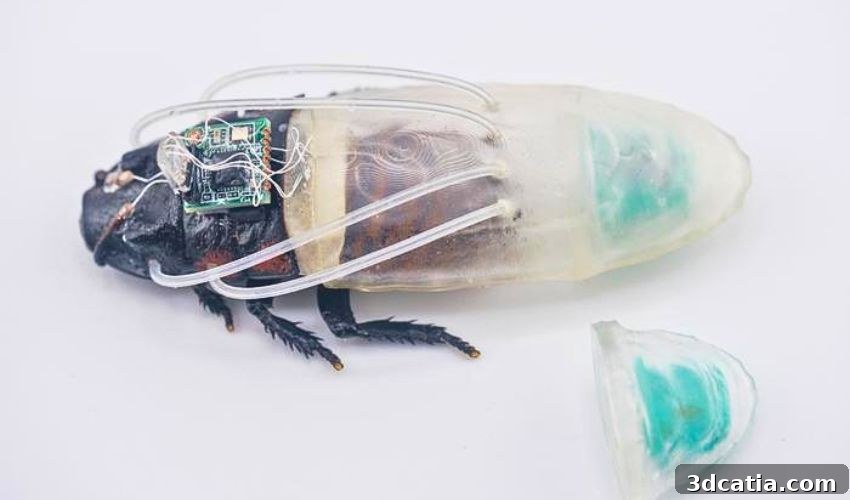
Cockroaches are rarely welcome guests. Yet researchers at Nanyang Technological University and Waseda University have transformed these hardy insects into practical tools for search-and-rescue and inspection work by outfitting living cockroaches with 3D-printed underwater suits. The result: remote-controlled cyborg insects capable of operating on land and in submerged environments where humans and conventional robots struggle to reach.
This work, reported in Nature Communications, takes a different approach than building tiny robots to mimic animals. Instead, the researchers used live Madagascar hissing cockroaches as the platform and augmented their bodies with electronics and a custom-printed breathing system. The hybrid system—combining an established control backpack with a newly designed 3D-printed oxygen supply—gives the insects true amphibious capability while preserving their natural mobility and energy efficiency.
Why use cockroaches for rescue and inspection?
Cockroaches offer formidably useful traits for confined and hazardous environments. They can squeeze through millimeter-wide gaps, traverse unstable debris piles, right themselves quickly if overturned, and operate for long periods on minimal energy. Engineers have struggled for years to reproduce all these abilities in small robots. Using a living insect leverages millions of years of evolutionary design while adding remote-control functionality for targeted tasks.
However, the main limitation for underwater or flooded scenarios is respiration. Cockroaches breathe through small openings along their body called spiracles, which become nonfunctional when submerged. The research team focused on solving that physiological barrier so the insects could remain active beneath the surface for extended periods.
A 3D-printed diving suit for insects
The team’s solution resembles a diver’s oxygen system: a flexible, lightweight shell printed to fit each insect individually and a compact oxygen-generating module that supplies air directly to the spiracles. The protective shell and oxygen unit are distinct from the movement-control backpack, so the cockroach keeps its natural locomotion while gaining the ability to survive underwater. With the suit fitted, insects remained active for up to three hours underwater; without it their survival time dropped to a matter of minutes.
Designing and fitting the suit required exacting constraints. The device had to be waterproof yet breathable where needed, lightweight so the insect could move freely, and precisely contoured so it would not hinder natural motion. Those constraints made additive manufacturing the ideal method: each component could be custom printed to match the animal’s shape and to include delicate seals and tubes that interface directly with the spiracles.
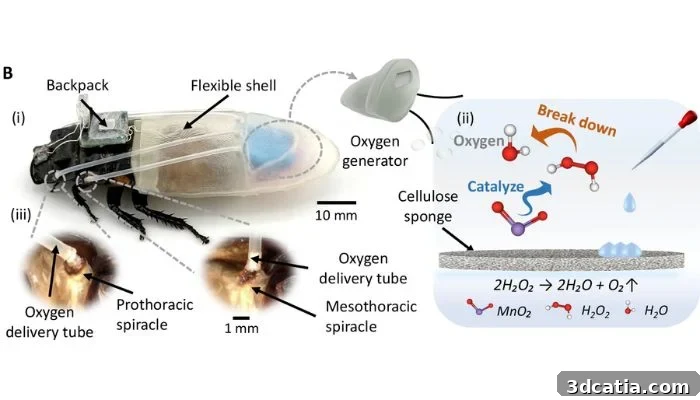
Photo Credit: Nature Communications
At the heart of the system is a transparent oxygen tank printed from a rigid resin similar to PMMA. Inside the chamber, a sponge coated with manganese dioxide reacts with a modest amount of hydrogen peroxide to generate oxygen on demand. Tiny silicone tubes carry the generated oxygen directly to the insect’s spiracles. Surrounding the tank, a soft flexible resin shell moves with the cockroach rather than constraining it. Even the connectors that seal to the different pairs of spiracles were individually shaped to ensure a reliable, low-leak interface.
Practical use and future directions
This is not merely a laboratory demonstration. The research team has already applied cyborg insects in real-world search-and-rescue operations. The technology was deployed as part of response efforts following the magnitude-7.7 earthquake that struck Myanmar in March 2025. Beyond disaster response, the group is advancing the platform for infrastructure inspection tasks where access is limited, dangerous, or submerged.
Our new insect diving suit works like the oxygen tank used by human divers. It generates oxygen and delivers it directly to the insect’s breathing holes, allowing the cyborg cockroach to survive and move in underwater or low-oxygen environments.” — Hirotaka Sato, Professor, School of Mechanical and Aerospace Engineering, NTU Singapore
The researchers also note that the approach could be adapted to other insects with similar spiracle-based respiratory systems. Locusts and many beetles use comparable breathing structures, so customized versions of the suit could potentially extend amphibious capability to different species suited to particular tasks or terrain.
This work highlights how biohybrid systems can combine natural adaptability with targeted human control to access spaces and perform functions that are difficult for conventional robots or humans to accomplish safely. As the technology matures, cyborg insects may become a practical component of emergency response toolkits and inspection teams for complex, hazardous environments.
*Cover Photo Credits: NTU Singapore