
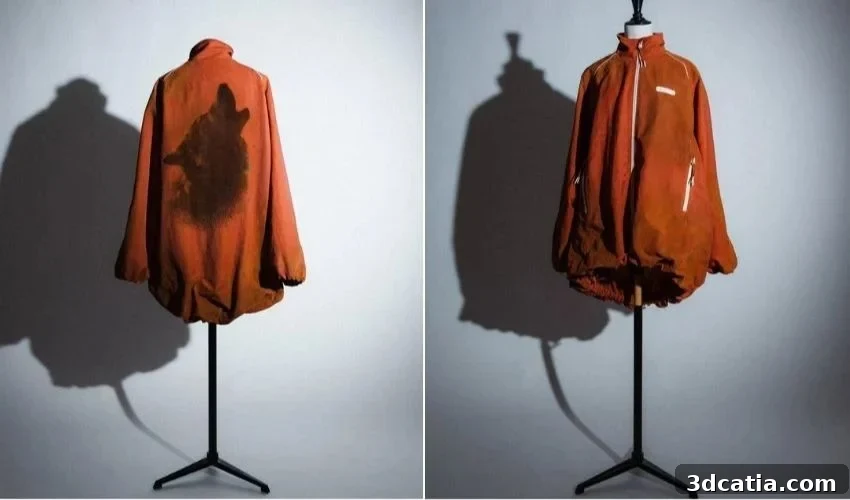
The 2026 Roland-Garros tournament began last week, and Novak Djokovic made a striking entrance in a specially designed jacket that drew attention. The garment features a raised, 3D wolf motif and real clay from the Parisian court. Pelagia Kolotouros, creative director at Lacoste, collaborated with Les Teintures de France, a workshop known for textile dyes and finishes, to create the piece in honor of Djokovic’s 22nd appearance at Roland-Garros — a milestone that ties a historic record.
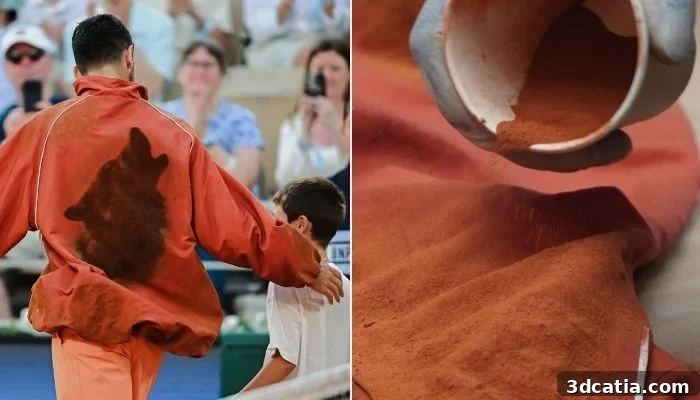
On the right, Djokovic is seen wearing the jacket as he arrives at Roland Garros 2026. On the left, the process of applying real clay to the garment.
Rather than relying on a flat print or embroidery, the design team chose a sculpted wolf in relief — a symbol Djokovic describes as his “spiritual guide” and an emblem of Serbia. To produce the three-dimensional effect, Les Teintures de France used industrial 3D printing technology suited to textiles. The workshop has experience with systems that print directly onto clothing, footwear and accessories, enabling durable, tactile embellishments that integrate with fabric.
In addition to the 3D wolf, the team treated the fabric with a binder to secure authentic Roland-Garros clay to the jacket. According to Serge Haouzi, design manager at Les Teintures de France, the finish was intended to create a worn, lived-in appearance that evokes the intensity of play and the physical mark a player leaves on the court.

On the court, Djokovic won his opening match against Frenchman Giovanni Mpetshi Perricard. He was eliminated in the third round by Brazil’s João Fonseca after a marathon match that approached five hours.
The jacket blends craftsmanship, textile finishing and advanced additive manufacturing to create a piece that is both symbolic and tactile. It showcases how contemporary techniques can be applied to high-profile sportswear to tell a personal and cultural story while honoring the event. The use of real clay and a raised emblem gives the jacket a distinctive texture and narrative that connects the athlete, the sport and the historic venue.
What do you think of the jacket and the approach behind it? Share your thoughts in the comments below.
*Photo credit: Serge Haouzi, Manager of Design at Les Teintures de France via LinkedIn.