
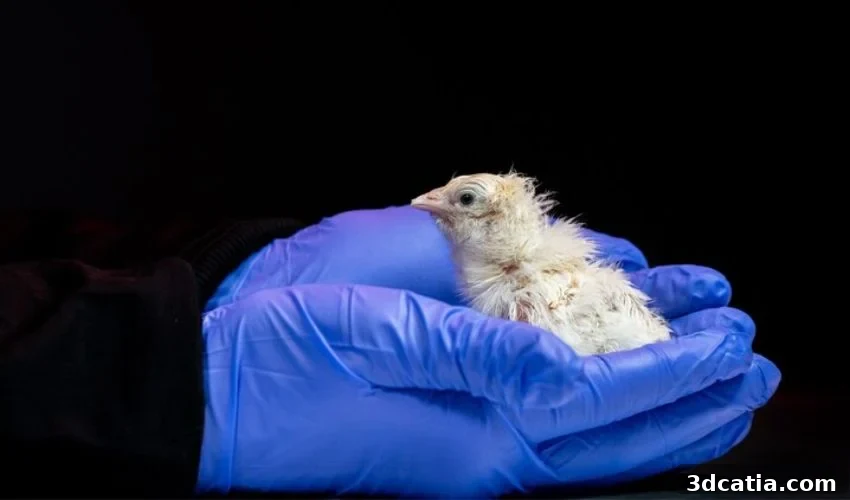
Can 3D printing revive extinct birds? Colossal Biosciences is pursuing that possibility. The Dallas-based biotech announced last week that it successfully hatched 26 healthy chickens using a complex artificial egg — an important proof-of-concept for the company’s long-term aim of recreating the Mauritius dodo and New Zealand’s South Island giant moa.
Designing a synthetic egg is challenging: the shell must allow oxygen to pass through while blocking pathogens and retaining moisture. Colossal’s Chief Biology Officer Andrew Pask explained that some early rigid shell prototypes were 3D printed on a FormLabs Form 4 with BioMed black resin. Those initial parts served as prototypes, and later iterations were produced in titanium. The final design combines a rigid hexagonal support cup with a semi-permeable silicone membrane that replicates the gas-exchange properties of a natural eggshell.

The artificial egg has a rigid shell and a silicone membrane.
The silicone membrane is tuned to allow gas exchange comparable to that of a biological shell. A transparent observation window in the top of the egg lets researchers monitor embryo development without disturbing the internal environment. The design is scalable, so it can be adapted for very small eggs such as hummingbirds’ or very large eggs like those that would have come from the giant moa, whose adults once stood nearly 12 feet tall.
Previous shell-free hatching systems often relied on supplying large amounts of supplemental oxygen late in development, which can damage embryonic DNA. Alternatives like plastic cups or cling film have yielded low success rates, according to Mike McGrew, an embryologist at the Roslin Institute and an avian stem cell advisor to Colossal. By enabling passive oxygen diffusion through the silicone membrane rather than active oxygen supplementation, Colossal’s artificial egg addresses this key limitation.
How Does the 3D Printed Egg Work?
To produce the 26 chicks, the team collected fertilized hen eggs within one to two days after laying. They opened the natural shells, selected embryos judged most likely to develop successfully, and transferred the contents into the artificial egg. No genetic modification was performed on these birds; they were simply incubated in the synthetic device.
For de-extinction, the artificial egg is intended as a later-stage incubation vessel. Creating a bird that resembles a dodo or a giant moa would require species-specific genetic edits much earlier in development. Once an egg is laid, the embryo already contains tens of thousands of cells, which is currently too many to alter reliably with existing genetic engineering methods, notes Hans Cheng, a molecular geneticist previously with the USDA’s Agricultural Research Service.
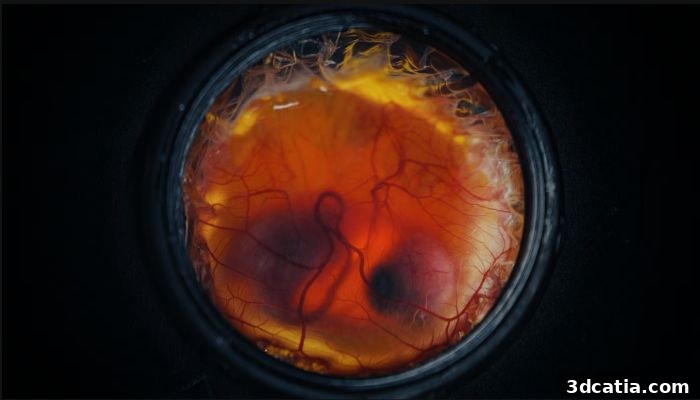
The open top of the artificial egg allows researchers to see into the embryo without disrupting the environment.
Colossal plans to use primordial germ cells — the stem cell precursors to sperm and egg — to introduce species-specific genetics earlier in development. Last fall the company successfully cultured primordial germ cells from a common pigeon, which is genetically close to the Nicobar pigeon. The Nicobar pigeon is a leading candidate surrogate for the dodo restoration project. For the giant moa, potential surrogates under consideration include emu and tinamou, though the moa’s enormous eventual size would likely exceed any natural surrogate egg, making the artificial egg system especially important.
Applications Beyond De-Extinction
Colossal made headlines in 2024 when three dire wolf pups were born to a gray wolf surrogate mother after genetic engineering using preserved ancient DNA. The company’s de-extinction portfolio also includes programs focused on the woolly mammoth and the thylacine, in addition to the dodo and the South Island giant moa. Since its founding in 2021 by CEO Ben Lamm and Harvard geneticist George Church, Colossal has attracted substantial investment and attention, raising hundreds of millions in funding.
Beyond de-extinction, the artificial egg offers practical value to developmental biology. The clear observation window allows direct monitoring of organ and blood vessel formation during early stages, which can help researchers studying embryonic development and evolutionary processes, says Vincent Lynch, an evolutionary biologist at the University at Buffalo.
Colossal has not yet published a peer-reviewed paper or released public datasets detailing the artificial egg results. The company has shared videos and updates, and continues to develop both the biological and engineering aspects of the system.
*Photo credits: Colossal Biosciences