
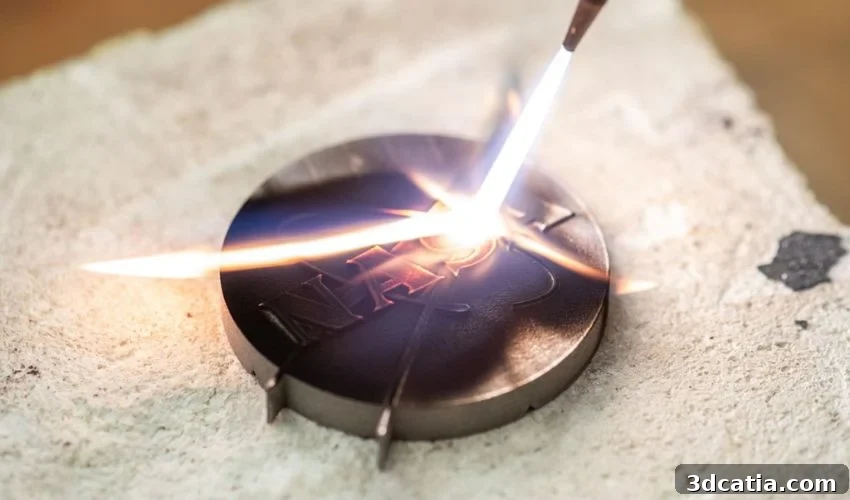
Jet turbine engineers require materials that can endure some of the most extreme environments—temperatures above 2,000°F (about 1,100°C) and prolonged exposure to stress and corrosion. For years, no off-the-shelf alloy printed by metal additive manufacturing reliably met those demands. The solution emerged from NASA Glenn Research Center as GRX-810, an oxide dispersion strengthened (ODS) superalloy designed specifically for additive manufacturing. GRX-810 delivers exceptional high-temperature creep performance—testing has shown lifetimes exceeding 6,000 hours—and it prints without special machine settings, establishing a new standard for high-temperature metal AM.
Tim Smith, a Research Materials Engineer at NASA Glenn, was instrumental in taking GRX-810 from concept to commercialization; the alloy was honored as NASA’s Commercial Invention of the Year. To learn how the material was developed and where it might be used, 3Dnatives spoke with Tim, who will also take part in a panel at the virtual ADDITIV Metals event on June 10. Read the edited interview below for insights into the alloy’s creation, capabilities, and future applications.
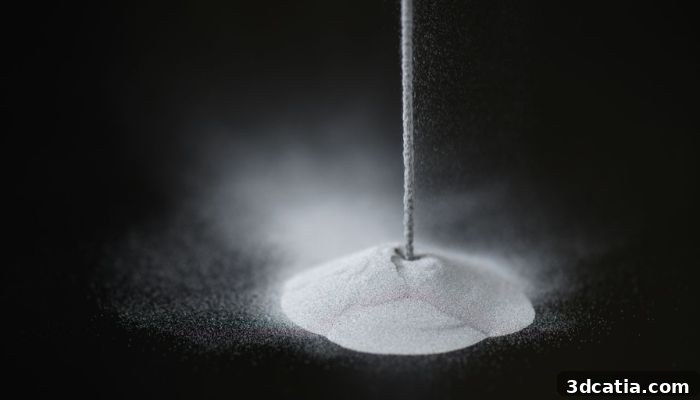
GRX-810 was designed specifically for 3D printing (Photo Credit: Jef Janis/NASA)
3DN: Can you tell us about the GRX-810 superalloy? Why was it created and what necessitated its development?
The GRX-810 effort began roughly seven to eight years ago when engineers at NASA Glenn wanted to 3D print a combustor dome for jet turbine engines with novel geometry. The challenge was the extreme operating temperature—around 2,000°F—where available, printable high-temperature alloys repeatedly failed in testing. Materials researchers were asked whether any commercially available alloy could be printed and survive those conditions. The short answer was no, but the team believed additive manufacturing itself could enable a purpose-built alloy. That approach launched the GRX-810 development program.
Instead of modifying existing alloys, the team pursued an ODS superalloy tailored for AM. The result is a powder feedstock with nanooxide dispersions that, when printed, yields a component capable of sustained performance under extreme temperature and stress.

3DN: Because this material can tolerate such high temperatures, does that make it more challenging to print? Does it require higher temperatures during the printing process?
Printing GRX-810 is not inherently more difficult. The alloy was intentionally designed to print with standard parameters so industry adoption would be straightforward. It does not require a heated build plate or specialized machine settings—if you have a reasonable starting point, you can produce very dense parts. The primary difference is the feedstock, which contains nanooxide particles; otherwise it processes like a conventional nickel-base alloy in powder bed systems.
3DN: Is GRX-810 exclusive to any specific type of metal 3D printing technology?
The highest technology readiness (TRL) and manufacturing readiness level (MRL) for GRX-810 is currently in laser powder bed fusion (LPBF), where most development and optimization occurred. However, NASA and industry partners are expanding into other AM methods to serve different part sizes and production requirements. Directed energy deposition (DED) and wire additive manufacturing are being explored, and the team has already completed some hot wire builds.
3DN: In what cases would laser powder bed fusion not be the optimal method for this material? Why explore DED and wire additive?
LPBF is limited by machine build volume and deposition rate. For large components or when faster material deposition is needed, DED or wire-based AM can be more appropriate. There is also industry interest in producing sheet stock or larger-format parts from GRX-810, which is complicated because the alloy is intended for additive production only. Higher-deposition processes like wire AM help bridge that gap and enable scaling beyond LPBF capabilities.
3DN: You mentioned this project started seven years ago. Why did it take that long, and what challenges did you face?
The alloy composition was identified relatively quickly using a modeling-first approach to optimize the ODS powder. However, the COVID-19 pandemic delayed lab work, and the first batches of GRX-810 sat unused for more than a year. Scaling presented another challenge: early lab batches were produced in 10-pound quantities suitable for small printers, but industrial adoption requires hundreds or thousands of pounds. Scaling feedstock production, ensuring consistent nanooxide dispersion, and validating process changes all demanded careful study.
Despite those hurdles, the timeline from initial property reporting in 2022 to commercialization in 2025 was rapid by traditional materials-development standards, reflecting how additive manufacturing accelerates discovery and deployment.
3DN: Beyond NASA and aerospace, what other applications do you see for GRX-810?
Any environment that combines extreme heat and corrosive conditions is a candidate for GRX-810. Interest has already come from automotive applications such as turbochargers for high-performance racing. The alloy is also useful for grips and rods used in high-temperature tensile testing, where conventional materials fail, and for temperature probes or instruments operating in corrosive, high-temperature settings. While much of the team’s work focuses on space and aerospace, the material’s capabilities make it relevant across industries that face extreme operating conditions.
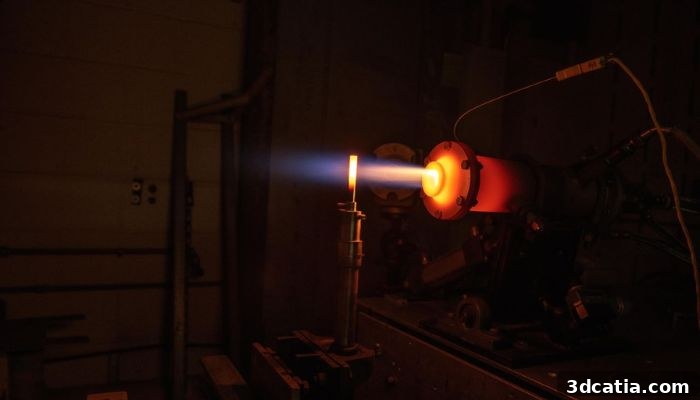
GRX-810 can withstand extreme conditions. (Photo Credit: NASA/Bridget Caswell)
3DN: GRX-810 won NASA’s Commercial Invention of the Year award. How did it feel to be part of the team that achieved that?
The recognition was an incredible honor. Tim describes it as a surreal and gratifying milestone that reflects the teamwork behind the achievement. Developing a material like GRX-810 required many contributors—modelers, powder manufacturers, AM specialists, and test engineers—and the collaborative environment at NASA Glenn made it possible to tackle complex questions quickly and effectively.
3DN: Was there anything that surprised you or your team during the development of GRX-810?
Early test results were unexpectedly positive. Initial low-stress, high-temperature creep tests of previous ODS alloys typically produced lifetimes on the order of 80 to 100 hours, which already exceeded many conventional superalloys. GRX-810, however, demonstrated lifetimes exceeding 6,000 hours in those early screens—an order-of-magnitude improvement that exceeded expectations. Since then, the team has continued investigating the microstructure and mechanisms behind that performance; the original composition predictions were remarkably accurate, and changes often reduce performance, which highlights how finely tuned the alloy is.
3DN: Are there common misconceptions in the metal additive manufacturing industry that you think need to be addressed?
A common hesitation is reluctance to adopt new materials. But additive manufacturing already produces materials with microstructures and properties that differ from wrought or cast equivalents. Designing alloys specifically for AM unlocks superior performance compared with repurposing legacy alloys. Even when using familiar alloys, it’s essential to thoroughly test and characterize printed material because the AM process fundamentally changes the material’s structure. Embracing purpose-built AM alloys leads to better components and more predictable outcomes.
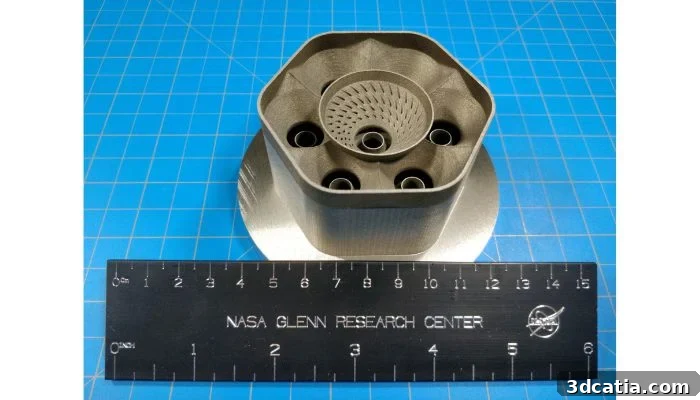
A turbine engine combustor that was 3D-printed at NASA Glenn, an example of a challenging component that can benefit from applying the new GRX-810 alloys. (Photo Credit: NASA)
3DN: Do you have any advice for young engineers who want to achieve work at this level?
Tim’s advice is simple: don’t go it alone. Seek mentors, collaborate widely, and use the expertise around you. GRX-810 succeeded because many people contributed at every stage. Young engineers should ask for help, accept mentorship, and, in turn, support the next generation when they have the chance.
If you want to learn more about metal additive manufacturing and GRX-810, consider registering for relevant industry events and following updates from research centers and manufacturers. What do you think of this material breakthrough? Share your thoughts in the comments.
*Cover Photo Credits: NASA/Jordan Salkin