
Additive Manufacturing in Aerospace: Overcoming Fatigue for Flight-Critical Applications
Additive manufacturing (AM) holds immense promise for the aerospace industry, offering the potential for lighter parts, complex geometries, and accelerated production timelines. However, in the highly regulated world of aviation, simply printing a component is just the first step. The true challenge lies in proving its operational reliability and securing the necessary approvals for service. While a component might be manufactured in a matter of hours, its qualification can demand months of rigorous fatigue testing and exhaustive analysis. At 30,000 feet, where safety is paramount, reliability isn’t a theoretical concept; it’s an absolute necessity, and uncertainty is simply unacceptable.
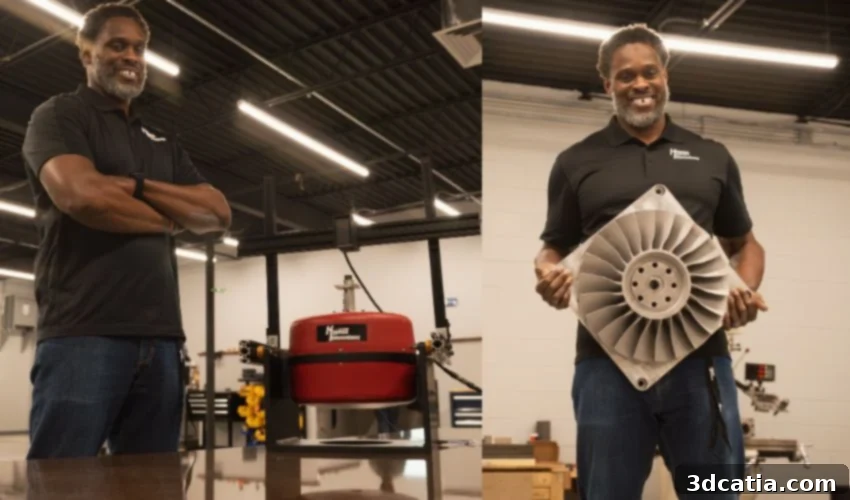
Dr. Onome Scott-Emuakpor, founder of Hyphen Innovations and a former researcher at the Air Force Research Laboratory’s Turbine Engine Structural Integrity Lab, has dedicated his career to bridging the gap between production speed and unwavering confidence. His work is pivotal in enabling the integration of additive manufacturing into critical flight hardware.
Dr. Scott-Emuakpor will be a featured speaker at RAPID + TCT 2026 in Boston this April. His presentation, titled “A Post-Process Treatment for Improving Fatigue Performance of Additive Manufactured Parts,” will delve into strategies for accelerating the qualification process for aerospace components produced via AM. In anticipation of the event, we engaged in a conversation with Dr. Scott-Emuakpor to gain insights into the evolving industry perspectives on additive manufacturing, understand why fatigue performance remains a significant barrier to widespread adoption, and identify the key considerations that engineers should address before venturing into flight-critical applications.
From Turbine Engines to Additive Innovation: Dr. Scott-Emuakpor’s Journey
 Dr. Scott-Emuakpor’s journey into additive manufacturing began at the Air Force Research Laboratory, specifically within the Turbine Engine Structural Integrity Lab. The lab’s core mission was to ensure the extended lifespan and reliable performance of critical engine components. He explains, “In aerospace, innovation follows a clear chain: new designs necessitate new materials, and new materials, in turn, require new manufacturing processes. Traditional manufacturing methods eventually reached their limitations, which led me to explore additive manufacturing approximately 15 years ago.”
He continues, “Metal AM revolutionized the field by enabling the creation of geometries that were previously deemed impossible to manufacture. The research and intellectual property (IP) developed during that period ultimately formed the foundation upon which Hyphen Innovations was built.” Dr. Scott-Emuakpor recognized the transformative potential of AM and its ability to overcome the constraints of traditional manufacturing in the aerospace sector.
The Evolution of Additive Manufacturing in Aerospace: A Shift in Perspective
Dr. Scott-Emuakpor, a regular attendee of RAPID + TCT, has witnessed a significant evolution in the industry’s perception of additive manufacturing. He notes, “The most significant change is the disappearance of absolute statements. A decade ago, it was common to hear that additive manufacturing would never be suitable for certain aerospace applications. Today, that sentiment has shifted to cautious optimism, driven by tangible data.”
He emphasizes that years of dedicated research have provided the industry with a deeper understanding of the unique behavior of AM materials compared to their traditionally manufactured counterparts. While these materials exhibit distinct characteristics, they have proven capable of meeting the stringent requirements for flight-critical applications. This data-driven approach has fostered a more nuanced and optimistic outlook on the potential of AM in aerospace.
Unconventional Thinking and the Power of Unexpected Insights at RAPID + TCT
When asked about specific presentations or discussions at past RAPID + TCT events that have influenced his research and technology development, Dr. Scott-Emuakpor highlights the collective impact of numerous moments of inspiration. “It’s difficult to single out a specific presentation. What has influenced me most are the moments when someone attempts something completely novel and succeeds in making it work.”
He elaborates, “Over the years at RAPID + TCT, I’ve experienced countless ‘I wouldn’t have thought of that’ moments, or instances where an idea I initially considered trivial turned out to be remarkably significant. This exposure to unconventional thinking has profoundly shaped my approach to research and development, encouraging me to explore ideas outside the established norms.” The conference serves as a catalyst for innovation by fostering a culture of open-mindedness and the willingness to challenge conventional wisdom.
RAPID + TCT: A Holistic Perspective for Qualification-Critical Applications
With numerous conferences dedicated to aerospace and manufacturing, Dr. Scott-Emuakpor explains what sets RAPID + TCT apart as a particularly valuable event for engineers working on qualification-critical applications. “RAPID + TCT provides a unique top-down perspective. Attendees can hear a CEO outline a pressing business challenge and the strategic approach to addressing it, and then immediately walk onto the expo floor and witness the machines and finished parts that are actively tackling that very challenge.”
He emphasizes the conference’s ability to connect the high-level vision, the technical solutions, and the practical realities of the shop floor in a single venue. This integrated approach is invaluable for engineers focused on qualification-critical applications, allowing them to gain a comprehensive understanding of the entire AM ecosystem.
Fatigue Performance: The Lingering Hurdle to Widespread Adoption in Aerospace
Despite the advancements in additive manufacturing, confidence in part reliability remains a major impediment to its widespread adoption in the aerospace industry. Dr. Scott-Emuakpor identifies fatigue performance as a critical area that continues to limit the broader use of AM. “Fatigue is arguably the most critical material property in aerospace. The vast majority of metal components ultimately fail or require maintenance due to fatigue-related issues.”
He underscores the critical importance of reliability in aviation, stating, “There’s no roadside assistance at 30,000 feet, so we need fast and reliable methods to predict fatigue behavior. Without accurate fatigue prediction, additive manufacturing cannot scale into wider adoption for flight-critical components.” The ability to accurately assess and mitigate fatigue risk is paramount to ensuring the safety and longevity of AM parts in aerospace applications.
Post-Processing: A Key to Unlocking Enhanced Fatigue Performance
Dr. Scott-Emuakpor’s presentation at RAPID + TCT, “A Post-Process Treatment for Improving Fatigue Performance of Additive Manufactured Parts,” offers a promising solution to the fatigue challenge. He explains that the traditional qualification process is often time-consuming. “The ‘rapid’ disappears when qualification takes months and optimization takes years. We’re challenging the assumption that performance must be solved at the printing stage. Instead, a targeted post-process treatment can significantly extend fatigue life and reduce the need for lengthy iteration cycles.”
Challenging Misconceptions: Vibration Damping and Fatigue Performance
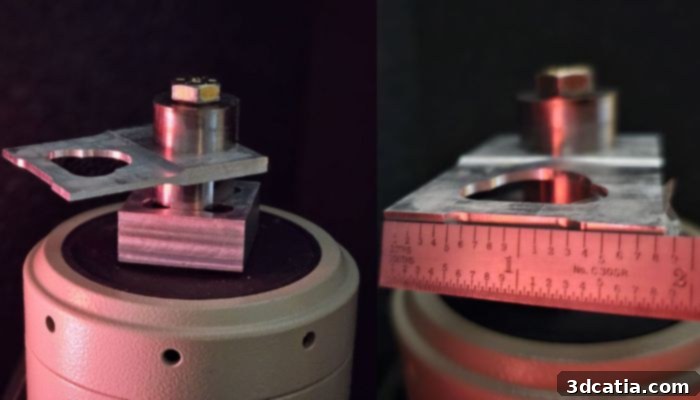
Improving fatigue performance is commonly associated with modifications to the printing process itself. Dr. Scott-Emuakpor’s work challenges a fundamental misconception about material performance in AM. Many assume fatigue must be solved by changing the material itself. “We approach it through physics. Much of aerospace fatigue is driven by vibration. Using our i-DAMP software, we can design parts with up to 96% vibration suppression. Lower vibration means lower stress, bringing the part below the fatigue limit and reducing the need for extensive optimization.”
Who Should Attend and Key Takeaways
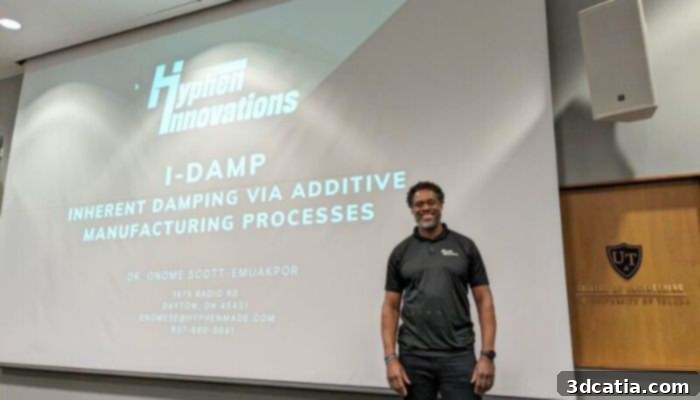
Dr. Scott-Emuakpor encourages aerospace and turbomachinery manufacturers to attend his talk. He aims for attendees to understand that reliable fatigue performance can be achieved cost-effectively, and qualification can be completed 70 to 300 times faster than traditional testing. “That shortens the path from innovation to deployment,” he concludes.
Register for RAPID + TCT 2026 as 3Dnatives’ guest. Click HERE to claim your free Expo Pass, save 20% on Conference Passes and discover the latest additive manufacturing technologies, exhibitors and conference sessions across the industry. Will you be attending the event this year? Let us know in the comments below or on our LinkedIn and Facebook pages. Plus, sign up for our free weekly Newsletter to get the latest 3D printing news straight to your inbox. You can also find all our videos on our YouTube channel.
*All Photo Credits: Hyphen Innovations