

Revolutionizing Defense: 3D Printing Aircraft Parts with Recycled Titanium
The British defense technology company, QinetiQ, has achieved a groundbreaking advancement in sustainable defense manufacturing. They successfully conducted the first flight test of a 3D-printed structural component made from recycled titanium. This pivotal test, executed by QinetiQ’s Flight Test Organisation at the MOD Boscombe Down facility in Wiltshire, involved a 3D-printed hinge installed on a QinetiQ-owned A109S helicopter.
The A109S helicopter is undergoing development for use at the globally recognized Empire Test Pilots’ School (ETPS). The 3D-printed hinge serves as a crucial attachment point for an Air Data Boom, a highly sensitive external probe responsible for measuring airspeed and angle of attack. The structural integrity of this hinge is paramount during flight testing. Any failure could lead to severe aerodynamic vibrations or even cause the boom to detach, compromising the critical instrumentation data essential for pilot training.
QinetiQ designed the hinge, and Additive Manufacturing Solutions Limited (AMS Ltd.) manufactured it. The hinge was crafted using titanium reclaimed from a decommissioned aircraft. This inaugural flight represents a major leap forward in demonstrating the feasibility of recovering flight-critical hardware from scrap materials and repurposing it for aerospace applications through additive manufacturing.
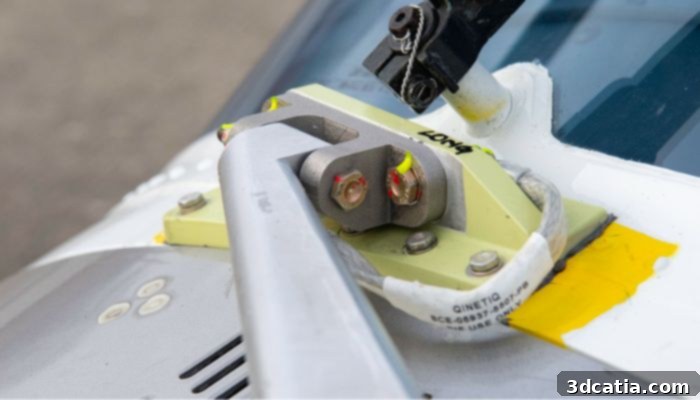
The hinge is a flight-critical component. (Photo Credit: QinetiQ)
The Advantages of 3D Printing the Hinge
AMS Ltd. employs a unique atomization process to convert recycled scrap metal into powder suitable for 3D printing. According to QinetiQ, this process boasts an impressive 97% efficiency, minimizing material waste. Although the specific powder bed fusion technique used to create the hinge remains undisclosed, AMS possesses in-house laser and electron beam powder bed fusion capabilities, suggesting that one of these methods was likely utilized.
Furthermore, QinetiQ reported that AMS’s manufacturing process achieves a remarkable 93.5% reduction in CO2e emissions compared to traditional manufacturing supply chains. This underscores the environmental benefits of utilizing recycled materials and additive manufacturing for aerospace components.
The Importance of Recycling Titanium in Aerospace
Titanium is a highly desirable metal due to its exceptional strength, low density, and superior corrosion resistance. These properties make it ideally suited for various demanding applications within the defense industry. While titanium ores are not inherently scarce, the metal’s high reactivity with atmospheric gases, such as oxygen, nitrogen, and hydrogen, at elevated temperatures significantly complicates and increases the cost of conventional titanium production. This makes recycling titanium a particularly attractive alternative.
The demand for titanium is consistently high across diverse sectors, including aerospace, infrastructure development, and global urbanization projects. Currently, China and Russia are the primary global suppliers of aerospace-grade titanium. By prioritizing titanium recycling, the UK could significantly reduce its reliance on imported materials and enhance its supply chain security.
AMS Ltd. estimates that the UK has the potential to achieve self-sufficiency in aerospace-grade titanium by effectively extracting and recycling all the titanium currently contained within scrap aircraft. This ambitious goal highlights the transformative potential of circular economy principles within the defense sector.
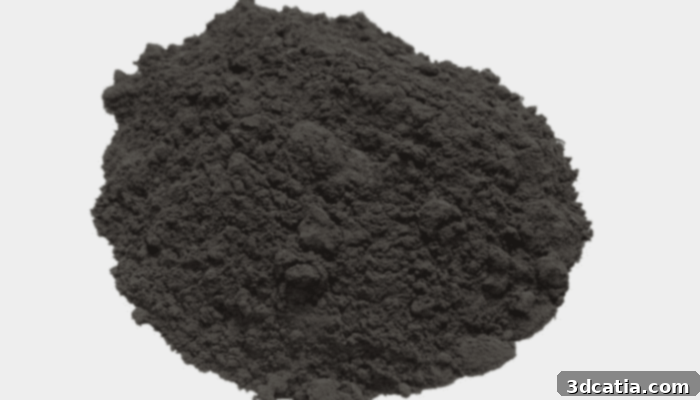
Titanium in powder form (Photo credit: AM Material)
Simon Galt, Managing Director Air at QinetiQ, emphasized the significance of this achievement, stating, “Our testing and engineering expertise is helping to prove the technology which will reduce the UK’s dependency on other nations for aerospace grade titanium.” He underscored the importance of domestic innovation in securing critical resources.
Rob Higham, AMS Director & CEO, added, “AMS has tirelessly built momentum and expertise within the additive powder market, with a sharp focus on providing recycled feedstocks. This milestone reflects the dedication of our team and QinetiQ’s commitment to a more resilient and sustainable future.” Higham’s statement highlighted the collaborative effort driving the advancement of sustainable manufacturing practices.
This groundbreaking achievement has far-reaching implications for the future of defense manufacturing. By embracing 3D printing and prioritizing the use of recycled materials, the aerospace industry can enhance sustainability, reduce costs, and improve supply chain resilience. The successful flight test of the 3D-printed titanium hinge represents a significant step towards a more circular and environmentally responsible defense sector.
The collaboration between QinetiQ and AMS Ltd. exemplifies the power of innovation and partnership in driving positive change. Their commitment to developing and implementing sustainable manufacturing solutions is paving the way for a more secure and environmentally conscious future. As the aerospace industry continues to evolve, the adoption of circular economy principles will become increasingly critical for long-term success. The achievements of QinetiQ and AMS Ltd. serve as a compelling example of the transformative potential of these principles.
The use of recycled titanium in 3D printing for aerospace components offers a multitude of benefits. Beyond the environmental advantages, it also presents significant economic opportunities. By reducing reliance on imported materials and fostering domestic manufacturing capabilities, the UK can create new jobs and stimulate economic growth within the aerospace sector. The development of advanced recycling technologies and additive manufacturing processes will further enhance the competitiveness of the UK aerospace industry on a global scale.
Moreover, the adoption of sustainable manufacturing practices can improve the overall resilience of the defense supply chain. By diversifying sourcing strategies and reducing dependence on geographically concentrated suppliers, the UK can mitigate the risks associated with geopolitical instability and supply chain disruptions. The use of recycled materials provides a more secure and reliable source of critical resources, ensuring the continued availability of essential components for defense applications.
To delve deeper into this topic, click here to read the full press release from QinetiQ.
What are your thoughts on recycling titanium for 3D printing applications? Share your opinions and insights in the comments below or join the conversation on our LinkedIn or Facebook pages! Stay informed about the latest advancements in 3D printing by subscribing to our free weekly Newsletter. Explore our extensive video library on our YouTube channel. For more focused news on 3D printing in the aerospace and defense sectors, visit our dedicated page HERE.
*Cover Photo Credits: QinetiQ