
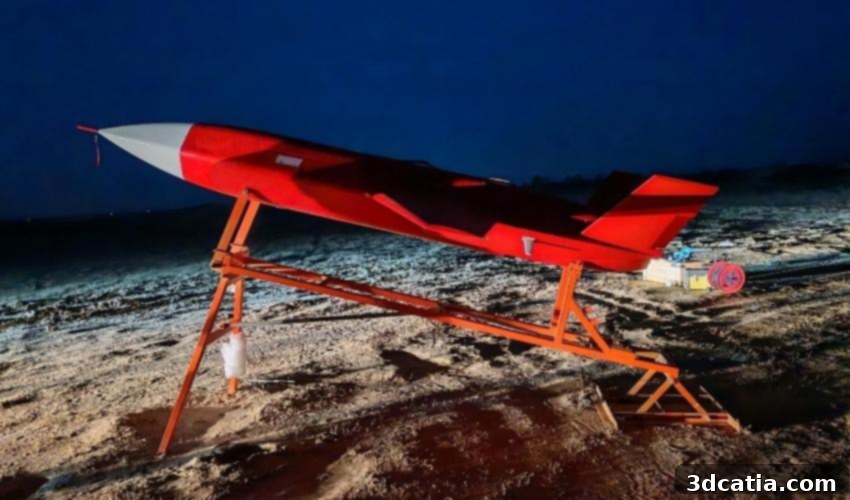
China Achieves Milestone with 3D Printed Turbojet Engine Flight Test
China’s ambitious pursuit of next-generation propulsion systems has reached a significant milestone with the successful first flight test of its newly developed 3D printed “minimalist” turbojet engine. This achievement marks a substantial leap forward in the application of additive manufacturing within operational aerospace systems, highlighting China’s growing capabilities in advanced manufacturing technologies.
The inaugural test flight, a crucial step in validating the engine’s performance, spanned 30 minutes and reached an altitude of 6,000 meters, achieving a top speed of Mach 0.75. According to officials overseeing the program, the engine demonstrated stable operation across its entire power range, exhibiting no abnormal parameters throughout the flight. This single-engine flight trial on an aircraft platform signifies that the engine design has progressed beyond mere laboratory validation, now undergoing rigorous evaluation in real-world flight conditions.
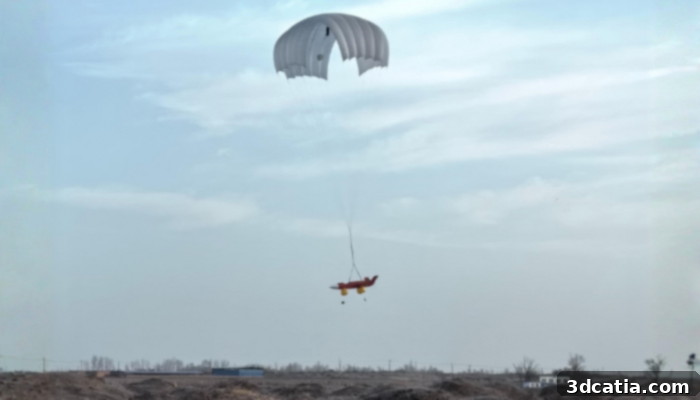
The development team placed a strong emphasis on reliability as the primary objective during this early demonstration. Mi Dong, Director at the China Aviation Engine Research Institute, emphasized that the successful test proves the engine’s functionality “at higher altitudes and in more complex environments,” while simultaneously confirming its seamless integration with the host aircraft. He further indicated that the system is adaptable for use in loitering munitions, unmanned aerial vehicles (UAVs), and target drones, hinting at a diverse range of potential future applications for this innovative engine technology.
A key element that distinguishes this program is its extensive utilization of additive manufacturing techniques. Impressively, over three-quarters of the engine’s total weight consists of components fabricated using 3D printing. This innovative approach leads to a substantial reduction in the number of individual parts required, simplifying the assembly process, improving overall efficiency, and enabling the implementation of more radical and complex design choices that would be exceedingly difficult, or even impossible, to achieve through traditional manufacturing methods. Aerospace engineers suggest that the weight reductions and enhanced thermal management capabilities achieved through 3D printing will be instrumental in future endeavors aimed at achieving higher flight speeds and greater operational altitudes.
The incorporation of 3D printing offers several advantages. Firstly, it enables the creation of complex geometries that would be challenging or impossible to manufacture using conventional techniques. This design freedom allows for optimized internal structures and aerodynamic profiles, leading to improved engine performance. Secondly, the reduction in the number of parts translates to simplified assembly, lower manufacturing costs, and increased reliability due to fewer potential failure points. Thirdly, 3D printing facilitates rapid prototyping and iterative design improvements, significantly accelerating the development cycle. Finally, the ability to use lightweight materials and create optimized thermal management systems contributes to improved fuel efficiency and overall engine performance.
This successful flight test is emblematic of a broader trend occurring within China’s aerospace industry, where additive manufacturing is increasingly recognized and adopted as a strategic tool for accelerating development timelines and creating lighter, more efficient propulsion systems. While this specific engine remains in the early stages of its development lifecycle, the successful demonstration provides compelling evidence that China is committed to transitioning a greater proportion of 3D printed hardware from research and development labs to real-world operational applications. This signifies a shift towards embracing advanced manufacturing as a core competency within the aerospace sector.
The implications of China’s advancements in 3D printed aerospace components are far-reaching. It positions the country as a potential leader in the development and deployment of advanced propulsion technologies. The increased efficiency and performance offered by these 3D printed engines could lead to improvements in aircraft range, payload capacity, and overall operational capabilities. Furthermore, the accelerated development cycles enabled by additive manufacturing could allow China to introduce new aerospace technologies more quickly than its competitors. The ability to customize engine designs for specific mission requirements also provides a significant strategic advantage.
The development of this 3D printed turbojet engine is not an isolated incident. It is part of a larger national strategy to promote innovation and technological advancement across various sectors, including aerospace. The Chinese government has invested heavily in research and development of additive manufacturing technologies, establishing numerous research centers and providing funding for companies engaged in 3D printing. This commitment to innovation is driving rapid progress in the field and enabling China to compete effectively on the global stage.
The successful flight test also highlights the importance of collaboration between research institutions, industry partners, and government agencies in driving technological innovation. The China Aviation Engine Research Institute played a crucial role in the development of the engine, leveraging its expertise in aerospace engineering and propulsion systems. Collaboration with industry partners ensured that the engine design was practical and could be manufactured efficiently. Government support provided the necessary resources and infrastructure to accelerate the development process.
Looking ahead, the development team plans to conduct further flight tests to evaluate the engine’s performance under a wider range of operating conditions. This will involve testing the engine at higher altitudes, speeds, and temperatures, as well as assessing its durability and reliability over extended periods of operation. The team also plans to explore the use of advanced materials and manufacturing techniques to further improve the engine’s performance and efficiency. The data gathered from these tests will be crucial for refining the engine design and preparing it for potential commercial applications.
The successful flight test of the 3D printed turbojet engine represents a significant achievement for China’s aerospace industry. It demonstrates the country’s growing capabilities in advanced manufacturing technologies and its commitment to innovation. As China continues to invest in research and development of additive manufacturing, it is likely to see further breakthroughs in the field, leading to even more advanced and efficient aerospace systems. This development has the potential to reshape the future of aerospace engineering and further solidify China’s position as a global leader in technology.
The implications extend beyond military applications as well. More efficient and lightweight engines could revolutionize commercial aviation, leading to reduced fuel consumption, lower operating costs, and a smaller environmental footprint. The ability to customize engine designs could also enable the development of new types of aircraft, such as electric vertical takeoff and landing (eVTOL) vehicles, opening up new possibilities for urban air mobility.
In conclusion, China’s successful flight test of its 3D printed turbojet engine is a testament to the power of innovation and the potential of additive manufacturing. It is a significant step forward in the development of next-generation propulsion systems and a clear indication that China is poised to become a major player in the global aerospace industry. The continued investment in research and development, coupled with strong collaboration between industry, government, and academia, will undoubtedly lead to further breakthroughs in the years to come.
What do you think of the turbojet? Feel free to share your thoughts in the comments below. You can also follow us on Facebook or LinkedIn! Plus, don’t forget to sign up for our free weekly Newsletter to get the latest 3D printing news straight to your inbox. You can also find all our videos on our YouTube channel.
*Photo & Video Credits: China Central Television (CCTV)