
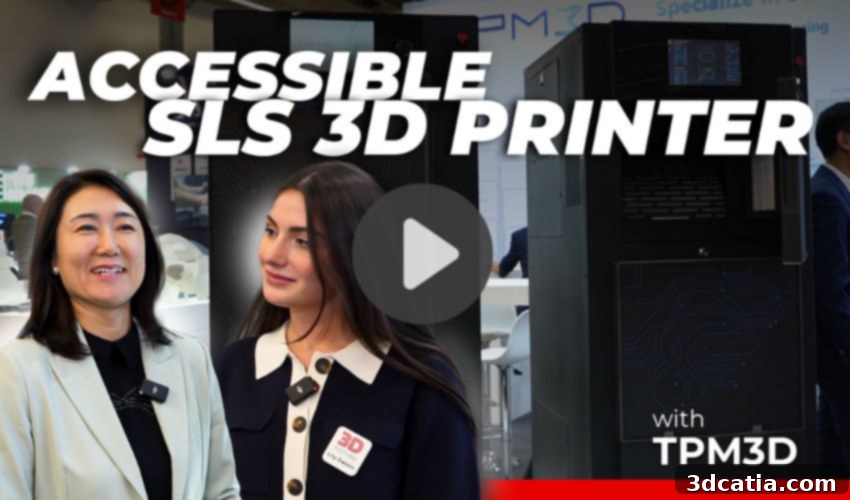
TPM3D Revolutionizes SLS 3D Printing: Making Industrial Technology Accessible
Selective Laser Sintering (SLS) technology, traditionally reserved for large-scale industrial applications with substantial investment requirements, is undergoing a significant transformation. Recent advancements have made SLS more accessible, primarily due to the development of user-friendly and, crucially, more affordable machines. While some challenges to widespread adoption persist, recent innovations offer promising solutions. Among these are the cutting-edge solutions developed by TPM3D, a prominent Chinese manufacturer. Once again, TPM3D showcased their innovations at Formnext, using the prestigious event to introduce a groundbreaking new SLS 3D printer and an advanced powder processing station. Their core mission is to democratize SLS technology, making it more accessible and user-friendly for a broader range of users.
We had the distinct opportunity to engage in a conversation with Lucy Zhai, the CEO of TPM3D, who provided invaluable insights into their latest innovations and discussed the company’s overarching strategic vision. This article delves into the details of the CF200, a compact and powerful SLS 3D printer, and the PPS200, a state-of-the-art powder processing station, both designed to redefine accessibility in SLS technology.
Beyond the unveiling of new hardware, Lucy Zhai also emphasized the diverse range of applications showcased at TPM3D’s booth. From revolutionary advancements in footwear manufacturing and cutting-edge electronics applications to innovative artistic projects, SLS technology continues to unlock limitless possibilities. To explore these applications further and discover the potential of TPM3D’s solutions, visit booth C18 in Hall 11.0 or explore their comprehensive website HERE.
Democratizing SLS: TPM3D’s Vision for Accessible 3D Printing
TPM3D’s approach to SLS 3D printing centers around the core principle of democratization. Historically, SLS has been perceived as a complex and expensive technology, limiting its accessibility to large corporations with significant capital. TPM3D is actively challenging this perception by developing machines that are not only more affordable but also easier to operate and maintain. This strategic shift opens up new opportunities for small and medium-sized enterprises (SMEs), research institutions, and even individual makers to harness the power of SLS technology.
The CF200, TPM3D’s compact SLS 3D printer, is a testament to this commitment. Its reduced size and simplified operation make it ideal for environments where space is limited and technical expertise may be less readily available. The PPS200 powder processing station further enhances accessibility by automating the critical process of powder handling, reducing the risk of contamination and ensuring consistent material properties. By streamlining these key aspects of the SLS workflow, TPM3D is lowering the barriers to entry and enabling a wider audience to benefit from this powerful technology.
The CF200: A Compact Powerhouse for SLS Printing
The CF200 stands out as a game-changer in the realm of SLS 3D printing. Its compact design belies its powerful capabilities, offering a build volume that is suitable for a wide range of applications. This printer utilizes a fiber laser, known for its precision and reliability, to selectively sinter powdered materials, creating complex geometries with exceptional accuracy. The CF200 supports a variety of materials, including nylon, TPU, and polypropylene, allowing users to tailor their prints to specific application requirements. Its open material system further expands its versatility, enabling users to experiment with custom blends and explore new material possibilities.
Beyond its technical specifications, the CF200 is designed for ease of use. Its intuitive software interface simplifies the printing process, guiding users through each step from file preparation to print execution. The printer also features automated calibration and maintenance routines, minimizing downtime and ensuring consistent performance. These user-friendly features make the CF200 an ideal choice for both novice and experienced SLS users.
PPS200: Streamlining Powder Handling for Optimal Results
Powder handling is a critical aspect of SLS 3D printing, directly impacting the quality and consistency of printed parts. The PPS200 powder processing station addresses this challenge by automating the key steps involved in powder management, including powder sieving, mixing, and dispensing. This automation minimizes the risk of contamination, ensures consistent material properties, and reduces the labor required for powder handling.
The PPS200 features a closed-loop system, preventing powder from escaping into the environment and ensuring a clean and safe working environment. Its integrated sieving system removes oversized particles and contaminants, ensuring that only high-quality powder is used in the printing process. The mixing system ensures a homogenous blend of powder, preventing variations in material properties throughout the print. The dispensing system precisely delivers the required amount of powder to the printer, minimizing waste and ensuring optimal layer thickness. By automating these key steps, the PPS200 significantly improves the efficiency and reliability of the SLS printing process.
Applications Across Industries: The Versatility of SLS Technology
SLS technology has proven its versatility across a wide range of industries, offering solutions for prototyping, tooling, and end-use part production. TPM3D’s booth at Formnext showcased a diverse array of applications, highlighting the transformative potential of SLS technology.
In the footwear industry, SLS is revolutionizing the design and manufacturing of customized shoes and insoles. The ability to create complex geometries with flexible materials allows for personalized designs that conform to individual foot shapes, providing enhanced comfort and support. In the electronics industry, SLS is enabling the production of intricate housings and enclosures for electronic components, offering lightweight designs and high-performance materials. Furthermore, artists and designers are leveraging SLS to create intricate sculptures, decorative objects, and functional prototypes, pushing the boundaries of creative expression.
These are just a few examples of the many applications of SLS technology. As the technology becomes more accessible, we can expect to see even more innovative applications emerge across various industries.
The Future of SLS: Continued Innovation and Accessibility
TPM3D’s commitment to democratizing SLS technology is driving innovation and expanding the reach of this powerful manufacturing process. By developing user-friendly and affordable machines, TPM3D is empowering a wider audience to harness the benefits of SLS, unlocking new opportunities for innovation and growth. As the technology continues to evolve, we can expect to see even more advancements in materials, software, and automation, further enhancing the capabilities and accessibility of SLS 3D printing.
The future of SLS is bright, and TPM3D is at the forefront of this exciting transformation. Their dedication to innovation and accessibility is paving the way for a future where SLS technology is a mainstream manufacturing process, empowering businesses and individuals to create anything they can imagine.
What are your thoughts on TPM3D’s latest SLS solutions? Share your comments below or connect with us on LinkedIn or Facebook! Don’t forget to subscribe to our free weekly Newsletter for the latest 3D printing news delivered directly to your inbox. Explore our comprehensive video library on our YouTube channel.