
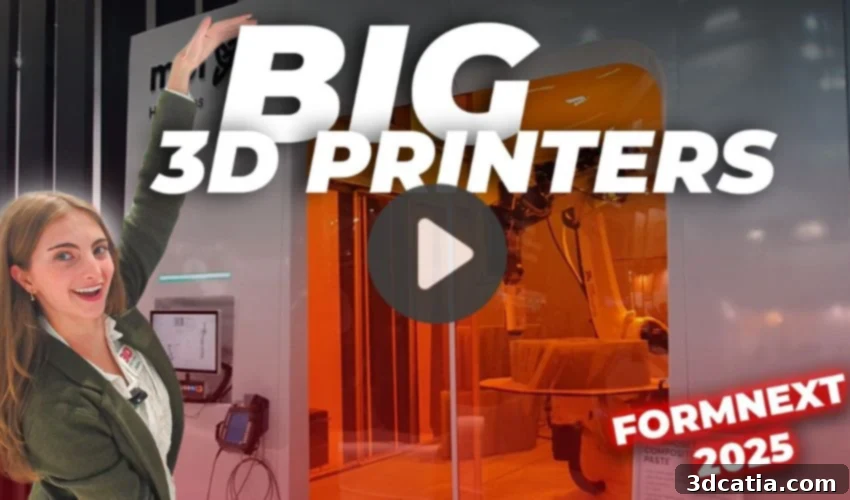
Exploring the Giants: A Tour of Large-Format 3D Printers at Formnext
Formnext, the premier trade show for additive manufacturing, is a spectacle of innovation, filled with cutting-edge machines and captivating 3D-printed creations. While the entire show floor buzzes with excitement, it’s the colossal 3D printers that invariably capture the most attention. These large-format additive manufacturing systems boast impressive build volumes, accommodate a diverse range of materials, and unlock unprecedented possibilities for production at scale. This article takes you on an exclusive tour of some of the largest and most impressive 3D printers showcased at the event, highlighting their unique capabilities and potential impact on various industries.
Crane WASP: 3D Printing Homes and Beyond
Our journey begins with the Crane WASP, a revolutionary construction 3D printer designed for printing with a variety of materials, including concrete, plaster, and even earthen materials. This innovative machine is poised to disrupt the construction industry by offering a faster, more sustainable, and more cost-effective way to build structures. The Crane WASP on display at Formnext represented only a part of its full potential. The showcased unit was a stand-alone version, but the complete system can be expanded significantly, making it capable of printing entire houses and other large-scale structures. The possibilities are truly limitless when it comes to architectural design and construction with this technology.
Moi HFP: Precision and Artistry in Cold Extrusion
Next, we venture to the Moi HFP printer, a marvel of cold-extrusion technology. This system utilizes a unique process to deposit vinyl-ester resin reinforced with glass fiber. What sets the HFP apart is its rapid curing process: each layer is instantly cured with UV light, resulting in remarkably fast and stable builds. This combination of material properties and precision makes the HFP exceptionally well-suited for a wide range of applications, from demanding industrial fabrication tasks to intricate artistic installations. Its ability to create complex geometries with high accuracy opens up new avenues for product design and artistic expression.
MULTIAX HYBRIDX: The Power of Hybrid Manufacturing
Our tour continues with the MULTIAX HYBRIDX machine, a game-changing hybrid system that seamlessly integrates extrusion-based 3D printing with precision milling. By combining additive and subtractive processes on a single platform, the HYBRIDX eliminates the need to transfer parts between different machines. This streamlined approach significantly reduces production time, minimizes errors, and improves overall accuracy. The ability to both add material and precisely remove it in the same workflow unlocks a new level of control and efficiency in manufacturing, making it ideal for creating high-precision parts with complex features.
FANUM: Lightweight Prototypes and Architectural Forms
We then explore the latest large-format system from FANUM, a company specializing in 3D printing with foamed polystyrene. This lightweight and easily machinable material offers significant advantages for creating oversized prototypes, molds, sculpture bases, and architectural forms. The reduced weight of the printed objects makes them easier to handle and transport, while the fast turnaround times enable rapid iteration and design validation. FANUM’s technology is particularly valuable for industries where speed and cost-effectiveness are paramount, such as architecture, product design, and art.
Rapid Fusion Cerberus System: A Triple Threat in Manufacturing
Our final stop is at Rapid Fusion, where the debut of the Cerberus System drew considerable attention. Named after the three-headed dog of Greek mythology, this massive machine is a true powerhouse, featuring three coordinated toolheads that work in harmony to deliver unparalleled manufacturing capabilities. The Cerberus System boasts a pellet extrusion head for high-volume printing, a filament extrusion head for intricate details, and a milling head for precise finishing. Encased in a standard, high-cube container, the printer is easily transportable and promises manufacturing within just 25 minutes of deployment. This remarkable combination of speed, versatility, and portability makes the Cerberus System a game-changer for on-demand manufacturing and rapid prototyping.
The Future of Large-Format 3D Printing
The machines showcased at Formnext highlight a clear trend: large-format and hybrid manufacturing technologies are rapidly becoming more capable, more versatile, and more accessible. As builders, designers, and manufacturers continue to push the boundaries of scale, the future of big 3D printing looks incredibly promising. These innovations are not only expanding the possibilities for creating larger and more complex objects but also enabling new business models and transforming entire industries. From construction and aerospace to art and product design, large-format 3D printing is poised to revolutionize the way we build, create, and innovate.
The Impact of Large-Scale Additive Manufacturing
Large-scale additive manufacturing isn’t just about building bigger; it’s about rethinking entire processes and unlocking new levels of efficiency and customization. Consider the implications for the construction industry. Imagine printing entire homes on-site, tailored to specific needs and environmental conditions. Or the possibilities for the aerospace industry, where lightweight, complex components can be created with unprecedented precision. Even the art world is being transformed, with artists using large-format 3D printers to create massive sculptures and installations that were previously impossible to conceive. As the technology matures and becomes more readily available, we can expect to see even more disruptive applications emerge in the years to come.
Materials and Innovation in Large-Format Printing
The versatility of large-format 3D printers is also expanding thanks to ongoing advancements in materials science. From durable concrete and reinforced polymers to lightweight foams and high-performance composites, the range of materials that can be used in these systems is constantly growing. This opens up new possibilities for creating objects with a wider range of properties, from high strength and heat resistance to flexibility and bio-compatibility. As new materials are developed and optimized for large-format printing, we can expect to see even more innovative applications emerge, pushing the boundaries of what’s possible with additive manufacturing.
The Role of Automation and Software
The rise of large-format 3D printing is also being driven by advancements in automation and software. Sophisticated control systems and sensor technologies are enabling these machines to operate with greater precision and reliability, while advanced software tools are simplifying the design and planning process. With the help of artificial intelligence and machine learning, these systems are becoming increasingly autonomous, capable of optimizing printing parameters and adapting to changing conditions in real-time. This level of automation is essential for scaling up production and making large-format 3D printing a viable alternative to traditional manufacturing methods.
Join the Conversation
Which big 3D printer showcased at Formnext captured your imagination the most? Share your thoughts in the comments below or connect with us on LinkedIn or Facebook. Stay informed about the latest 3D printing news by subscribing to our free weekly Newsletter. You can also explore our comprehensive video library on our YouTube channel.