
3D Bioprinting Human Muscle in Microgravity: A Leap for Space Exploration and Regenerative Medicine
In a groundbreaking scientific endeavor, researchers at ETH Zurich have successfully pushed the boundaries of space-based biomanufacturing by 3D printing human muscle tissue in conditions simulating the weightlessness of space. This remarkable achievement, conducted during parabolic flights, marks a significant milestone as it represents the first successful bioprinting of human skeletal muscle in microgravity. While previous experiments aboard the International Space Station (ISS) have demonstrated the 3D printing of polymers, cartilage, and even complex vascular tissues, the ability to fabricate viable human muscle opens up an entirely new frontier for scientific discovery and medical application beyond Earth’s confines.
This pioneering work builds upon years of research into bioprinting biological materials in unique environments, but with a crucial difference: precision engineering of living muscle tissue. The ETH Zurich team’s focus on muscle brings unprecedented accuracy to the creation of tissue models, which are invaluable for a multitude of applications. These include advanced drug testing, in-depth disease research, and critically, the development of long-term healthcare solutions for astronauts on extended space missions. Muscle degradation, also known as muscle atrophy, stands as one of the most severe physiological challenges faced by astronauts during prolonged periods in microgravity. Therefore, the capacity to create accurate, functional muscle models in such an environment is not merely an academic exercise; it is essential for comprehensively studying and ultimately mitigating this debilitating loss. Published in the prestigious journal Advanced Science, the study emphatically demonstrates how the fundamental accuracy and structural integrity of 3D bioprinting technology can be dramatically improved once the pervasive influence of Earth’s gravity is removed from the equation, paving the way for superior tissue constructs.
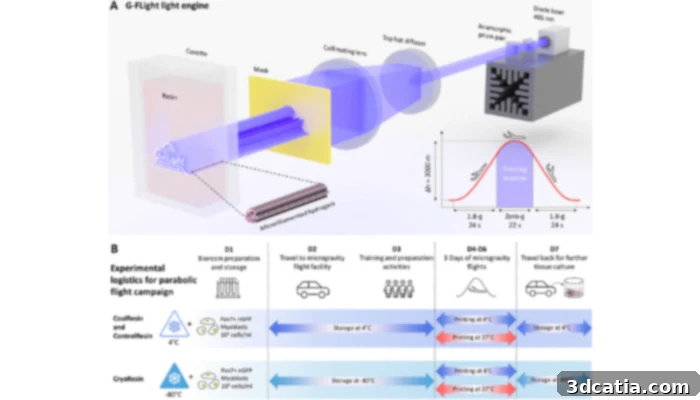
Diagram of the G-FLight bioprinting system and workflow, showing laser-based printing of bioresins and the experimental process used during parabolic flight. (Photo credit: ETH Zurich)
The Imperative of Microgravity: Why Print in Zero Gravity?
For decades, the ambitious goal of precisely recreating the intricate complexity of human tissues through 3D printing has been fundamentally constrained by one ubiquitous and persistent factor: gravity. On Earth, the delicate nature of soft bio-inks – typically hydrogels laden with millions of living cells – presents a significant hurdle. These fragile materials are prone to collapsing, deforming, or sagging under their own weight before they can fully solidify. This inherent instability severely compromises the accuracy, resolution, and overall structural integrity of the resulting printed architecture. Furthermore, the gravitational pull can cause cells within the bio-ink to settle unevenly during the printing process, leading to a non-uniform distribution that diminishes the biological realism and functional efficacy of the engineered tissue. Microgravity fundamentally alters these dynamics, offering an environment where these limitations are largely negated.
In a microgravity environment, the absence of gravitational forces allows bio-inks to maintain their desired shape and cellular distribution with remarkable fidelity. This enables the creation of far more complex, precise, and biomimetic structures than is typically achievable on Earth. Without the constant downward pull, delicate scaffolds can be built layer by layer without the risk of collapse, and cells remain homogeneously suspended, ensuring a more accurate representation of natural tissue architecture. This unique advantage of microgravity is particularly critical for bioprinting soft tissues like muscle, which require intricate cellular arrangements and a high degree of structural stability to function correctly. By removing gravity from the equation, researchers can unlock new possibilities for developing advanced tissue models that more accurately mimic in vivo conditions, thereby improving the predictive power of drug screens and deepening our understanding of disease mechanisms.
Parth Chansoria, the lead researcher for this pivotal study, highlighted the transformative capability of their system: “Our system, G-FLight, together with the novel biomaterial inks to encapsulate cells, can produce biomimetic muscle constructs in seconds. This system is also not affected by gravity, where the tissues printed in zero gravity aboard parabolic flights mimic the properties of those printed in Earth’s gravity, enabling a predictability of tissue properties.” This remarkable ability to precisely replicate the intricate architecture of muscle tissue with unparalleled consistency and speed is paramount for biomedical research. In this field, even the most subtle structural variations can profoundly alter the progression of diseases or dictate how effectively new pharmaceutical compounds interact with and perform within human tissue. The predictability of tissue properties achieved in microgravity offers a significant advantage for scientific rigor and reproducibility.
G-FLight: Pioneering Gravity-Independent Bioprinting
To accomplish this extraordinary feat of extraterrestrial bioprinting, the ETH Zurich team meticulously engineered and developed its own cutting-edge microgravity-capable bioprinter, aptly named G-FLight (Gravity-independent Filamented Light). The experiments were conducted over a series of 30 demanding parabolic flight cycles, each meticulously orchestrated to create approximately 20 seconds of precious weightlessness. During these fleeting moments of simulated microgravity, the G-FLight system proved its exceptional capability by successfully printing viable muscle constructs in midair. This was achieved using a specially formulated custom bio-resin, precisely infused with living muscle cells, demonstrating the system’s robustness and efficiency under extreme conditions.
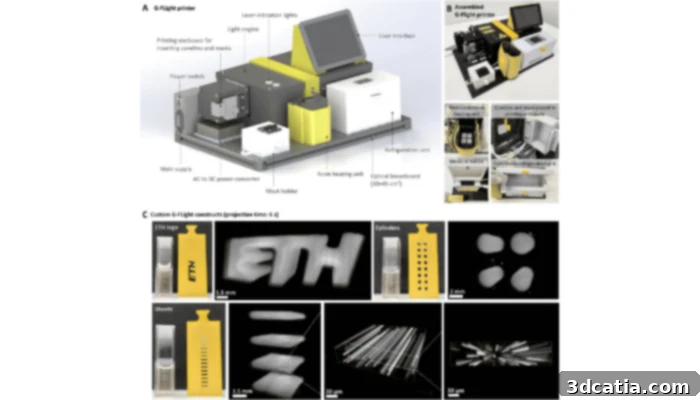
G-FLight 3D bioprinter and example constructs, including the ETH logo, cylinders, and sheets, printed in microgravity with visible microfilament detail. (Photo credit: ETH Zurich)
Despite the inherent challenges of being produced under such dynamic and extreme conditions, the muscle fibers bioprinted in microgravity exhibited remarkable characteristics. Crucially, they demonstrated comparable cell viability and cellular density to samples printed under normal gravitational conditions on Earth. However, where the microgravity samples truly excelled was in their significantly improved structural integrity. This enhancement is directly attributable to the complete absence of gravitational deformation during the printing and initial solidification phases, allowing the bio-ink and cells to maintain their intended configuration with greater precision. This improved structural integrity translates directly into more realistic and potentially more functional tissue models, offering a tangible advantage over ground-based methods.
Beyond the immediate success of printing, the research team also achieved another vital milestone for future space missions: they demonstrated that their specialized bio-resins could be stably stored for extended periods and subsequently activated for printing while in flight. This capability is absolutely critical for the practicality of long-duration space processing and manufacturing applications, where resupply missions are infrequent and the ability to maintain and use biological materials over time is paramount. This robust storage and activation mechanism ensures that future space-based bioprinters can operate autonomously and effectively, providing on-demand tissue fabrication for a variety of scientific and medical needs far from Earth.
Toward Space-Based Tissue Engineering and Regenerative Medicine
The successful 3D printing of human muscle tissue in microgravity is far more than an isolated scientific triumph; it represents a profound leap forward that could fundamentally reshape how humanity approaches the study, repair, and even the eventual manufacturing of biological systems in space. This achievement paves the way for a new era of space-based tissue engineering, where the unique environment of microgravity can be leveraged to create biological constructs with unparalleled precision and complexity. Such capabilities are not only vital for understanding life beyond Earth but also for advancing regenerative medicine on our home planet.
The ambitious next phase for ETH Zurich involves moving their pioneering research beyond the confines of parabolic flight experiments – often colloquially referred to as the “vomit comet” due to the intense G-forces – and into the sustained microgravity environment of Earth’s orbit. The ultimate goal is to fabricate complex organoids and even larger tissue structures aboard platforms like the International Space Station (ISS) or emerging commercial space stations. These sophisticated, lab-grown tissues and mini-organs would offer an unparalleled opportunity to study conditions such as severe muscle atrophy, a debilitating effect commonly experienced by astronauts during extended spaceflight, or chronic terrestrial diseases like muscular dystrophy. By conducting such research in an environment free from the distorting interference of Earth’s gravitational pull, scientists can gain purer, more accurate insights into disease progression, drug efficacy, and fundamental biological processes, potentially leading to breakthroughs that are impossible to achieve in ground-based laboratories.
A Global Movement: The Growing Field of Space Bioprinting
ETH Zurich’s groundbreaking work is not an isolated effort but rather a crucial contribution to a rapidly expanding global movement focused on pushing the frontiers of bioprinting technology beyond Earth’s surface. This collective endeavor highlights a shared vision among leading research institutions and private companies to harness the unique advantages of microgravity for biomedical innovation. Earlier this year, for instance, Redwire Space made headlines by announcing the successful bioprinting of a human knee meniscus aboard the ISS, showcasing the potential for on-demand tissue repair in space. Concurrently, the Wake Forest Institute for Regenerative Medicine, a pioneer in the field, dispatched 3D printed liver tissue to space to meticulously study organ development and function under microgravity conditions, providing critical data for understanding human physiology in space and for advancing regenerative therapies.
These collective advancements, while still in their nascent stages of application, underscore a pivotal shift in scientific thinking. They demonstrate that additive manufacturing, specifically bioprinting, is not merely a tool for terrestrial innovation but a foundational technology for our future in space. ETH Zurich’s achievement, alongside those of other leading institutions, represents a key step forward in the complex and challenging effort to develop reliable, robust, and versatile bioprinting systems specifically designed for the demanding space environment. This research not only promises to support profound scientific discovery by enabling new forms of biological experimentation but also holds immense potential for ensuring the long-term health and well-being of humanity as we venture further beyond our home planet. As the scientific community continues to explore and develop these extraordinary capabilities, it becomes increasingly clear that what once seemed like science fiction is rapidly becoming a tangible reality. You can delve deeper into the specifics of this remarkable study by finding more information in the official press release from ETH Zurich HERE. Indeed, this is truly one small step for man, one giant leap for space-based tissue engineering and regenerative medicine.
What are your thoughts on ETH Zurich’s pioneering research in space bioprinting and its implications for the future of space exploration and medicine? We’d love to hear your perspective! Let us know your insights in the comments section below, or engage with us on our LinkedIn or Facebook pages! To stay at the forefront of additive manufacturing news, don’t forget to sign up for our free weekly newsletter and get all the latest 3D printing updates delivered straight to your inbox. You can also discover a wealth of insightful videos and content on our YouTube channel.
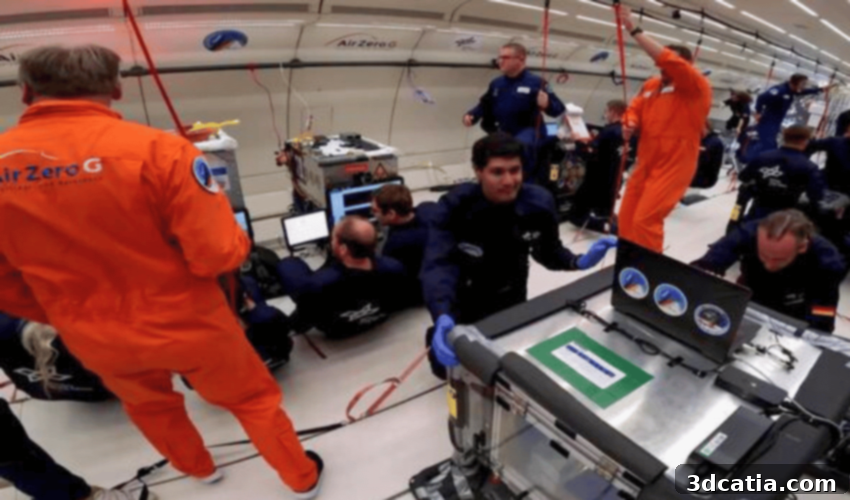
*Cover Photo: Researchers led by Parth Chansoria performed parabolic flight experiments simulating microgravity to 3D print muscle tissue. (Photo Credit: ETH Zurich)