
Revolutionizing Vehicle Safety: The Rise of Adaptive 3D Printed Metamaterials
In a groundbreaking development poised to transform automotive safety, researchers from leading institutions in Scotland and Italy have unveiled a novel type of 3D printed metamaterial. This innovative material possesses an extraordinary ability to dynamically adapt its response to impacts, fundamentally changing how vehicles absorb collision energy. Designed with a unique twisting lattice structure, this adaptive material holds immense potential for implementation in critical safety components such as crumple zones. Typically located in the front of a vehicle, crumple zones are engineered to deform upon impact, absorbing kinetic energy and protecting occupants, particularly in head-on collisions. This new metamaterial represents a significant leap forward, paving the way for not just safer, but also more efficient and adaptable crash protection systems across various industries.
The creation of this adaptive twisting metamaterial is a testament to the power of advanced manufacturing, specifically additive manufacturing, often known as 3D printing. At its core, the material features a precisely engineered gyroid lattice, meticulously printed from robust steel. The choice of steel ensures durability and strength, vital for impact absorption, while the gyroid structure provides the unique mechanical properties. What sets this design apart is its inherent capability to twist into itself when subjected to pressure, or impact force. This elegant mechanical action allows the structure to disperse energy in a controlled and highly effective manner. Unlike conventional materials such as passive foams or traditional crumple zones, which offer a singular, fixed resistance profile to impact, this metamaterial introduces an unprecedented level of responsiveness and tunability. This adaptiveness is not just an incremental improvement; it marks a paradigm shift in material science and safety engineering, offering the potential for systems that can react optimally to a wide spectrum of collision scenarios.
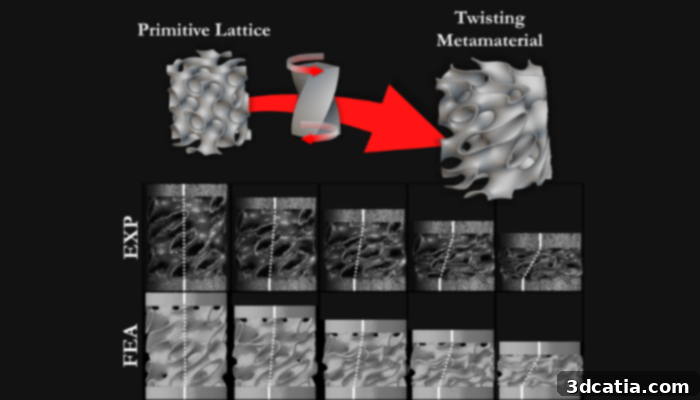
A graphic showcasing the evolution from primative lattice to the new twisting metamaterial. (Photo Credit: University of Glasgow)
Unlocking Adaptive Response: Research and Development Insights
The innovative research driving this breakthrough was spearheaded by Professor Shanmugam Kumar and his dedicated team at the University of Glasgow’s James Watt School of Engineering. Their extensive work demonstrated the remarkable ability to tune the material’s behavior simply by adjusting mechanical constraints during the compression process. This means the material’s stiffness and flexibility can be precisely controlled, offering a dynamic response rather than a static one. In rigorous laboratory tests, the 3D-printed lattice successfully showcased its capacity to seamlessly shift between significantly stiff and highly flexible configurations. This inherent adaptability translates directly into tailored energy absorption, allowing the material to provide optimal protection across a diverse range of impact scenarios, from minor fender-benders to high-speed crashes. This fine-tuning capability is crucial for developing truly intelligent safety systems that can react appropriately to the specific dynamics of any collision.
The Crucial Role of Additive Manufacturing
The successful fabrication of such an intricate and functional gyroid architecture would be nearly impossible using conventional manufacturing methods. This is where high-resolution additive manufacturing, or 3D printing, proved indispensable. The ability to precisely deposit material layer by layer allowed the researchers to create the complex internal geometry required for the twisting metamaterial’s adaptive properties. Traditional techniques like casting, machining, or injection molding simply lack the precision and geometric freedom needed to produce such fine and complex lattice structures with the necessary consistency. The iterative design and fabrication process inherent in 3D printing also enabled rapid prototyping and testing, accelerating the development cycle significantly. To rigorously validate the material’s performance, the research team employed a combination of experimental analysis and advanced computational simulations. This included integrating micro-CT (computed tomography) scans of the printed structures, which allowed them to account for even the most minute geometric variations and imperfections that might occur during the printing process. This comprehensive validation approach ensured the reliability and accuracy of their findings, underscoring the potential for real-world application.

Researchers hope this new material will provide even more safety for drivers who experience collisions. (Photo Credit: HOMOLKA)
Exceptional Performance and Tunability for Dynamic Safety
The performance metrics of this novel twisting metamaterial are particularly impressive. According to the researchers, when fully constrained, the material demonstrated an energy absorption capacity of up to 15.36 joules per gram. To put this into perspective, this is a remarkably high energy-to-weight ratio, indicating its efficiency in dissipating impact forces without adding excessive mass to a vehicle. This level of absorption is crucial for mitigating the destructive effects of high-energy collisions. While more flexible configurations showed a slightly reduced absorption capacity, they compensated with significantly increased adaptability. This critical tunability means future car safety systems equipped with this metamaterial could become truly dynamic and intelligent. Imagine a system that can stiffen instantly to absorb the brutal force of a high-speed collision, yet remain flexible enough to deform progressively in a minor bump, reducing damage and potentially even whiplash. This dynamic response holds the promise of a new era in occupant protection, moving beyond static, one-size-fits-all safety solutions to highly responsive, context-aware systems.
Broadening Horizons: Applications Beyond Automotive
While the initial focus and immediate impact of this 3D printed metamaterial are clearly in the automotive sector, the research team firmly believes its applications extend far beyond car safety. The same principles of adaptive energy absorption and controlled deformation could revolutionize numerous other industries. In aerospace, for instance, the material could be used to create lighter, more resilient aircraft structures, improving crashworthiness and reducing fuel consumption. Imagine aircraft fuselages or landing gear components that can dynamically absorb impact during turbulence or an emergency landing, distributing stress more effectively and preventing catastrophic failure. The defense industry could also benefit immensely, with applications in advanced protective gear such as helmets, body armor, and even blast-resistant structures, offering superior protection against impacts and explosions. The material’s unique mechanical properties also open doors to entirely new fields, such as energy harvesting systems. By converting mechanical impact into controlled rotational motion, this metamaterial could potentially be engineered to generate electricity from everyday movements or vibrations, offering a sustainable solution for powering small devices. What makes this technology particularly elegant and promising is its reliance on purely mechanical adjustments rather than complex electronics or sensors. This inherent simplicity enhances reliability, reduces manufacturing costs, and offers a straightforward yet highly effective path toward a new generation of adaptive protection technologies that are both robust and intelligent.
The Future of Material Science and Safety
The development of this adaptive twisting metamaterial represents more than just a new material; it signifies a significant advancement in our understanding and manipulation of material properties at the micro-structural level. By harnessing the power of additive manufacturing to create bespoke lattice structures, researchers are unlocking possibilities previously confined to theoretical models. This research underscores the transformative potential of combining advanced design principles with cutting-edge manufacturing techniques. The shift towards purely mechanical, adaptive systems suggests a future where safety components are not just strong, but smart, reacting intelligently to diverse threats without the need for complex, failure-prone electronic systems. As development continues, we can anticipate seeing these materials integrated into a wide range of products, enhancing safety, durability, and performance across various sectors. The path forward involves further optimization of material properties, scaling up production, and rigorous testing under real-world conditions. However, the foundational work laid by the Scottish and Italian research teams has undoubtedly set a new benchmark for material innovation in crash protection and beyond.
What are your thoughts on this revolutionary new metamaterial? How do you envision it impacting car safety and potentially other critical applications? We invite you to share your insights and engage with us in the comments section below, or join the discussion on our LinkedIn or Facebook pages! Plus, don’t forget to sign up for our free weekly Newsletter to get the latest 3D printing news straight to your inbox. You can also find all our videos on our YouTube channel. If you are interested in more 3D printing news in the automotive and transportation sector, visit our dedicated page HERE.
*Cover Photo Credit: Ford