
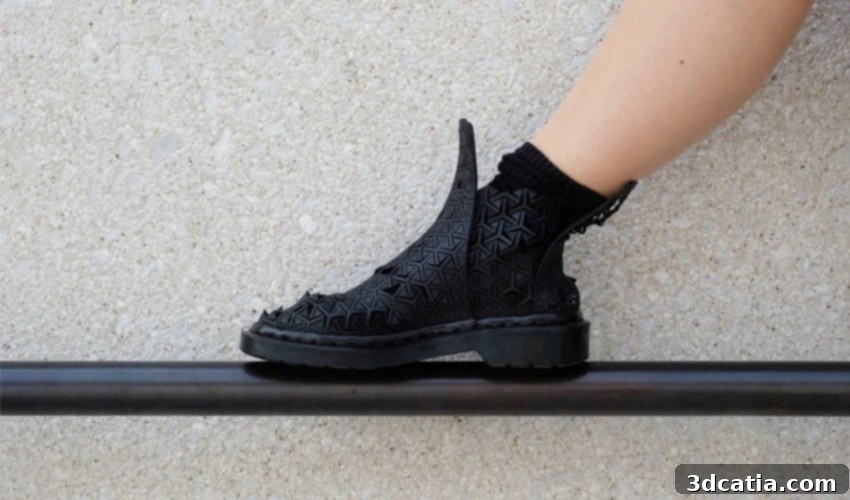
Adaptive Footwear Redefined: Exploring WertelOberfell’s Auxetic 3D Printed Shoes for Ultimate Comfort
Imagine a shoe that truly understands and adapts to your foot, not the other way around. This aspirational concept has long been a dream for many, yet often remains elusive in the world of mass-produced footwear. The quest for perfect comfort and a personalized fit is what propelled the innovative design studio WertelOberfell to embark on a groundbreaking project. Their vision culminated in Auxetic Wear, a revolutionary line of 3D printed shoes specifically engineered to offer unprecedented adaptability, marking a significant leap forward in footwear design.
Leveraging the precision and flexibility of additive manufacturing, WertelOberfell developed these unique boots using a desktop FDM (Fused Deposition Modeling) 3D printer and high-performance TPU (Thermoplastic Polyurethane) filament. The core innovation lies in their reliance on an advanced auxetic structure. Unlike conventional materials, auxetic materials possess a unique property that allows the shoe to expand or compress precisely according to the dynamic stresses and movements of the wearer’s foot throughout the day, ensuring a continuous, custom-like fit that responds in real-time to every step.
For too long, the search for truly comfortable footwear has been a frustrating journey. It’s a common experience to struggle with shoes that cause discomfort, pain in the heel or ball of the foot, or simply don’t accommodate the natural biomechanics of walking and standing. Standardized shoe sizes and rigid designs often fail to account for individual foot variations, swelling during the day, or the subtle changes in foot shape during movement. This leads to a compromise between style and comfort, frequently resulting in nagging aches and even long-term foot health issues that can significantly impact daily life.
Recognizing these pervasive issues, designers Gernot Oberfell and Jan Wertel sought a paradigm shift in footwear design. Their goal was to move beyond the limitations of traditional manufacturing methods and create a shoe that actively enhances the wearer’s well-being. After extensive research and testing of various materials and production techniques, they conclusively turned to additive manufacturing. This modern technology offered an unparalleled degree of design freedom, material efficiency, and the ability to create complex geometries that would be impossible or cost-prohibitive with conventional methods, making it the ideal choice for their ambitious project of innovative 3D printed shoes.
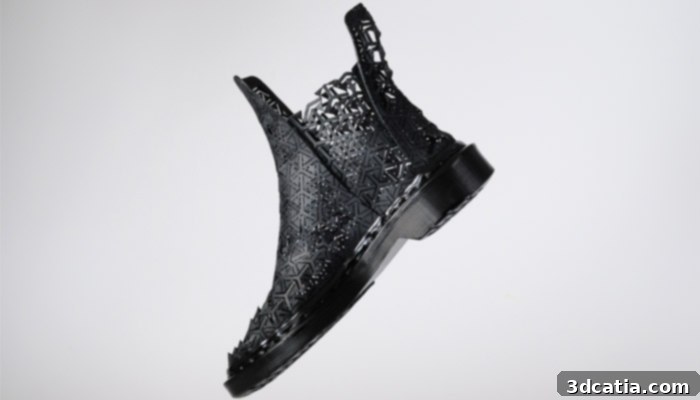
Photo Credits: WertelOberfell
The Manufacturing Process of Auxetic Wear
The fundamental principle behind Auxetic Wear lies in its ingeniously integrated auxetic structure. To fully grasp its significance, it’s essential to understand what auxetic materials are. Unlike most conventional materials, which tend to become thinner when stretched (exhibiting a positive Poisson’s ratio), auxetic materials exhibit a remarkable counter-intuitive property: they actually thicken perpendicularly when stretched, and thin out when compressed. This phenomenon is known as having a negative Poisson’s ratio, a characteristic that makes them exceptionally responsive and adaptable to external forces in a unique way.
This distinctive mechanical behavior grants auxetic structures superior energy absorption capabilities, enhanced toughness, and, crucially for footwear, the ability to conform dynamically to varying shapes and pressures. The designers at WertelOberfell skillfully harnessed this principle, conceptualizing a basic skeletal structure for the shoe that inherently integrates auxetic properties. This foundational framework serves as the blueprint for the final shape, allowing for inherent flexibility and adaptive expansion or compression precisely where needed most to cradle the foot effectively.
To optimize this basic auxetic framework, WertelOberfell explored and tested numerous reinforcement options, heavily relying on advanced computational tools, particularly generative design. This iterative design approach allowed them to automatically generate and evaluate multiple structural variations, identifying the most efficient and effective designs for durability, flexibility, and comfort. The use of generative design ensured that the auxetic structures were not just aesthetically pleasing, but functionally superior, precisely tuned to the nuanced demands of dynamic foot movement. The chosen material, TPU with a shore hardness of 98A, was selected for its exceptional resistance to wear and tear, its inherent flexibility, and its excellent suitability for FDM 3D printing, making it a robust yet adaptable choice.
The development process, as described by Auxetic Wear on WertelOberfell’s website, highlights a sophisticated hybrid manufacturing strategy: “The individual pieces are made with a resistant TPU (shore 98A), the auxetic structure is printed, including its reinforcement. They are glued together and then sewn onto the existing sole, combining traditional craftsmanship with modern technology. The final design has been refined through many iterations.” This quote beautifully encapsulates the essence of the project: a harmonious fusion where the precision and complexity afforded by 3D printing meet the proven comfort and longevity of traditional shoemaking. Each component, from the intricate auxetic upper to its internal reinforcements, is meticulously 3D printed, then carefully integrated with a conventionally manufactured sole, ensuring both innovation and reliability.
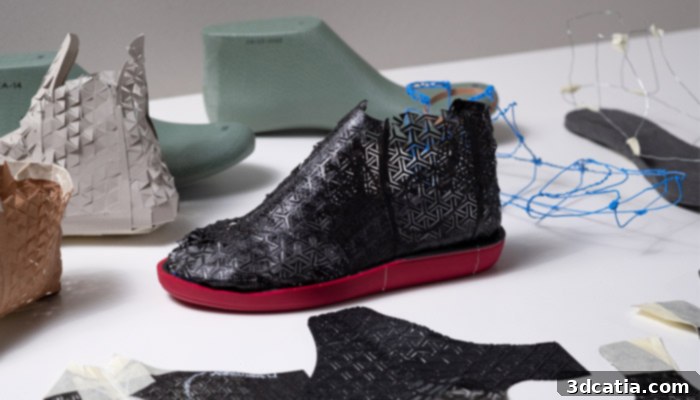
The design studio has already created many prototypes (photo credits: WertelOberfell)
The culmination of this innovative approach is a shoe where the upper part comprises several two-dimensional 3D printed shapes. These intricately designed sections are then expertly sewn onto a traditionally crafted sole, creating a cohesive and highly functional piece of footwear. This project stands as a compelling testament to the synergy between time-honored manufacturing practices and the cutting-edge capabilities of modern 3D printing technologies. The resulting Auxetic Wear shoe possesses an inherent ability to dynamically adjust its size and shape, either stretching to accommodate expansion or compressing as needed, in direct response to the unique contours and movements of the individual foot, offering unparalleled adaptive comfort.
This unprecedented adaptability means that the common inconveniences associated with ill-fitting footwear—tightness, pressure points, and general discomfort—are effectively eliminated. Wearers can finally experience a shoe that feels custom-made, providing continuous comfort and support throughout their day. Whether standing, walking, or engaging in light activity, the Auxetic Wear shoe intuitively responds, making the wearer forget they are even wearing shoes at all. For those intrigued by this transformative footwear concept and eager to delve deeper into its design and development, further details are available HERE.
The Auxetic Wear project by WertelOberfell is more than just a new shoe; it represents a significant leap forward in the footwear industry. It showcases how advanced materials science, computational design, and additive manufacturing can come together to solve long-standing problems of comfort and fit. By demonstrating the practical application of auxetic structures, it opens doors for further research and development in personalized goods, not just in shoes but across various consumer products where adaptability and user-specific comfort are paramount. This innovative approach also hints at a future where footwear can be produced on-demand, potentially reducing waste and promoting more sustainable manufacturing practices within the industry.
What are your thoughts on these exceptionally designed Auxetic Wear shoes? Do you envision yourself stepping into a pair that actively adapts to your every movement? We invite you to share your perspectives and comments below, or connect with us on our social media channels: LinkedIn, Facebook, and Twitter. Don’t miss out on the latest advancements in 3D printing; sign up for our free weekly Newsletter here to receive top industry news directly in your inbox. For a visual deep dive, explore all our videos on our YouTube channel.
*Cover Photo Credits: WertelOberfell