
3D Printing Transforms Cultural Heritage: Preserving the Ancient Yungang Grottoes for Future Generations
The advent of advanced 3D printing technologies is revolutionizing how we interact with and safeguard our global cultural heritage. These innovative methods bridge the gap between ancient art and modern audiences, making invaluable historical artifacts, monumental buildings, and intricate artworks more accessible than ever before. By creating precise, full-scale replicas, 3D printing offers a unique opportunity for people to experience these treasures up close without risking damage to the fragile originals. These highly accurate reproductions are typically modeled from extensive 3D scanning data, capturing every detail, and then brought to life using cutting-edge additive manufacturing processes. This approach not only facilitates broader engagement with cultural relics but also provides an unprecedented tool for their reconstruction, meticulous documentation, in-depth research, and long-term preservation efforts.
A compelling testament to this transformative power comes from China, where for the past five years, the Yungang Grottoes Research Institute has been at the forefront of this digital revolution. Located in the city of Datong, Shanxi province, the institute has dedicated itself to replicating parts of the magnificent 1,500-year-old Yungang Grottoes, a site justly recognized as a UNESCO World Heritage Site. These Buddhist cave temples, carved into the Wuzhou Mountain, represent a pinnacle of early Chinese Buddhist art, showcasing thousands of statues and intricate carvings that reflect the cultural exchanges along the ancient Silk Road. Their delicate sandstone structure, however, is vulnerable to natural erosion and human impact, making preservation a critical challenge. The institute’s ambitious project leverages the precision and versatility of 3D printing to tackle this monumental task.
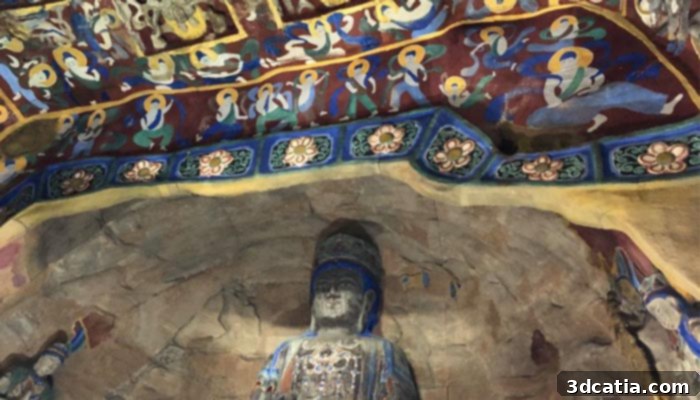
The sandstone of the cave is bathed in hues of red and yellow that make each piece of carving stand out from the rest, showcasing the artistry of ancient sculptors.
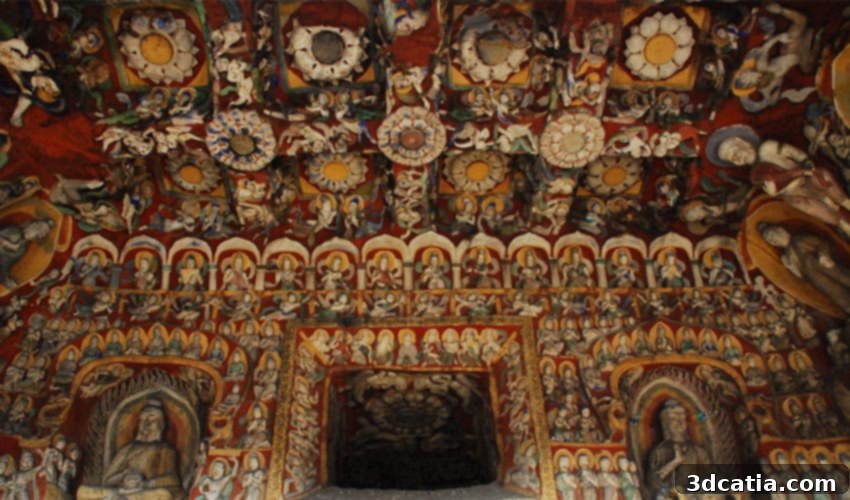
Recently, the Yungang Grottoes Research Institute celebrated a significant milestone, announcing the successful completion of a full-size replica of one of the most iconic caves within the sprawling complex. This breathtaking reproduction is eagerly anticipated to make its public debut soon, offering visitors in one of the museums of the Zhejiang province a unique immersion into ancient Chinese artistry. According to Xinhua News, China’s official state-run press agency, this meticulously crafted grotto replica is based on the original Cave Number 12, famously known as the “Cave of Music.” This particular cave is renowned for its vibrant depiction of celestial musicians and dancers, a rich tapestry of Buddhist narratives, and an astonishing array of carved musical instruments that provide invaluable insights into the musical traditions of the Northern Wei Dynasty.
Reconstructing Cave Number 12 was an undertaking of immense complexity and scale, as detailed by the Chinese press agency. The project required the fabrication of more than 1,300 individual 3D printed modules, each meticulously designed to fit together seamlessly. Once assembled, the replica stands at an impressive nine meters tall, extends 12 meters wide, and measures 14 meters long, perfectly mirroring the grand dimensions of the original grotto. The original Cave of Music is a marvel of ancient craftsmanship, featuring intricate designs that display row upon row of masterfully carved musical instruments, revered Buddhist statues, and symbolic references that deeply resonate with the Buddhist faith. The natural sandstone of the cave, bathed in rich hues of red and yellow, enhances the dramatic effect, causing each delicate piece of carving to stand out with striking clarity and depth. This visual spectacle underscores the profound artistic and religious significance of the site, making its accurate replication a truly ambitious endeavor.
It comes as no surprise that such an intricate and expansive project demanded a considerable investment of time and expertise. Indeed, the Yungang Grottoes Research Institute dedicated three intensive years to complete this monumental replica. The process involved several critical stages, beginning with exhaustive data collection through sophisticated 3D scanning techniques, followed by advanced digital processing to create precise 3D models. This digital blueprint then guided the 3D printing of the hundreds of modules. The final crucial steps involved meticulous post-processing, including expert coloring to accurately mimic the aged and vibrant palette of the original grotto, ensuring the replica offers an authentic visual experience. This comprehensive process highlights the blend of cutting-edge technology and traditional artistic sensibility required to faithfully reproduce such a significant piece of cultural heritage.
3D Printing: A Pathway to Eternally Preserving Our Shared Heritage?
In recent years, China has demonstrated a proactive commitment to cultural heritage conservation, vigorously promoting and adopting advanced digital technologies across its vast array of historical sites. From high-precision laser scanning to sophisticated 3D modeling and photogrammetry, these tools are being deployed to safeguard ancient architectural wonders, particularly those as grand and fragile as the Yungang Grottoes. The quest for digital preservation at Yungang began as early as 2003, with researchers tirelessly exploring methods to permanently record and protect its invaluable cultural relics from the ravages of time and environmental degradation. This pioneering spirit bore significant fruit in 2017 when, leveraging the nascent capabilities of 3D printing technology, they successfully produced a remarkable reproduction of Yungang Grottoes Cave Number 3, which was subsequently exhibited to much acclaim in the eastern coastal city of Qingdao, demonstrating the powerful potential of these new approaches.
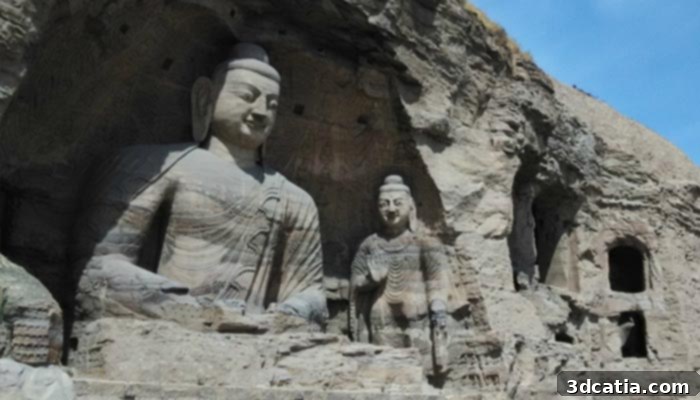
The Yungang Grottoes stand as a magnificent testament to ancient Buddhist art and architecture.
The benefits offered by 3D printing technologies in the field of cultural heritage are profound and multifaceted. One of the most critical advantages lies in disaster preparedness and recovery. Should cultural heritage sites suffer damage from unforeseen natural disasters, such as earthquakes or floods, or from human-induced factors, the existence of highly precise 3D models and printed replicas allows for repairs and reconstruction to be carried out with unparalleled accuracy. This ensures that the original artistic and architectural integrity can be faithfully restored or, at the very least, documented for posterity. Beyond immediate preservation, the extensive data gathered through 3D scanning and modeling opens up vast new avenues for academic research and scholarly study. It provides a unique, non-invasive opportunity for historians, archaeologists, and art conservators to delve deeply into the intricacies of heritage sites, analyzing construction techniques, artistic styles, and historical contexts in unprecedented detail. This wealth of information is vital for understanding our past and informing future conservation strategies. Moreover, these digital assets can form permanent archives, safeguarding cultural data for generations to come, even if the physical artifacts themselves face irreparable decline.
The use of digital technologies to promote and preserve cultural heritage is a global trend, and China’s efforts with the Yungang Grottoes serve as an inspiring example for nations worldwide. This approach allows countries to share their unique cultures and past narratives with a global audience, fostering greater understanding and appreciation for human history and artistic achievement. Such initiatives are not confined to a single nation but represent a collaborative effort to safeguard our collective human legacy. By embracing digital replication, cultural institutions can create touring exhibitions of highly detailed replicas, making ancient wonders accessible to communities far removed from their original locations. This democratization of cultural experience enriches education, stimulates cultural tourism, and promotes a deeper connection to our shared global heritage. You can learn more about the broader context of these initiatives and their impact by exploring official news sources and related reports. For further details on the project, please refer to the original report HERE.
The integration of additive manufacturing into cultural heritage preservation marks a pivotal moment, ushering in an era where the past can be experienced, studied, and protected with unprecedented precision and accessibility. The groundbreaking work at the Yungang Grottoes exemplifies how 3D printing is not just a technological marvel, but a profound tool for cultural stewardship. It enables us to bring ancient wonders into the modern age, ensuring that their beauty and historical significance resonate with current and future generations. The possibilities are truly boundless, promising a future where our most cherished artifacts are safeguarded against decay and shared more broadly than ever before, fostering a deeper connection to the rich tapestry of human history and creativity.
What are your thoughts on experiencing artwork and cultural heritage through the innovative lens of additive manufacturing? Do you believe these digital replicas can truly capture the essence of the originals, or do they offer a complementary, new way to engage with history? We’d love to hear your perspective! Let us know your opinions in a comment below or join the discussion on our Facebook and Twitter pages! And don’t forget to sign up for our free weekly Newsletter to stay informed about the latest advancements in 3D printing and its diverse applications!